Fourth Generation Inclusive

Historical Documents of Genealogical Interest to Researchers of North Carolina's Free People of Color

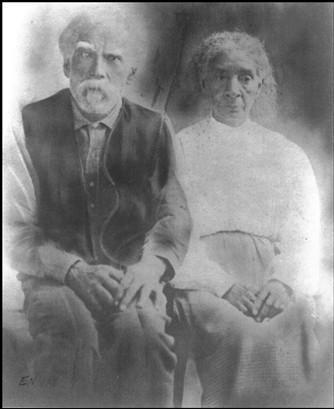
Frances Jacobs Carter.

Image

FRANCES JACOBS CARTER was born about 1861 in Sampson County to Jesse Adam Jacobs (ca1820-1902) and Abigail Gilliam Jacobs (ca1820-?). She married Marshall Archie Carter (1860-1922), son of William and Mary Carter, and died in 1937 in Wayne County. Jesse A. Jacobs, Jr., was her brother.

In the 1870 census of Sampson County: Jessey Jacobs, 50, farmer; wife Abigiel, 50; and children John R., 20, Martha, 17, Soloman, 15, Jessey, 13, Abigiel J., 11, and Margett F., 9; all mulatto.

We have further allotted the widow one bed, wheel and cards.

State of North Carolina, Robeson County   }   To the worshipful the Justices of the court of pleas and quarter-sessions for said county November term 1862

We John G. M’Lean Justice of the Peace of said county and Hector J. M’Lean Angus Wilkison and John McNair freeholders in obedience to the anexed order proceeded on the 17th day of October to view the estate of Hugh Chavous, deceased, and out of the crop stock and provisions on hand we have laid off and allotted Clarisa Chavous widow of Hugh Chavous (deceased) as follows that is to say one hindred bushels of corn eighteen hed of hogs one Beef all the peas, one Table four Bushels of Salt one Bible and Hym Book one Loom one pot one tray and sifter and these being not sufficient of the crop stock and provision on hand to make a comfortable provision for the Said Widow and family for a year We assess the deficiency to the sum of Thirty five Dollars in money to be paid to the said Widow by the administrator of the said Hugh Chavous (Decd) and we have further laid off and allotted to the said Widow one Bed and necessary furniture and Wheel and Cards as her absolute property and put her in possession of the same

Given in our hands and seals this 17th day of October AD 1862.  /s/ John G. M’Lean, Hector M’Lean, A.D. Wilkison, Jno. McNair

In the 1860 census of Robeson County: Hugh Chavis, 50, farmer; wife Clarisy, 45; and children Benjamin, 18, Pinkney, 16, Preston, 16, Nancy, 13, Prissey, 13, Hugh, 9, Melinda, 8, Turner, 7, Murdock, 6, D. Richard, 5, Sallie B., 3, and Alston, 1; all described as mulatto.

Free-Issue Death Certificates: EVANS and PACE.

Willis Evans. Died 24 July 1932, Smithfield, Johnston County. Colored. Married to Viney Evans. Farmer. Age 74. Born Johnston County to Clem Evans and Martha Evans. 

Alexandra Evans. Died 2 Dec 1934, McNeills, Southern Pines, Moore County. Colored. Widower. Employed in merchandising. Born in Four Oaks to Clem Evans of Four Oaks and Martha Jones of Smithfield. Informant, Sudie Holmes.

In the 1850 census of Johnston County: Clemons Evans, 32, farmer; wife Martha, 25; and children John, 10, Willis, 7, Ellick, 5, Lucinda, 3, and infant, 1 month.

Harriet Pace Richardson. Died 23 June 1930, ONeals, Johnston County. Colored. Widowed. Age 80. Son of Alsy Pace and Casandra Pace. Informant, Duke Richardson.

Beadie Williamson. Died 14 March 1919, Little River, Wake County. Colored. Widow of Ruben Williamson. Age about 76. Son of Alsey Pace and Cassandia Dean. Buried Johnston County. Informant, Adolphus Williamson.

In the 1850 census of District 11, Johnston County: Alsey Pace, 65; wife Cashey, 35; and children Noah, 14, Madison, 11, David, 9, Harriet, 7, Beady, 5, and Rhenison, 3.

Surnames: Iredell County, 1850.

The following surnames are found among free people of color in Iredell County in 1850:

BELT, DUNCAN, GARDNER, GRAHAM, HAYS, HENRY, LEAGONS, PRYER and SMITH.

Free Colored Inhabitants of the Town of Greenville, Pitt County, 1850.

#20. R.A. Brooks, 13, servant, in the household of E.A. Long.

#44. Alvana Albertson, 13, servant, in the household of Richard Rouse, silversmith.

#50. Eunice Graham, 84, washwoman.

#51. Morning Brooks, 48, servant, in the household of M.A.M. Pearce, seamstress.

#65. Mary Norris, 28, servant, in the household of John Chestnut, laborer.

#74. Richard Keel, 40, carpenter, reported personal property valued at $3000.

#78. Jenny Hanrahan, 33, washwoman, in the household of Martha Hanrahan.  She reported owning $150 real property and $100 personal property.

US Federal Population Schedule.

Register of (NC-born) Negroes & Mulattos: Bartholomew County, Indiana, no. 2.

Christy Ann Blanks, age 18, born Robeson County NC, registered 21 Sep 1853. She was described as a mulatto woman; 5 feet 9; no marks or brands; unmarried. Witness: Edward A. Herod.

Eli Blanks, age 13, born Robeson County NC, registered 21 Sep 1853. He was described as a mulatto boy; “young, likely and growing finely;” hair nearly straight; no marks or brands; son of John Blanks. Witness: Edward A. Herod.

Elizabeth Blanks, age 15, born Robeson County NC, registered 21 Sep 1853. She was described as a mulatto girl; 5 feet 5 inches and growing; has a blemish on the ball of the right eye; small scar on right arm; no other marks. Witness: Edward A. Herod.

John Blanks, age 54, born Robeson County NC, registered 21 Sep 1853.  He was described as a mulatto man; 6 feet high; no hair on the top of his head where hair ought to grow; crooked left wrist; right big toe wounded by an ax.  Witness: Edward A. Herod.

Willis Blanks, age 21, born in Robeson County NC, registered 21 Sep 1853. He was described as a mulatto man; 6 feet 2; scar on left side of left wrist about one inch long; no other marks. Witness: Edward A. Herod.

To prevent him from becoming the property of his own children or sold off from them.

Craven County, June Term 1797,

To the Justices of the Court of Sd. County, The Petition of Margaret Moore, a free negro woman, Humbly sheweth, that your petitioner has been possessed for seven years past of a negro man slave named Jack Fennel, with whom she has lived several years as a wife, & by whom she has had a number of children.

That she has acquired, chiefly thro’ the industry, labour & economy of said slave, a plantation containing two hundred acres of land, on which he has built her a good house & grow many valuable improvements; that the said farm is stocked with cattle, hogs &c.

That the said Slave has otherwise rendered her several meritorious services;

That her duty prompts her not to detain her said husband in bondage, & to endeavour if she can  do it to prevent him from becoming on her death the property of his own children, or, being otherwise sold off from them.

She therefore prays that Your Worships would grant her a license authorising her to emancipate & set free the said negro Jack Fennell & as in duty bound &c.    T.N. Martin att: Pet.

Miscellaneous Records, Craven County Records, North Carolina State Archives.

Enos & Matilda Goodman Jacobs.

Image

ENOS JACOBS (1842-1925) and ALMIRA MATILDA GOODMAN JACOBS (1847-1927) of Sampson County. Enos was the son of Archibald Jacobs and Temperance Manuel Jacobs.  Matilda was the daughter of Timothy Goodman and Nancy Maynor Goodman.

Mortality Schedule: Cumberland County, 1850.

Cater Bryant, Fayetteville, 33, mulatto, cooper, died February, drowned.

John Bryant, Fayetteville, 4, mulatto, died December, fever.

Calvin Burnet, Northern Division, 20, mulatto, died December, barber, unknown causes.

Elizabeth Burnet, Northern Division, 1 month, mulatto, died April, unknown causes.

Curtis Demry, Northern Division, 13, black, died August, dropsy.

Obediah Hagans, Northern Division, 80, mulatto, laborer, died May, unknown causes.

Ephraim Holly, Northern Division, 10, mulatto, died September, measles.

Patsy Holly, Northern Division, 2, mulatto, died September, “Infl. throat.”

Nelly Will Kings, Fayetteville, 90, mulatto, died July, old age.

Sarah J. Lucas, Northern Division, 2, mulatto, died July, diarrhoea.

Virginia Lucas, Eastover, 1 month, mulatto, died April, pneumonia.

Rose Mainer, Northern Division, 50, black, died July, consumption.

Elsey Parker, Northern Division, 20, mulatto, died September, unknown causes.

Sophia Scott, Northern Division, 1 month, mulatto, died October, unknown causes.

James Stewart, Northern Division, 1, mulatto, died June, consumption.

Infant, Northern Division, 1 month, mulatto, died July, colick.

All deaths in 1849. US Federal Mortality Schedule, 1850.

He cannot go blow for blow, but he can defend himself.

State v. Lawrence Davis, 52 NC 52 (1859).

This indictment for assault and battery arose in Craven Superior Court.  Lawrence Davis was a free negro living in New Bern.  Edward Hart was a regularly appointed and qualified constable for the town. Hart had a notice directing David to show cause why he should not work on the streets as the penalty for not having paid his taxes. (A New Bern ordinance: “Ordered that all free negroes, who have not paid their taxes, shall be made to work on the streets two days for each and every dollar of tax due the town by them, and if he refuses to do the same, upon due notice being given him, he shall pay a fine, at the discretion of the Mayor, not exceeding $10.” Hart arrested Davis and, while he attempted to tie him, Davis struck him.

The lower court found Davis guilty, and he appealed.

The Supreme Court suggested that Davis’ conviction may have rested on the proposition that a free negro is not justified, under any circumstances, in striking a white man. “To this, we cannot yield our assent. Self-defense is a natural right, and, although the social relation of this third class of our population, and a regard for its proper subordination requires that the right should be restricted, yet, nothing short of manifest public necessity can furnish a ground for taking it away absolutely; because a free negro, however lowly his condition, is in the “peace of the State,” and to deprive him of this right, would be to put him on the footing of an outlaw.” So, though a free negro ordinarily was not to return blow for blow or fight with a white man, “as one white man may do with another, or one free negro with another, he is not deprived, absolutely, of the right of self-defense.” Rather, to justify a battery on a white man, the free negro is required to prove that it was necessary for him to strike in order to protect himself from “great bodily harm or grievous oppression.” In other words, if there is cruelty or unusual circumstances of oppression, a blow is excusable. 

In this case, a constable serving a notice on the defendant, without any authority whatever, arrested him and attempted to tie him.  “Is not this gross oppression? For what purpose was he to be tied? What degree of cruelty might not the defendant reasonably apprehend after he should be entirely in the power of one who had set upon him in so highhanded and lawless a manner? Was he to submit tamely? Or, was he not excusable for resorting to the natural right of self-defense?” 

Under these circumstances, the judge committed error, and a new trial was ordered.