Fourth Generation Inclusive

Historical Documents of Genealogical Interest to Researchers of North Carolina's Free People of Color

He deserves a gun.

Agreeably to an act of Assembly passed during the session of 1840-41 Chapter XXX. Hilary Coor free man of color petitions the worshipful Court of pleas and Quarter sessions for license to use a gun for one year from the date hereof.  August 17, 1841

We recommend Hilary Coor as deserving the benefit of the act cited above.

John G. Eliot, J. Martin, Harris Barfield, M.G. Harrell, Saml. Flowers, L. Cogdell, John Manly, Aaron Martin

Records of Slaves and Free Persons of Color, Wayne County Miscellaneous Records, North Carolina State Archives.

[Sidenote: According to the 1850 census, Coor (who was also known Hillary Croom)’s supporters were a collection of farmers and one school teacher, Eliot. Coor/Croom named Eliot as the executor of his 1843 will, which requested that Eliot free Croom’s wife Hannah and their children Charles, Ann and Tempie.  Lewis Cogdell, J. Martin, David Cogdell and Daniel Cogdell witnessed the will. In 1850, Hillery Crooms headed a household on the south side of the Neuse that included children Annie, 14, Charles, 12, Tempy, 10, and John, 9, as well as two slaves, one of which may have been his wife. Two years later, he filed a petition with the North Carolina legislature seeking to bring his freed wife and children back into the state. — LYH]

I am but illy able.

To the Worshipful Court, Feby Term 1833

I beg leave to request that you would take into your wise consderation and bind my Son Sherard unto Exum Pike, as the said Exum has agreed to find & furnish me something towards my support for his labor, as I am but illy able now to support myself without assistance.  Druzilla X Hagans  Feby 18, 1833

Witness Nathan Davis       N.B. Sherard is about 17 years of age.

[Sidenote: Sherard Hagans was already a father when he was bound to Exum Pike. He and Nancy Hall eventually had nine or ten children. The oldest four — Mozana, Samuel, Winifred and Benjah Ann Hall, small children during their father’s term of indenture — were repeatedly bound until they reached adulthood.  When Sherard Hagins, age 63, married Serena Jackson, 35, on 26 September 1878 in Wayne County, their license listed his parents as Sam and Zilla Hagins. — LYH]

Lemuel W. Boone.

Image

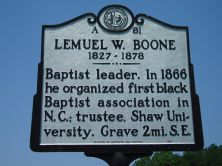
LEMUEL WASHINGTON BOONE (1827-1878) was a leader of African American Baptists in North Carolina during the Reconstruction era. In 1866, he organized on Roanoke Island the East Roanoke Association, the first black Baptist association in the state. The following year, he moderated the organizational meeting of the General Association of the Colored Baptists of North Carolina, the first statewide black Baptist association and the direct forerunner of the present-day General Baptist Convention of North Carolina. Praised by Carter Woodson as a “preacher of power,” Boone is said to have “possessed a gift of oratory and mental ability seldom excelled by men of the best opportunities.”

Boone, born free in Northampton County, worked as a brickmason and teacher preceding the Civil War. After moving to Hertford County, he organized twenty churches with over 3,000 members in the area. The inaugural meeting of the statewide Baptist organization took place in 1867 in Goldsboro and was timed to coincide with the white annual Baptist State Convention from whose members they received counsel and support.

Boone sought a reconciliation between white and black Baptists and opposed a rule requiring that white churches dismiss former slaves who ran away to join the Union army and served as one of seven original trustees of Shaw University. At his death in 1878, the minutes of his association recorded that “it is safe to say that from his ordination till his death, no person in eastern North Carolina exerted a wider and more lasting influence among his people than Elder Boone.” In 1913, a monument was erected at his grave.

Adapted from http://www.ncmarkers.com.

Acquitted.

AIDING A SLAVE TO ESCAPE. – William Mayes, a free negro from North Carolina, was tried by the Hustings Court, yesterday, on the charge of advising Henry, slave to E.H. Stokes & Co., to escape from his owners, on the 26th of July last, and accompany him to North Carolina. Henry, the slave, testified that the prisoner had invited him to return to Carolina and promised to pay his passage to that State. Judge Crump appeared for the prisoner, and defended him with marked ability; Mr. Daniel prosecuting on behalf of the Commonwealth. At the conclusion of the argument, the prisoner was acquitted, three of the Justices believing him guilty and two of them deciding he was not.

The Daily Dispatch, Richmond VA, 12 August 1857.

They emigrated for safety.

A company of sixty free negroes from North Carolina, arrived at Baltimore on Wednesday, who are emigrating to Ohio for safety.

The National Republican, Washington DC, 2 February 1861.

———-

FREE NEGROES ON THE WING. – On Wednesday last, sixty-three free negroes from Edgecourt [sic] county, North Carolina, crossed the Ohio river at Bellaire on their way to Zanesville. An old negro acted as leader of the party, holding the tickets, disbursing funds, etc.

Daily Dispatch, Richmond VA, 7 Feb 1861.

———-

NEWS ITEMS &C.

Sixty-three free negroes from North Carolina arrived at Zanesville on Thursday. They were from Edgecomb county, and had been ordered to leave by the whites of that section.

Fremont Journal, Fremont OH, 8 February 1861.


Axey Jane Manuel Simmons.

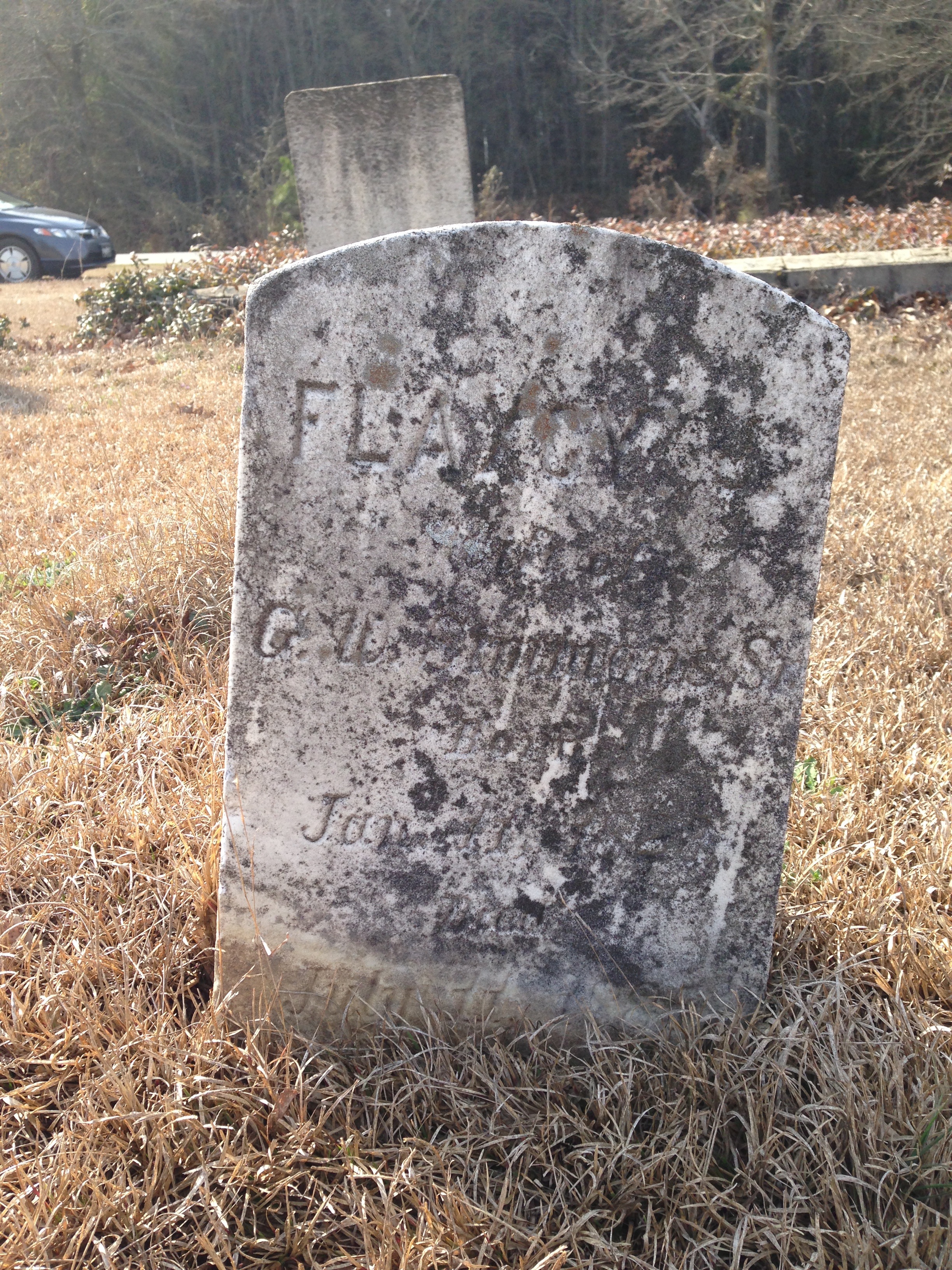
ImageAXEY (or FLAXEY) JANE MANUEL SIMMONS (1823-1885) was probably born in Sampson County.  She married George Washington Simmons circa 1840. Their children were: Riley B. Simmons, Susannah Simmons, Simon Simmons, George Robert Simmons, Zachariah T. Simmons, Sylvania Simmons Sutton, Bryant Simmons, Hillary B. Simmons and General W. Simmons. She is buried in the First Congregational Church cemetery in Dudley, Wayne County.

Photo taken by Lisa Y. Henderson, March 2013.

[N.B.: She is called Axey (or some alternate spelling thereof) in every census record and on sons Riley and Zachariah’s death certificates, but Flaxy (or something similiar) on her headstone and the death certs of three other sons. — LYH]

He had Negro blood in him.

SOLDIER OF 1776 WED CAROLINA COLORED GIRL

White Soldier of General Cornwallis’s Army Drank Some of His Colored Sweetheart’s Blood Before Marriage in Order to be Able to Marry Her Legally.

By JOSEPH SEWELL in Raleigh (N.C.) Observer.

Joseph Butler (white), a member of Cornwallis’s army, was severely wounded in the battle of Guilford, March 15, 1781.

In Cornwallis’s retreated toward Eastern North Carolina Butler became a straggler and was lost from the English army. He was succored by a free mulatto woman, who hid him in her home until the surrender of the English army the following October.

During Butler’s confinement he was faithfully nursed by the daughter of his benefactress, who was nearly white, and there grew between them a mutual affection. It was Butler’s ardent desire to marry the young woman, and he was greatly distressed upon realizing that, under the laws of North Carolina, to wed the woman was impossible – she had Negro blood in her, and Butler was a full-blooded white man.

Hid in the Home of his Sweetheart

Butler remained at the home of his sweetheart in an unfrequented part of the country, and cultivated the small farm where he lived – isolated and ignored, an alien enemy, a fugitive hiding under a Negro’s roof. He finally conceived and immediately acted upon a plan to thwart the law, which forbade him marrying the woman he loved.

In those times the “letting of blood” was regarded almost as a panacea in the treatment of all bodily ailments. The mulatto girl was, for some physical disorder, bled by a surgeon.

Her sympathizing lover was at hand during the operation, and to the astonishment of the surgeon, deliberately drank an appreciable portion of the patient’s blood.

He immediately departed and upon his return exhibited a duly authenticated license to wed his mulatto sweetheart. He had gone to the proper official, made affidavit that he had Negro blood in him, and had procured a license to marry a half-blooded Negro woman.

Son of Couple Still Living

Rev. John J. Young, 78, Baptist minister, now living, is the son of this colored girl and the English soldier. His grandfather, Thomas Blacknall, had this interesting history:

Thomas Blacknall was born in Granville County, North Carolina, considerably over a century ago, as the chattel of John Blacknall, a typical slave owner of the South. Tom Blacknall was not only a remarkable Negro, he was a remarkable man.

Under apprenticeship provided by his master, Tom became a blacksmith and bell maker of more than local renown. He was permitted to keep his earnings and “buy his time.”

It is history in the Blacknall family that he was absent from home at intervals of a year without intermission, and that, with his master’s  permission, Tom went as far away as Baltimore, peddling his bells and plying his trade.

Tom Blacknall, the slave, was permitted to save his earnings and buy his freedom. The price paid for his freedom was $900. He afterwards purchased the freedom of his wife and his three sons, taking title to all of his ransomed family in himself.

He afterwards purchased three additional slaves. Had Blacknall’s wife given birth to other children, which does not seem to have occurred, such children would have been chattels of their father. Blacknall’s first wife died in de facto serfdom to her husband and he afterwards married a free Negro.

Wives Owned Their Husbands

He died in 1863 and by the terms of his will his three sons passed to the ownership of their respective wives who were free Negro women. Evidently he believed in reciprocity in the marital relation. His first wife had been his de facto slave and he made his sons, who were also his slaves, the slaves of their wives.

Another astounding thing about Tom Blacknall is that he was a Negro deacon in a white Presbyterian church.

This, and the fact that he frequently led the white congregations in prayer, are established to my entire satisfaction.

I have frequently conversed with very old white people of the highest veracity and of pronounced mentality, who, as restive children, heard but did ot attentively listen to, the prolix implorations of black Tom Blacknall, fervently poured forth in the midst of white congregations in a white Presbyterian church.

The Afro-American, Baltimore MD, 26 April 1930.
Mortality Schedule: Perquimans County, 1850.

Joseph Overton, age 3 months, mulatto, died October of unknown causes.

Christian Baines, age 40, black, died June of bilious fever.

Rosanna Winslow, age 90, black, widow, died June of old age.

Cintha Randol, age 23, black, died August of pleurisy.

Richard Dempsey, age 60, black, died June of consumption.

All died in 1849.  1850 US mortality schedule.

Free-Issue Death Certificates: MISCELLANEOUS, no. 10.

James Francis. Died 21 September 1941, Dysartville, McDowell County. Colored. Widower. Farmer. Born 15 November 1856, McDowell County, to Austin Francis and Mary Owens.

Biddie Jackson. Died 17 October 1955, Gassy Creek, Mitchell County. Negro. Widowed. Resided Spruce Pine, Mitchell County. Born 9 February 1850 to Austin Francis and Mary Owens. Buried family cemetery. Informant, Mrs. Claude Ray, Spruce Pine.

In the 1860 census of McDowell County: Austin Francis, 49, miner, wife Mary, 48, and children Rachel, 16, William, 12, Jane, 10, Elizabeth, 7, and James, 5.

Mattie Owens Johnson. Died 18 June 1930, Bracketts, McDowell County. Colored. Widow of Henry Johnson. Born about 1854, McDowell County, to Bill Owens and Lucinda Mathews. Informant, George Owens.

Joseph Owens. Died 20 November 1923, Brackett, Vein Mountain, McDowell County. Resided Vein Mountain. Colored. Widower of Martha Payne. Born 14 Jan 1839, Vein Mountain, McDowell County, to William M. Owens and [blank] Mathis. Buried Bracket Town Colored Cemetery. Informant, S.R. Soxan.

In the 1860 census of McDowell County: William Owens, 45, miner, wife Loucinda, 46, and children Joseph, 19, Edward, 17, Jane, 15, James, 13, William, 11, Thomas, 8, Martha, 6, and Rachel Owens, 1, plus Isaac Herdy, 10, Washington Wilson, 10, William Daniel, 14, and Sarah Johnson, 50.

He does all he can to keep me in slavery.

The Petition of negro man Dick Dingley to the worshipfull County Court of Chowan humbley sheweth that a certain Ichabod Jordan of the county aforesaid Redeem’d the said Petitioner of Mr. James Legett on Ronake for the Consideration of ninty five pounds & then the Said Petitioner made a bargain with Said Ichabod Jordan before witness that if the Said Petitioner was to be a full Liberty as will more fully appear the said Petitioner has paid Said Jordan his full Demand and Since that the Said Jordan has Let him have his Liberty for three years as agreed but so it is that of Late the Said Jordan has renewed his Clame & has most Cruely Beaten your Petitioner and does all he Can to keep him the Said Petitioner in Slavery this therefore is Humbley to pray your worships that as your Petitioner is without redress only through your worships that you will be please to Confirm the above bargain & Redress your Said Petitioner & as in duty Bound Shall Ever Pray.       Dick Dingle  March 8th 1798

Miscellaneous Slave Records, Chowan County Records, North Carolina State Archives.