Fourth Generation Inclusive

Historical Documents of Genealogical Interest to Researchers of North Carolina's Free People of Color

Category: Migration

The sailor quit his vessel and stayed.

State of North Carolina, Chowan County     }  Court of Pleas & Quarter Sessions, August Term 1856

The Jurors for the State on this oath present that Anthony Adams a free man of colour not being a citizen of the State did on the 1st day of July 1856 migrate into this State contrary to the form of the statute in such case made & provided.

The Jurors aforesaid on their oath aforesaid do further present that Anthony Adams a free man of colour not being a citizen of this State & coming into the State as a sailor did on the 1st day of June 1856 attempt to & did migrate into this State by quitting the vessel in which he came into the State & not leaving the State in the same contrary to the form of the Statute in such case made & provided.   Hines Solicitor

[On reverse] State vs Anthony Adams } Misdm’r  A True Bill

Miscellaneous Slave Records, Chowan County Records, North Carolina State Archives.

Free-Issue Death Certificates: (NC-Born) Michiganders, no. 5.

William Sylas Copley. Died 28 December 1915, Vandalia, Cass County, Michigan. Mulatto. Married. Retired farmer. Born 15 August 1840, North Carolina, to Peter Copley and Delia Scott, both of NC. Buried Chain Lake cemetery. Informant, Melvin Copley, Vandalia.

Derry Anderson. Died 31 July 1919, Mason, Cass County, Michigan. Black. Married to Amon Anderson. Born 15 February 1850 to Peter Copley of North Carolina and unknown mother. Buired Lake View. Informant, Grace Artis, Kalamazoo, Michigan.

Calvin M. Copley. Died 11 March 1915, Vandalia, Cass County, Michigan. Colored. Widower. Farmer. Born 13 August 1846, North Carolina, to Peter Copley and Delila Scott. Both of North Carolina. Buried Chain Lake. Informant, Homer Copley, Vandalia.

Caswell Oxendine. Died 3 May 1914, Dowagiac, Cass County Michigan. Colored. Married. Farmer. Born 4 March 1844 in NC to unknown parents. Buried Calvin Center. Informant, Mrs. Oxendine.

Berry Haithcox. Died 16 March 1904, Porter, Cass County, Michigan. Married 15 years. 3 children, all living. Born 1825 in North Carolina to Mills Haithcox and Sarrah Byrd. Buried at Mount Zion. Informant, Roberta Haithcock, Vandalia.

I blame the State of North Carolina.

THOMAS HEDGEBETH.

I was born free, in Halifax Co. North Carolina, where I lived thirty-five years. About ten years ago, I removed to Indiana. My father was a farmer, half white, who ran through his farm. If a white man there brings a great account, the white man would carry it against the colored, — the law there does not favor colored people. I cannot read or write. A free-born man in North Carolina is as much oppressed, in one sense, as the slave: I was not allowed to go to school. I recollect when I was a boy, a colored man came from Ohio, and opened a school, but it was broken up. I was in the field ploughing with my father, — he said he wished we could go and learn. I think it an outrageous sin and shame, that a free colored man could not be taught. My ignorance has a very injurious effect on my prospects and success. I blame the State of North Carolina — the white people of that State — for it. I am now engaged in a troublesome lawsuit, about the title to my estate, which I would not have got into, had I known how to read and write.

There were lots of slaves in the neighborhood where I was raised. After I grew up to take notice of things, I found I was oppressed as well as they. I thought it a sin then, for one man to hold another. I never was allowed to visit among the slaves, — had I been caught visiting them, I should have been fined: if a slave had visited me, he would have been whipped. This prevented my having much intercourse with them, except when I was hired to work by the masters. The conversation among the slaves was, that they worked hard, and got no benefit, — that the masters got it all. They knew but little about the good of themselves, — they often grumbled about food and clothing, — that they had not enough. I never heard a colored man grumbling about that here. They were generally religious, — they believed in a just God, and thought the owners wrong in punishing them in the way they were punished. A good many were so ignorant that they did not know any better, than to suppose that they were made for slavery, and the white men for freedom. Some, however, would talk about freedom, and think they ought to be free.

I have often been insulted, abused, and imposed upon, and had advantage taken of me by the whites in North Carolina, and could not help myself.

When I was twenty-one, I went to vote, supposing it would be allowed. The ‘Squire, who held the box objected, and said no colored man was allowed to vote. I felt very badly about it, — I felt cheap, and I felt vexed: but I knew better than to make an answer, — I would have been knocked down certain. Unless I took off my hat, and made a bow to a white man, when I met him, he would rip out an oath, —  “d–n you, you mulatto, ain’t you got no politeness? Do n’t you know enough to take off your hat to a white man?” On going into a store, I was required to take off my hat.

I have seen slaves with whom I worked, nearly starved out, and yet stripped and whipped; blood cut out of them. It makes my flesh creep now to think of it – such gashes as I’ve seen cut in them. After a whipping, they would often leave and take to the woods for a month or two, and live by taking what they could find. I’ve often heard it said that’s the cause of colored people in the South being dishonest, because they are brought so as to be obliged to steal. But I do not consider it dishonest — I always thought it right for a slave to take and eat as much as he wanted where he labored.

At some places where I have worked, I have known that the slaves had not a bite of meat given them. They had a pint of corn meal unsifted, for a meal, — three pints a day. I have seen the white men measure it, and the cook bake it, and seen them eat it: that was all they had but water — they might have as much of that as they wanted. This is no hearsay — I’ve seen it through the spring, and on until crop time: three pints of meal a day and the bran and nothing else. I heard them talk among themselves about having got a chicken or something, and being whipped for it. They were a bad looking set — some twenty of them — starved and without clothing enough for decency. It ought to have been a disgrace to their master, to see them about his house. If a man were to go through Canada so, they ‘d stop him to know what he meant by it — whether it was poverty or if he was crazy, — and they ‘d put a suit of clothes on him. I have seen them working out in the hot sun in July or August without hats — bareheaded. It was not from choice, — they could n’t get hats.

I have seen families put on the block and sold, some one way, some another way. I remember a family about two miles from me, — a father and mother and three children. Their master died, and they were sold. The father went one way, the mother another, with one child, and the other two children another way. I saw the sale — I was there — I went to buy hogs. The purchaser examined the persons of the slaves to see if they were sound, — if they were “good niggers.” I was used to such things, but it made me feel bad to see it. The oldest was about ten or eleven years. It was hard upon them to be separated — they made lamentations about it. I never heard a white man at a sale express a wish that a family might be sold together.

On removing to Indiana, the white people did not seem so hostile altogether, nor want the colored people to knuckle quite so low. There were more white people who were friendly than in North Carolina. I was not allowed my vote nor my oath. There were more who wished colored people to have their rights than in North Carolina, — I mean there were abolitionists in Indiana.

I came here a year last spring, to escape the oppression of the laws upon the colored men. After the fugitive slave bill was passed, a man came into Indianapolis, and claimed John Freeman, a free colored man, an industrious, respectable man, as his slave. He brought proofs enough. Freeman was kept in jail several weeks, — but at last it turned out that the slave sought, was not Freeman, but a colored man in Canada, and F. was released. The danger of being taken as Freeman was, and suffering from a different decision, worked on my mind. I came away into Canada in consequence, as did many others. There were colored people who could have testified to Freeman’s being free from his birth, but their oath would not be taken in Indiana.

In regard to Canada, I like the country, the soil, as well as any country I ever saw. I like the laws, which leave a man as much freedom as a man can have, — still there is prejudice here. The colored people are trying to remove this by improving and educating themselves, and by industry, to show that they are a people who have minds, and that all they want is cultivating.

I do not know how many colored people are here — but last summer five hundred and twenty-five were counted leaving the four churches.

From Benjamin Drew, A North-Side View of Slavery. The Refugee: or the Narratives of Fugitive Slaves in Canada Related by Themselves, with an Account of the History and Condition of the Colored Population of Upper Canada (1856).

Though his age is off by several years, this is possibly the Tho. Hedgepath, 31, farmer, with wife Mary, 28, and children A., 7, M.J., 3, and L., 7 months, listed in the 1850 census of Center, Marion County, Indiana. Thomas, Mary and A. were born in North Carolina; the younger children in Indiana.

Matthew Artis Post No. 341, G.A.R.

Matthew Artis Post, No. 341, was organized at Day March 10, 1866, with twenty-one members, as follows:

Commander, Bishop E. Curtis; Senior Vice Commander, Henry D. Stewart; Junior Vice Commander, James Monroe; Adjutant, Abner R. Bird; Quartermaster, Solomon Griffin; Surgeon, Harrison Griffin; Chaplain George Scott; Officer of Day, Zachariah Pompey; Officer of Guard, John Copley; Sergeant Major, James M. Stewart; Quartermaster Sergeant, James H. Ford. Members: Peter Saunders, Caswell Oxendine, Berry Haithcock, John Curry, Samuel Wells, John Brown, Martin Harris, Andrew Gillum, George Broairdy, L.B. Stewart. …

From L.H. Glover, A Twentieth Century History of Cass County, Michigan (1906).

In the 1850 Perry, Logan County, Ohio: Elisha Bird, 60, farmer, Sarah, 60, Nancy, 36, Mary A., 15, James, 20, Lawson, 17, Abner, 8, and John Bird, 23. Elisha, Sarah and Mary were born in Virginia; Nancy and John Bird in NC; and James, Lawson and Abner Bird in Ohio. In the 1860 census of Calvin, Cass County, Michigan: Wyatt Byrd, 37, wife Charlott, 32, and children Mary J., 10, Leander, 6, Eliza A., 3, Sarah J., 2, and Abner, 15. Wyatt was born in NC; Charlotte in Virginia; and their children in Michigan, except Abner, Ohio.

In the 1850 census of Frankfort, Clinton County, Indiana: Peter Copley, 40, wife Delila, 34, and children Elius A., 12, John A., 10, Mary M., 10, William C., 8, Caroline M., 7, Martha J., 6, Delily E., 4, and Matilda C., 1.  All born in NC, except the three youngest children, who were born in Indiana.  In the 1860 census of Porter, Cass County, Michigan: Peter Copley, 52, farmer, wife Delia, 44, and children John, 22, Wm., 17, Calvin, 16, Jane, 15, Elizabeth, 12, and Matilda, 10. All born in NC, except the three youngest children, who were born in Indiana.

In the 1850 census of Fugit, Decatur County, Indiana: Sally Hunt, 55, Celia Hunt, 22, Susan Hunt, 2, Levi Hunt, 1, Wiley Jones, 14, Jordon Jones, 12, Flora Oxendine, 10, Parmelia Oxendine, 6, and Caswell Oxendine, 4.  All born in NC except Levi Hunt, who was born in Indiana. In the 1860 census of Calvin, Cass, Michigan: Isaac Hunt, 36, wife Dorcas, 40, children Drusilla, 13, Susan, 10, Mary, 10, and Roxa A. Hunt, 6, plus C. Oxendine, 15.

Caswell Oxendine. Died 3 May 1914, Dowagiac, Cass County Michigan. Colored. Married. Farmer. Born 4 March 1844 in NC to unknown parents. Buried Calvin Center. Informant, Mrs. Oxendine.

In the 1850 census of Xenia, Greene County, Ohio: Berry Heathcock, 45, farmer, wife Fanny, 43, and William Lilly, 10, James A. Lilley, 8, Isaiah Lilley, 6, and Moses Daniel, 25, all born in NC. In the 1860 census of Burr Oak, Saint Joseph County, Michigan: Berry Hathcock, 35, born Ohio, in the household of Geo. Boyles, farmer.

Berry Haithcox. Died 16 March 1904, Porter, Cass County, Michigan. Married 15 years. 3 children, all living. Born 1825 in North Carolina to Mills Haithcox and Sarrah Byrd. Buried at Mount Zion. Informant, Roberta Haithcock, Vandalia.

In the 1850 census of Fugit, Decatur, Indiana: Arthur Gillam, 26, laborer, Margaret, 36, Harriet Bowden, 16, Mary Bowden, 14, Jackson Bowden, 11, Higgins Bowden, 10, John Bowden, 7, and Andrew Gillam, 4.  All born in NC, except Andrew and the two youngest Bowden children. In the 1860 census of Liberty, Union County, Indiana; Auther Gillam, 36, laborer, wife Margaret, 47, Mary Borden, 22, servant, Jackson Bowden, 20, laborer, Andrew Agillam, 13, and Taylor Gillam, 3, all classified as Indian. All were born in NC except Auther and Andrew, born in Indiana. 
Sold for taxes, redux.

No. 471. An Act for the relief of John Montgomery and William A. Lewis, of Forsyth County; Nancy Going, Adaline Page, Thursday, Isabella, De la Fayette, and Elmira, free persons of color, of the County of Columbia, and for other purposes therein specified.

WHEREAS, Bryant Oxendine, a free person of color, was taken up for failing to comply with the Registration Laws of this State, in the year 1850, and was found guilty and fined by the Inferior Court of Forsyth County one hundred dollars, and being unable to pay the fine was hired out, under the Laws of this State, for a term of eighteen months, for the price of one hundred dollars, to John Montgomery, on the 5th day of December, 1850, and the said John Montgomery gave his note due eighteen months after date, to the Justices of the Inferior Court of Forsyth County, for the sum of one hundred dollars, with William A. Lewis as security for the same. And,

WHEREAS, The said Bryant Oxendine ran away on the 28th day of August, 1851, and therefore failed to perform the service for the time for which he was hired.

SECTION I. Be it therefore enacted by the Senate and House of Representatives of the State of Georgia in the General Assembly met, and it is hereby enacted by the authority of the same, That the said John Montgomery and WIlliam A. Lewis be relieved, discharged and acquitted from the payment of so much of the said note, in proportion, as the service aforesaid was not performed, to wit: the sum of fifty-five dollars.

Acts of the General Assembly of Georgia, 1853-4 (1854).

Unlawfully did migrate, no. 3.

February Term 1851 County Court of Chowan

The Jurors for the State upon their oath present the following free negroes living in this County as having migrated into this the State of North Carolina contrary to the form of the statue in such case made and provided viz Abram Savage, Dred Copeland, Agnes Brown, Henry Copeland, Alfred Folk and June a girl living in Edenton with Thomas J. Miller

It is therefore ordered by the court that the sheriff proceed immediately after the rising of this Court to notify the said free negroes that they must leave and go beyond the bounds of this state within twenty days next ensuing after the days upon which they shall be informed of this order or they will be arrested by warrant and carried before some Justice of the Peace of this county and bound over to appear at the next term of this Court to be dealt with according to law.   Test  Wm. R. Skinner, clk.

[Notes on the reverse show that Jane, Abram Savage, Agnes Brown and Alfred Folk were served, but “Henry Copeland not in this county.”]

Records of Slaves and Free Persons of Color, Chowan County Records, North Carolina State Archives.

Unlawfully did migrate, no. 2.

State of N Carolina, Chowan County   } Court of Pleas & Quarter Sessions Aug’ts term 1859

The Jurors for the State upon there oath present that on the first day of January 1859 a free negro named Peter Cain did migrate & move from the State of Virginia into the County of Chowan in the State of North Carolina and from that time up to the time of taking this inquisition has continuously resided in the said County of Chowan State aforesaid Contrary to the form of the Statute in such case made & provided & against the peace & dignity of the State.   /s/ Ms. S. Hawks Sol.

Records of Slaves and Free Persons of Color, Chowan County Records, North Carolina State Archives.

I worked for it.

TESTIMONY OF NAPOLEON HIGGINS.

NAPOLEON HIGGINS, colored, sworn and examined. By Senator Vance:

Question: Where do you reside? – Answer. Near Goldsborough. I don’t stay in Goldsborough, but it is my county seat. I live fifteen miles from town.

Q. What is your occupation? – A. I am farming.

Q. Do you farm your own land? – A. Yes, sir.

Q. How much do you own? – A. Four hundred and eighty-five acres.

Q. How did you get it? – A. I worked for it.

Q. Were you formerly a slave? – A. No, sir; I was a free man before the war.

Q. What did you pay for it? – A. I believe I paid $5,500; and then I have got a little town lot there that I don’t count; but I think it is worth about $500.

Q. How much cotton do you raise? – A. I don’t raise as much as I ought to. I only raised fifty-eight bales last year.

Q. What is that worth? – A. I think I got $55 a bale.

Q. How many hands do you work yourself? – A. I generally rent my land. I only worked four last year, and paid the best hand, who fed the mules and tended around the house, ten dollars; and the others I paid ten, and eight, and seven. … I gave them rations; and to a man with a family I gave a garden patch and a house, and a place to raise potatoes.

Q. How did you start [your farm]? – A. I rented a farm and started on two government horses. I went to the tightest man I know and got him to help me. I rented from Mr. Exam out there.

Senate Report 693, 2nd Session, 46th Congress: Proceedings of the Select Committee of the United States Senate to Investigate the Causes of the Removal of the Negroes from the Southern States to the Northern States, Washington DC, beginning Tuesday, 9 March 1880.

Napoleon Hagans (not Higgins) testified before a Senate Select Committee investigating the migration of hundreds of “colored people” from the South to Indiana in the late 1870s.  Hagans testified about the source of his relative wealth (above), as well his opinion of the political climate for colored men in his part of North Carolina.

Napoleon Hagans, 6, was apprenticed in 1845 to William Thompson.  Apprenticeship Records, Wayne County Records, North Carolina State Archives. In the 1850 census of  North of Neuse, Wayne County, Aaron Seaberry, 32 year-old black farmhand, with wife Louisa, [stepson] Napoleon [Hagans], daughter Frances, and 17 year-old Celia Seaberry. In a duplicate listing, also North of the Neuse: Leacy Hagans, 55, with probable grandson Napoleon Hagans, 10.  


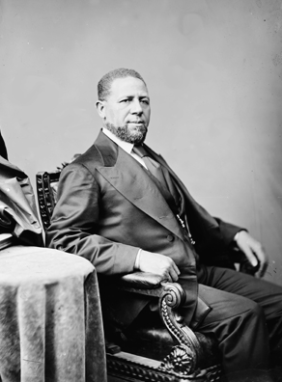
Hiram Rhodes Revels.

Image

Hiram Rhodes Revels was the first person of color to serve in the United States Congress.

Revels was born free in 1827 in Fayetteville, North Carolina. In 1838 he moved to Lincolnton, North Carolina to apprentice in his brother Elias B. Revels’ barber shop. After attending seminary in Indiana and Ohio, Revels was ordained as a minister in the African Methodist Episcopal Church in 1845 and served as a preacher and religious teacher throughout the Midwest.

Revels served as a chaplain in the United States Army during the Civil War and helped recruit and organize black Union regiments in Maryland and Missouri. He took part at the battle of Vicksburg in Mississippi. In 1865, Revels left the AME Church and joined the Methodist Episcopal Church. In 1866, he was given a permanent pastorship in Natchez, Mississippi, where he settled with his wife and five daughters, became an elder in the Mississippi District, continued his ministerial work, and founded schools for black children.

In 1869, Revels was elected to represent Adams County in the Mississippi State Senate. In 1870 he was elected to finish the term of one of the state’s two United States Senators, vacant since Mississippi seceded from the Union.

When Revels arrived in Washington, Southern Democrats opposed seating him in the Senate, basing their arguments on the Dred Scott decision, which ruled that people of African ancestry were not and could not be citizens. Because no black man was a citizen before the 14th Amendment was ratified in 1868, they argued, Revels could not satisfy the requirement for nine years’ prior citizenship.

Revels’ supporters of Revels made a number of arguments, including: (1)  that Revels was of mixed black and white ancestry (an “octoroon”) and the Dred Scott decision applied only to blacks who were of purely African ancestry; (2) that Revels had been  considered a citizen (and indeed had voted in Ohio) before Dred Scott; and (3) that the Civil War and the Reconstruction Amendments had voided Dred Scott. On February 25, 1870, Revels, on a strict party-line vote of 48 to 8, became the first black man to be seated in the United States Senate.

Revels resigned two months before his term expired to accept appointment as the first president of Alcorn Agricultural and Mechanical College (now Alcorn State University). In 1873, Revels took a leave of absence from Alcorn to serve as Mississippi’s secretary of state ad interim.  He died on January 16, 1901.

Adapted from Wikipedia. 

In the 1850 census of Cambridge City, Wayne County, Indiana: Robert Freeman, 34, laborer, born Virginia; Jane Freeman, 30, born Virginia; Malinda Freeman, 14, born Ohio; Hannah, 13, William H., 10, Robert, 4, and Margaret Freeman, 3, all born in Indiana; Charles Guinea, 18, born Virginia; and Hiram Revels, 25, and wife Phebe Revels, 17, both born in NC.

In the 1860 census of Ward 11, Baltimore, Baltimore County, Maryland: Hiram Revels, 35, Prest’n clergyman O.S., born North Carolina; wife Phoebe, 25, born Ohio; Elizabeth, 5, and Emma Revels, 3 months, born in Maryland; and Mary Brooks, 16, born in Maryland.

Register of (NC-Born) Negroes and Mulattos: Bartholomew County, Indiana, no. 3.

Daniel Oxendine, age 37, born Robeson County NC, registered 19 Aug 1853.  He was described as a mulatto man, five feet nine and a half inches high; rather rawboned; medium size; rather light complexion; good teeth, two out; with a small mole on the right side of his upper lip.  Witnesses: John A. Abbott and Randolph Griffith.

Priscilla Jane Oxendine, age 10, born Robeson County NC, registered 10 Apr 1854.  She was described as a mulatto girl, daughter of Daniel Oxendine.

Sarah L. Almenya Oxendine, age 9, born Robeson County NC, registered 5 Oct 1855.  She was described as a bright mulatto girl, daughter of Daniel Oxendine, no marks.

Senith Oxendine, age 7, born Robeson County NC, registered 5 Oct 1855.  She was described as a dark mulatto, daughter of Daniel Oxendine, no marks.

In the 1850 census of Columbus, Bartholomew County: Daniel Oxendine, 33, laborer, born NC, wife Elizabeth, 41, and children Priscilla Jane, 7, Sarah E., 4, Seneth E., 2, Mary Ann, 1, plus Samuel Freeman, 45, and William Gilmore, 12. All born in NC except Seneth and Mary Ann, born in Indiana.