Fourth Generation Inclusive

Historical Documents of Genealogical Interest to Researchers of North Carolina's Free People of Color

Category: Apprentices

Runaway bound boy, no. 6.

Twenty-Five Cents Reward.

RAN away from the subscriber on the 12th instant, a negro boy by the name of LEROY BRANDOM, who was bound to me by the court of this county, to serve until he became twenty-one years of age.  Said boy is about eighteen years old, dark complexion, bushy head of hair, large white eyes, and wears a truss.  I forewarn all persons from harbouring said boy under the penalty of the law.  I will give twenty-five cents reward for the delivery of said boy to me in this place, but will not pay any charges or expences.  Said boy had sundry clothing, not any recollected.         John Young. Aug. 20.

Hillsborough Recorder, 29 Aug 1821.

Wayne County Apprentices, 1822-1824.

Bitha Reed, 10, Vina Reed, 8, Zion Reed, 6, Washington Reed, 3, and William Hagans, 6, were bound to Thomas Person in 1821.

[The Reids were children of free woman of color Rhoda Reid and her enslaved husband. — LYH]

Whitly Hagans, age 5, and Larkin Hagans, age 3, were bound to Jesse Bardin as farmers in 1822.

In the 1850 census of Cape Fear North East Side, Bladen County: Whitley Hagans, 30, carpenter, in the household of Edmund Richardson, farmer. By 1870, Whitley Hagans, 51, house carpenter, was listed in the census of Wadesboro, Anson County, with his wife Margarett, 54, and children Catharine, 24, Whitley, 23, Cora, 18, Hattie, 7, Allice, 5, and William, 1.

William Artis was bound to Stephen Woodard in 1822.

Theo King was bound to Mark Smith in 1822.

In the 1850 census of North Side of Neuse, Wayne County:  Theo. King, 22, farm hand, in the household of Major Smith, farmer.

David Lane, age 7, was bound to Matthew Grace in 1822.

In the 1850 census of Madison, Jefferson County, Indiana: David Lane, 34, carpenter, $400, Eda, 24, David, 8, and Nathan, 6, all described as mulatto, all born in NC. In the 1860 census, Indianapolis Ward 1, Marion County, Indiana: Eda Lane, 40, washwoman, and children David, 18, Nathan, 16, John, 12, Josephine, 9, and Kizziah, 4.

Henry C. Berry, age 8, was bound to Simon Copeland as a farmer in 1822.

Vina Hagans, 16, Eli Hagans, 18, and Sherard Hagans, 9, were bound to Robert Hooks in 1824.

In the 1850 census of North Side of Neuse, Wayne County: Sherrard Hagins, 39, day laborer, wife Mary, 39, and children Samuel, 20, day laborer, Winifred, 18, Benjamin, 16, Mary, 13, Smithy, 10, Narcissa, 7, and Robert, 7, and Nancy, 1.  In the 1860 census of Nahunta, Wayne County:  Sherard Hagans, 49, carpenter, wife Nancy, 50, washwoman, and children Mary E., 22, Robert, 18, Nancy, 12, and Marshall, 9. 

Poll, 14, and Major, 12, no last names, were bound to Blake Hooks in 1824.

Vina Seaberry, age 7, was bound to Henry Best as a spinster in 1824.

Mary Herring, age 18, was bound to Tobias Burns, as a spinster in 1824.

Nancy Burnett, age 11, was bound to James Musgrave, as a spinster in 1824.

Possibly, in the 1850 census of Fayetteville, Cumberland County: Miles Baker, 41, boatman, Nancy Burnett, 35, Benj. Roberts, 38, laborer, Jane Burnett, 15, Elizabeth Burnett, 11, Lovedy Brooks, 1, and Caroline Brooks, 25.

Micajah Burnett, age 13, was bound to John Cox as a farmer in 1824.

Lewis Artis, 12, was bound to Woodard Daniel as a farmer in 1824.

In the 1850 census of District 85, Parke County, Indiana: Lewis Artis, 40, farmer, wife Heneretta, 33, and Mathew Artis, 32, farmer, all born in NC, in the household of Henry Milligan, farmer, also born in NC. Lewis reported $1400 in real property.  (Milligan reported none.) Next door, Alford Artis, 52, farmer, born NC, and family. But see the 1860 census of Florida, Parke County, Indiana: Lewis Artis, 48, farmer, born NC, wife Elizabeth, 48, and children Lucy A., 22, Jesse, 20, John, 18, Louisa, 16, James, 12, Exum, 8, Eli, 7, and Margaret, 4. [Is this the same man? Are either the boy bound in 1824?]
Wayne County Apprentices, 1807-1820.

Bennett Artis was bound to John Woodard in 1807.

Jonathan Artis, age 4, was bound to James Sparkman as a shoemaker in 1807.

Possibly Jonathan Artis, aged 24-36, head of a household of six free people of color in the 1840 census of Fayetteville, Cumberland, 1840.

Abram Johnston was bound to Joel Newsom in 1807.

Haywood Hagans was bound to Thos. Broadstreet in 1807.

Patience Hedgman was bound to James Reasons in 1812.

Welthy [no last name], age 15, and Ned [no last name], age 4, were bound to Stephen Woodard in 1820.

Kinnard Samson, age 7, Liza Samson, age 12, and Jere Samson, age 2, were bound to Stephen Woodard in 1820.

“Jere Samson” is possibly Jesse Sampson, 35, day laborer, with wife Mary, 30, and children Caswell, 10, Martha, 8, Elizabeth, 6, Temda, 4, and Gabriel, 6 months, listed in the 1850 census of North Side of Neuse, Wayne County. 

Rufus Seeberry, age 6, and James Madison Seeberry, age 8, were bound to Henry Best in 1820.

In the 1860 census of Neuse River, Johnston County: Rufus Ceberry, 43, miller, wife Dolly, 40, and children Nicy, 22, Willis, 21, Susanna, 19, John, 17, Polly, 15, Eliza, 12, Malena, 9, Melvina, 5, and Hanibal, 4.

Apprentice Records, Wayne County Records, North Carolina State Archives.

Onslow County Apprentices, 1828-1833.

Durant Dove and Willis Dove were bound to James Mills in 1828.

In the 1850 census of Upper Richlands, Onslow County, Durant Dove, 40, mulatto, wife Anny and children Margarett Ann, Eliza Jane, Wm., Julia, Nancy, Durant, Edward, Mandy, Joshua, and Henry.

Durant Henderson and Willis Henderson were bound to James Mills in 1829.

Jacob [no last name] was bound to John Langley in 1829.

Silas White, son of Esther White, was bound to Jesse Sandlin in 1830.

Jesse Holly was bound to Phenehas Rouse in 1832.

Tom Hammonds was bound to Leroy Hammonds in 1832.

In the 1850 census of Half Moon, Onslow County: Thos. Hammonds, 55, farmer, wife Sena, 55, Susan Hammonds, 35, Thomas Hammonds, 24, Seana Littleton, 14, and Marthy White, 13. Thomas the elder reported $800 personal property. [Sidenote: if Thomas were the son of Thomas and Sena Hammonds, a married couple, upon what basis was he bound out?]

Edward Griffith and Sarah Griffith were bound to David Jarman in 1833.

This is possibly the Edward Griffith listed in the 1840 census of South Side of Neuse River, Craven County, as the head of a household of three free people of color.

Onslow County Apprentices, 1825-1827.

Elizabeth Simmons was bound to John Grant in 1825.

Alfred, son of Rhoda (no last name given), was bound to Charles Thompson in 1825.

James Jarman was bound to Thomas Batten in 1825.

Gatsey Pittman was bound to Jacob Williams in 1826.

James Sheppard was bound to Edward Johnson in 1826.

Betty Sampson was bound to Solomon E. Grant in 1826.

Bill White, Edward White, Morris White and Anna White, children of Elizabeth White, were bound to Jesse Sandlin in 1827.

Gatsey Pittman was bound to Hezekiah Williams in 1827.

Betsy White and Nancy White, children of Oma White, were bound to Lott Gregory in 1827.

William Henderson, son of Nancy Henderson, was bound to Lemuel Williams in 1827.

Joe Higgins was bound to Henry Henderson in 1927.

George Boon was bound to John B. Thompson in 1827.

Apprentice Records, Onslow County Records, North Carolina State Archives.

I worked for it.

TESTIMONY OF NAPOLEON HIGGINS.

NAPOLEON HIGGINS, colored, sworn and examined. By Senator Vance:

Question: Where do you reside? – Answer. Near Goldsborough. I don’t stay in Goldsborough, but it is my county seat. I live fifteen miles from town.

Q. What is your occupation? – A. I am farming.

Q. Do you farm your own land? – A. Yes, sir.

Q. How much do you own? – A. Four hundred and eighty-five acres.

Q. How did you get it? – A. I worked for it.

Q. Were you formerly a slave? – A. No, sir; I was a free man before the war.

Q. What did you pay for it? – A. I believe I paid $5,500; and then I have got a little town lot there that I don’t count; but I think it is worth about $500.

Q. How much cotton do you raise? – A. I don’t raise as much as I ought to. I only raised fifty-eight bales last year.

Q. What is that worth? – A. I think I got $55 a bale.

Q. How many hands do you work yourself? – A. I generally rent my land. I only worked four last year, and paid the best hand, who fed the mules and tended around the house, ten dollars; and the others I paid ten, and eight, and seven. … I gave them rations; and to a man with a family I gave a garden patch and a house, and a place to raise potatoes.

Q. How did you start [your farm]? – A. I rented a farm and started on two government horses. I went to the tightest man I know and got him to help me. I rented from Mr. Exam out there.

Senate Report 693, 2nd Session, 46th Congress: Proceedings of the Select Committee of the United States Senate to Investigate the Causes of the Removal of the Negroes from the Southern States to the Northern States, Washington DC, beginning Tuesday, 9 March 1880.

Napoleon Hagans (not Higgins) testified before a Senate Select Committee investigating the migration of hundreds of “colored people” from the South to Indiana in the late 1870s.  Hagans testified about the source of his relative wealth (above), as well his opinion of the political climate for colored men in his part of North Carolina.

Napoleon Hagans, 6, was apprenticed in 1845 to William Thompson.  Apprenticeship Records, Wayne County Records, North Carolina State Archives. In the 1850 census of  North of Neuse, Wayne County, Aaron Seaberry, 32 year-old black farmhand, with wife Louisa, [stepson] Napoleon [Hagans], daughter Frances, and 17 year-old Celia Seaberry. In a duplicate listing, also North of the Neuse: Leacy Hagans, 55, with probable grandson Napoleon Hagans, 10.  


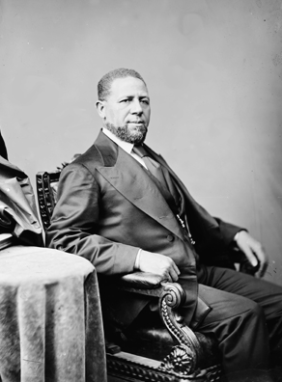
Hiram Rhodes Revels.

Image

Hiram Rhodes Revels was the first person of color to serve in the United States Congress.

Revels was born free in 1827 in Fayetteville, North Carolina. In 1838 he moved to Lincolnton, North Carolina to apprentice in his brother Elias B. Revels’ barber shop. After attending seminary in Indiana and Ohio, Revels was ordained as a minister in the African Methodist Episcopal Church in 1845 and served as a preacher and religious teacher throughout the Midwest.

Revels served as a chaplain in the United States Army during the Civil War and helped recruit and organize black Union regiments in Maryland and Missouri. He took part at the battle of Vicksburg in Mississippi. In 1865, Revels left the AME Church and joined the Methodist Episcopal Church. In 1866, he was given a permanent pastorship in Natchez, Mississippi, where he settled with his wife and five daughters, became an elder in the Mississippi District, continued his ministerial work, and founded schools for black children.

In 1869, Revels was elected to represent Adams County in the Mississippi State Senate. In 1870 he was elected to finish the term of one of the state’s two United States Senators, vacant since Mississippi seceded from the Union.

When Revels arrived in Washington, Southern Democrats opposed seating him in the Senate, basing their arguments on the Dred Scott decision, which ruled that people of African ancestry were not and could not be citizens. Because no black man was a citizen before the 14th Amendment was ratified in 1868, they argued, Revels could not satisfy the requirement for nine years’ prior citizenship.

Revels’ supporters of Revels made a number of arguments, including: (1)  that Revels was of mixed black and white ancestry (an “octoroon”) and the Dred Scott decision applied only to blacks who were of purely African ancestry; (2) that Revels had been  considered a citizen (and indeed had voted in Ohio) before Dred Scott; and (3) that the Civil War and the Reconstruction Amendments had voided Dred Scott. On February 25, 1870, Revels, on a strict party-line vote of 48 to 8, became the first black man to be seated in the United States Senate.

Revels resigned two months before his term expired to accept appointment as the first president of Alcorn Agricultural and Mechanical College (now Alcorn State University). In 1873, Revels took a leave of absence from Alcorn to serve as Mississippi’s secretary of state ad interim.  He died on January 16, 1901.

Adapted from Wikipedia. 

In the 1850 census of Cambridge City, Wayne County, Indiana: Robert Freeman, 34, laborer, born Virginia; Jane Freeman, 30, born Virginia; Malinda Freeman, 14, born Ohio; Hannah, 13, William H., 10, Robert, 4, and Margaret Freeman, 3, all born in Indiana; Charles Guinea, 18, born Virginia; and Hiram Revels, 25, and wife Phebe Revels, 17, both born in NC.

In the 1860 census of Ward 11, Baltimore, Baltimore County, Maryland: Hiram Revels, 35, Prest’n clergyman O.S., born North Carolina; wife Phoebe, 25, born Ohio; Elizabeth, 5, and Emma Revels, 3 months, born in Maryland; and Mary Brooks, 16, born in Maryland.

Their father bound them out, but wanted them back.

Haywood Musgrove v. Wm. J. Kornegay, et al., 52 NC 71 (1859).

On a writ of habeas corpus, Simon and Lucretia Musgrove, colored children, were brought into Wayne County Superior Court upon the petition of their father, Haywood Musgrove.  William J. Kornegay, in his defense, presented a deed that Musgrove had executed to Kornegay, purporting to bind the children to him as apprentices.  It appeared that Simon was over twelve years old at the time of the transaction; assented to the binding, but did not sign the deed; and served Kornegay three or four years.  However, Lucretia was only three or four years old at the time and did not assent to the binding in any way.

The court ordered Simon and Lucretia returned to Kornegay, and their father appealed.

The Supreme Court: “A father is entitled to the services of his child until he arrive at the age of twenty-one.” He has a right of property in the child’s services, may enforce them by reasonable correction, and if the child absconds or is taken away, may recover custody by habeas corpus.  However, a father cannot assign this interest to a third person, unless the child is old enough to enter a contract (age twelve at the time) and assents to the assignation by executing the contract with his father. In this case, Lucretia was too young to be sign a contract and should be returned to her father.  And though Simon was more than twelve years old, he did not sign the deed, “the proper order is to discharge the infant and permit him to go where he pleases. Order below reversed. This order will be entered, and judgment against Kornegay for costs.”

Onslow County Apprentices, 1823-24.

James Henderson and Bryan Henderson were bound to Jason Gregory at February term, 1823.

Betsy Henderson was bound to James Glenn Jr. at February term, 1823.

Betsy, Nancy and Appie [no surnames] were bound to David Mashborn in 1823.

Miranda Henderson, James Henderson, Martha Henderson and Bryant Henderson were bound to James Glenn at February term, 1824.

Miranda Henderson was bound to Elizabeth Williams at August term, 1824.

William Henderson was bound to Lemuel Williams at May term, 1824.

James Henderson and Bryan Henderson, “the baseborn children of Patsey Henderson,” were bound to James Glenn Sr. at August term, 1824.

James Jarman, son of Charlotte Jarman, was born to 1824.

Amos Pittman, son of Sally Pittman, was bound to Edward Erwin in 1824.

Betsy Henderson and Gatsey Henderson, daughters of Nancy Henderson, were bound to Lewis Mills at August term, 1824.

Gatsy Pittman, daughter of Sucky Pittman, was bound to Jesse Humphrey in 1824.

In the 1860 census of Half Moon, Onslow County: Edmund Marshall, 25, cooper, and wife Martha, 20, “serving,” Gatsey Pittman, 45, domestic, and D.R. Ambrose, 23, merchant.

Needham Potter, son of Alice Potter, was bound to Charles Cox in 1824.

Patsy Henderson was bound to Amos Askew at November term, 1824.

Apprentice Records, Onslow County Records, North Carolina State Archives.

[Sidenote: All these Hendersons are my kin.  My great-great-great-great-grandfather James Henderson and his brother Bryan/Bryant were sons of Patsey Henderson.  Miranda and Martha “Patsey” Henderson probably were their sisters.  I believe Nancy Henderson was Patsey Henderson the elder’s sister, and her children above were Betsy, Gatsey and, possibly, William.  Apprentice records show a dozen or so free colored Henderson children in Onslow County in the first quarter of the nineteenth century.  It seems likely that they were from one extended family, but proof is thin. — LYH]

James Boon.

James Boon (1808-1850s or later) was a free black carpenter active in North Carolina from the 1820s through the 1850s. As historian John Hope Franklin relates, the rare if not unique survival of the personal papers of this free black artisan provides an important window into the ‘common experiences, the fortunes, both good and ill, which all free Negroes had.’ Boon was evidently born to a free mother and was apprenticed at 18 to Franklin County carpenter William Jones until the age of 21. In 1829, he received a paper that served as a pass, stating ‘James Boon, a boy of colour who was bound to William Jones by this court’ was ‘ordered to be liberated and set free.’

“Boon led a mobile life and carried with him passes and letters of reference from employers and prominent citizens to affirm his free status and good work. He worked first around Louisburg in construction and furniture making. In the mid-1830s, he went to Raleigh, possibly to help build the Duncan Cameron House (1835-1836). He traveled to Littleton in 1839 and to rural Halifax County in 1842. A reference to ‘Boon’ in Skinner family correspondence suggests that he worked on the Greek Revival style plantation house Linden Hall (1841-1844) near Littleton for Charles and Susan Little Skinner; there are also references to ‘Mr. Bragg’ (probably Thomas Bragg, Sr.) and ‘Jones’ (possibly Albert Gamaliel Jones). One of his employers, R. H. Mosby, affirmed in 1842 that Boon was ‘an orderly and well behaved man, and attentive to his business. His work is executed better and with more taste than any persons within my knowledge in this section of country.’ In 1848, James Boon joined his brothers and a friend seeking work in Wilmington. He then went to Raleigh in 1849, where he was employed by the prominent builder Dabney Cosby on various projects. There he hired other workmen to help on ‘Mr. D. Cosby’s work.’ On October 27, 1850, Cosby wrote him a reference stating that ‘Jim Boon’ had been in his employ ‘for some time’ and was ‘a good workman.’

“Boon sometimes worked alone but also hired as many as nine workmen, including whites, slaves, and free blacks. He charged $1.25 a day for his own time and $0.50 cents to $1.00 for his employees. He owned one slave, Lewis, and land in Franklin County, which he occasionally mortgaged. Boon did not learn to read and write, but William Jones, who remained a friend, helped him in business matters. Various receipts note payment for such jobs as ‘Mill House 30 by 36, Ten feet pitch, Two stories, three floors, 12 windows and ten doors, weatherboarding dressed plain strong work,’ or for a more finished project, ‘24 lights glass, 12 x 15, Pilasters rose blocks–inside double architraves.’

“James Boon’s family included a brother, Carter Evans. Boon’s first wife was Sarah, a literate slave who belonged to Maria Stallings. They had a son who went to Raleigh with his father in 1849. (James Boon does not appear in the 1850 census.) In 1854, Boon married Mahaly Buffalo in Raleigh. His last record was in 1857; his death date is unknown.”

Author: Catherine W. Bishir.  Published 2009.

As published in North Carolina Architects and Builders: A Biographical Dictionary,  http://ncarchitects.lib.ncsu.edu  (All rights retained.) This web site is a growing reference work that contains brief biographical accounts, building lists, and bibliographical information about architects, builders, and other artisans who planned and built North Carolina’s architecture.