Fourth Generation Inclusive

Historical Documents of Genealogical Interest to Researchers of North Carolina's Free People of Color

She hath been arrested.

State of North Carolina Chatham county

We Lucretia Evans & Philip Hartsoe, acknowledge ourselves indebted to the State of North Carolina in the sum of Fifty pounds each, to be levied on our goods & chattles, Land & tenaments, But to be void on condition that the said Lucretia Evans makes her personal appearance at the next county Court for Chatham to be held on 2nd Monday of August next, and not depart the said court without leave, and to answer the within charge – This 25th June, 1826.   Lucretia X Evans {Seal}

Teste. Jon: Haralson , Philip Hartso

———-

State of North Carolina, Chatham County

Thos. Lasater, one of the Justices of the peace for the said County To the keeper of the common Jail of the County af’d.

Whereas Lucretia Evans a free woman of the County af’d. hath been arrested by the lawful authority of the af’d County and brought before me charg’d with entering the house of Vicy Mason and feloneaus stealing and carrying away a web of cloth for which offence she has been duly examined before me and the presumption is she is guilty thereof.

These is therefore to command you the keeper to receive the said Lucretia Evans in your Jail there to remain until she shall be delivered by due course of law, given under my hand this 26th of June 1826   Thos. Lasater

Records of Slaves and Free Persons of Color, Chatham County Records, North Carolina State Archives.

Napoleon Hagans house.

ImageNapoleon Hagans (1840-1896) built this house near the south bank of Aycock Swamp, near Fremont in northern Wayne County, between 1870 and 1885. “The house, a single-pile center-hall-plan dwelling, has retained much of its charming original hip-roofed front porch, now supported by replacement square columns. Windows are surmounted by moulded peaked arch surrounds. … One original single-shouldered exterior end chimney was plastered; the other was replaced by a concrete-block flue. …” A stone monument marking the graves of Napoleon and his wife Apsilla Ward Hagans stands in a cornfield about one hundred yards west of the house.

Detail from J. Daniel Pezzoni and Penne Smith, Glimpses of Wayne County, North Carolina: An Architectural History (1998).

Photo by Lisa Y. Henderson, December 2010.

The war effort.

CHAPEL HILL. – A letter from a friend at Chapel Hill informs us that a full company of Volunteers under Capt. Richard J. Ashe left that place on Saturday last. It comprised about 20 of the Students and the choice spirits of the community. A fund of about $1600 was cheerfully contributed in the village, and wagons loaded with provisions had been coming in from the country for some days. The free negro population asked the privilege of contributing, and gave from $10 to $15 each. A free washerwoman whose husband is a slave went out and collected $5 to expend for provisions for the company. Our correspondent says justly, that with God’s help a people so united cannot be overcome by any nation.

A large party of slaves and free men of color were assembled here on Saturday last, from the town and county, ready to start for labor at Fort Caswell, but instructions were received to send no more, and they were reluctantly disbanded.

Carolina Observer, Fayetteville, 29 April 1861.

Cocks fight; man dies.

Halifax, April 16.

Murder. – On Tuesday last, an inquest was held in this town on the body of Samuel Horne, a free colored man, who died the preceding day. From the Coroner’s report it appears that on Sunday last Edward Jones, a shoemaker, residing in this place, saw two chicken-cocks fighting near his house; he caught one and threatened to shoot the other, which Samuel Horne, the deceased, begged him not to do; upon this Jones ordered him out of the house, and swore if he did not go he would kill him, and immediately looked about for his shoe knife; the deceased went off, was pursued and stabbed by Jones. The wound was afflicted just above the collar bone on the left side of the neck, passing obliquely across the breast, cutting the windpipe, puncturing the swallow, and dividing important blood-vessels. Jones was immediately taken in to custody, and is now in jail awaiting his trial.  Free Press.

Hillsborough Recorder, 28 April 1824.

A reward for apprehending a slave.

GENERAL ASSEMBLY OF NORTH CAROLINA.

We take Monday’s proceedings from the Standard. Our Reporters’ letters annexed furnish those of Tuesday and Wednesday.

… Wednesday, Jan’y 30th.

Mr Peebles, a bill to pay to Evans Ferguson and Ben Smith, free persons of color, of Northampton County, $400, the reward by the Governor for the apprehension of Ephraim, a slave, for the murder of his master, Mr. Woodruff. Passed and sent to the Senate.

Carolina Observer, 4 February 1861.

Of sound mind and memory.

I Charles Winn of the County of Wayne and State of North Carolina being in sound mind and memory do this the 2nd day of November in the year of our Lord One Thousand eight hundred and eighty one make and declare this to be my last will and testament in manner and in form following that is to say

Item 1st – I leave to my beloved wife America Winn the plantation where on I now live during hir natural life time, and after her death I give and bequeath the said plantation to the lawfull heirs of her body.

Item 2st – I give and bequeath to William Winn, Churchwell Winn, Margaret Capps, Levi Winn, Mary Winn, Francies Winn, Charles Winn, Wyett Winn and Nancy Winn, my tracks of land lying on Brooks Swamp and adjoining the lands of A.T. Grady and the heirs of James Kelly Dec’d to be devied between them.

Item 3 – I leave to my wife all of my Househole and Kitchen furntiture during hir naturall life and after hir death to be devied between hir children.

Item 4th – I leave all of the balance of my personall property to be sold by my Executor for cash and pay all of lawfull debts and the Balance if any to be devied between the children of my wife America Winn.

Item 5th – I do here by constitute and appoint James Winn Executor to this my last will and testament, in witness where off I Charles Winn Sr. have here unto set my hand and seal.  Charles X Winn

Signed and sealed in the presents of us who at this time subscribed our own name as witnesses there to – John A. Kornegay Jr., George Winn

Office of Clerk of Superior Court, Wayne County Courthouse, Goldsboro NC.

In the 1860 census of Brogden, Wayne County: Charles Winn, wife America, and children Churchill, Marina, Levyet, Mary, Frances, Wyatt, and Nancy.

James L. & Bettie Johnson Mozingo.

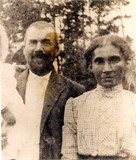
ImageJAMES LODY MOZINGO was born about 1862 in Cumberland County to Wiley Mozingo (ca1830-ca1915) and Agnes Allen Mozingo (ca1840-1923). His wife Bettie Johnson Mozingo was born around 1873 in Johnston County to Stephen Johnson (1838-1914) and Mary Sasser Johnson (1845-??).

In the 1860 census of Cumberland, Cumberland County: Wiley Mozingo, 25, wife Agus, 20, and children S.E., 4, Mary C., 3, and Lavina, one month. The censustaker noted that S.E. and Mary had red hair.

John P. Green.

Image

Hon. John P. Green was born in 1845 at New Berne, N.C., of free parents. As a boy of twelve years of age, he went with his widowed mother to Cleveland, Ohio. He was educated in the Cleveland public schools, graduating from the Central High School in 1869.

He was admitted to the bar of South Carolina in 1870. Returning to Cleveland, he for nine years served as justice of the peace. In 1881 he was elected member of the Ohio Legislature, serving three terms.

In 1897 he was appointed to a position in the postoffice department by President McKinley.He was also delegate to the National Republican Convention in 1872, in 1884 and 1896.

From D.W. Culp, ed., Twentieth century Negro literature, or, A cyclopedia of thought on the vital topics relating to the American Negro.

Courtesy of New Bern-Craven County Public Library. 

Should he be a slave ….

TAKEN UP, AND committed to the Jail of this county on the 3d of August last, a Negro man who calls himself PETER GREEN, says he is free, and that he belongs to Providence, Rhode Island. He professes to have followed the sea, and exhibits an American Protection, which, however, does not correspond with his height. He appears to be about 33 or 35 years of age, very black, well made, about 5 feet high, very artful, and had on when taken, the clothing of a seaman.

Should he be a slave, the owner is notified to come forward, comply with the requisitions of the law and take him away; otherwise he will, after a reasonable time, be sold for his jail fees, and discharged form custody.   W.C. TAYLOR, Jailor.   October 11th, 1823.

New Bern Sentinel, 24 October 1823.

As good as any mill in the state.

GRINDING CORN!

I have rented the Mill on Cross Creek, formerly owned by Mr. Hall. I will carry Corn to the mill and deliver MEAL or HOMINY without charge in any part of town. I have a Dray ready always for this very purpose, and I will guarantee customers as good meal or Hominy as any mill in the State can make. I will be very thankful for a liberal share of the public patronage.   ABEL PAYNE.  March 11.

Carolina Observer, Fayetteville, 11 March 1861.

———-

The subscriber would be pleased to grind, haul to and carry from the Mill, free of charge, at the Mill near the Gas Works, formerly Mr. Hall’s.   ABEL PAYNE. July 21, 1862.

Carolina Observer, Fayetteville, 21 July 1862.