Fourth Generation Inclusive

Historical Documents of Genealogical Interest to Researchers of North Carolina's Free People of Color

Category: Free Women of Color

Eliza Simmons Bryant.

Image

ELIZA SIMMONS BRYANT (1827–1907) founded a home in Cleveland, Ohio, for elderly African-Americans, many, freed slaves.  The Cleveland Home for Aged Colored People, now known as Eliza Bryant Village, continues to serve some of Cleveland’s most vulnerable residents.

Eliza Bryant’s official biography asserts that she “was born in North Carolina to Polly Simmons, a slave, and her master. She was raised on a plantation in Wayne County. In 1848, Polly Simmons was freed, and moved with her family to Cleveland, Ohio, where she purchased a home, with funds from her master.” In fact, Eliza was born free to Polly Simmons, who was part of a large family whose freedom dated from at least the mid-18th century.  Her father may have been white, and may have employed her mother, but was not her master.  (Eliza turned 21 in about 1848 — was a release from an indenture the “freedom” attributed to her mother in her bio?) The 1850 census of the South Side of the Neuse, Wayne County, shows: Polly Simmons, 47, her children Eliza, 23, Buckner, 21, and George, 18; plus Nancy A., 17, and Willie Grice, 15, and Rufus Daniel, 14; all described as mulatto. They are listed among a cluster of Simmonses, including 84 year-old Phereby Simmons, who may have been Polly’s mother.

Photo courtesy of http://www.elizabryant.org.  Wikipedia; US Federal Population Schedule.

Complaint for possession of land.

North Carolina, Wayne County   } In Superior Court April Term 1892.

David Brown and wife Minta Brown vs. Sallie Simmons and Frank Winn – Complaint.

The plaintiffs for their complaint allege, I. That prior to the [blank] day of April 1854 David Simmons was the owner in fee of a tract of land in Wayne County near the town of Mount Olive on which the defendant Sallie Simmons now lives, bounded as follows, Beginning at a pine and running thence S 82 poles to a pine, then S 87 W 81 poles to a pine, the N 47 W 46 poles to a pine, then N 5 E 56 poles to a stake, then East 110 poles to the beginning containing 57 acres more or less.

II. That on said [blank] day of April 1854 the said David Simmons conveyed said tract of land for life to his mother Ita Simmons reserving an annual rent of one penny by deed duly admitted to probate and registered in Wayne County.

III. That thereafter on the 23rd day of April 1855 the said David Simmons conveyed said land in fee to one James McDuffie by deed duly admitted to probate and registered in Wayne County.

IV. That thereafter the said McDuffie died in the County of Wayne leaving a last will and testament by which he devised said land in fee to the plaintiff Minta Brown (then Minta Bryant) subject to the life estate of the said Ita Simmons.

V. That soon after the execution of said deed to Ita Simmons set out in the second paragraph of this complaint, the said Ita Simmons took possession of said land under said deed and remained in possession thereof until her death in the year 1891.

VI. That the plaintiff Minta Brown is the owner in fee of said land and in entitled to recover possession thereof.

VII. That the defendants are now in possession of said land and wrongfully withholding the same from the plaintiffs.

Wherefore the plaintiffs pray for Judgment.

1. That the plaintiff Minta Brown is the owner in fee of said land.

2. For possession & costs.

Minta Brown being duly sworn says, That the facts stated in the foregoing complaint as of her own knowledge over time and then states on information and belief she believes to be true.  Minta X Brown    Sworn to & subscribed before me this 9 day of April 1892.  Jno. D. Taylor, Clerk Superior Court, New Hanover County

In the 1850 census of the South Side of the Neuse, Wayne County: Ity Simmons, 40, born in Duplin County, with sons David, 22, cooper, and George, 20, hireling; all mulatto.  Also, Sally Bryan, 30, and her children Arimenta, 8, Penny, 6, Charley, 4, and Caroline, 4, and Charity Bryan, 70, perhaps her mother.  Arimenta and Penny were described as mulatto; the rest of the family, white.  In the 1860 census of Indian Springs, Wayne County, Minta Bryant, 23, and her children Mitchel, 4, Edith, 6, and Rufus Bryant, 2, all mulatto, lived in the household of James McDuffee, 41. [Was McDuffie the father of Bryant’s children?]

Ita Simmons Estate Papers, Estate Records, Wayne County Records, North Carolina State Archives.  US Federal Population Schedules.

Her complexion is an act of the Almighty, not her crime.

Pasquotank County   } To the Worshipfull the Justices of the Inferior Court of Pleas and Quarter Sessions of the County of Pasquotank County now in Court sitting.  The humble Petition of Ruth Tillet a free born, coloured Woman, Humbly sheweth unto Your Worships, that she was born of a Free woman named Ann Tillet, The daughter of the Wife of one [blank space] Tillet of Powel’s Point, supposed by a Black Man; That your Petitioner’s mother moved from Currituck to a Neighborhood on Little River, and was delivered of your Petitioner at the House of one Timothy Mead, where she remained until the Death of her Mother and the said Timothy, at whose [illegible] she was sold to one Blackstock who she verily believes was not ignorant of her Condition and Rights to Liberty, and sold her to a distant Merchant called Barny Coffoo of Newbern.  At which place, she had eight, Several Masters, each getting rid of her, as soon as thgey could, on hearing of her Story, and her Resolution to regain her Liberty.  That in the lifetime of her last Master John Bishop, she made her escape, and came to her native County, to which Place the said Bishop followed her and sold her to one Zachariah Jordon, (and he, as she has been informed gave no Purchase Money for her, and that the said Bishop enjoin’d the said Zachariah to inquire into her Rights and if true, to let her enjoy them, and if otherwise to send him payment, which was like the common Honest behaviour of his Life) who she believes, noways ignorant of the Premisses, still detains her in Slavery and Duress.  Your Petitioner humbly begs to inform Your Worships, That she has been so happy to find reputable and honest Evidence alive, although at the Distance of forty Years, of her Birth and of her Civil and Social Rights.

Whereupon your Poor and Distressed Petitioner humbly prays (Altho’ her Complection, which is an Act of the Almighty Not her Crime) Your Worships will, of your Mercy, take her Case under your Guidance and Consideration, and to render her such Redress as to Your Worships in your great Wisdom and Justice you shall seem Meet.    And Your Poor Petitioner as in Duty bound and ever Pray &c, Ruth Tillet by Will Cumming her Att’y

Ruth Tillet vs Zachariah Jordon}   Petition

Records of Slaves and Free Persons of Color, Pasquotank County Records, North Carolina State Archives.

Dangerous characters.

We the grand jury present Sarah, Hannah, Betty, being free negroes, as dangerous characters.

/s/ Challe Eagerton, Jas Forbs, W.W. Shaw, Lot Williams, David Jenkins, Jas. Scott, Mitchel Barber, Samuel Evens, Hinton Barber, James Brown, John Jarman, Danis Aman, Wm Webb.

———-

We as grand Juriors present a Certain percis of Free Negres that has not been Dealt with according to law having obtaind their Freedom by John Pair which Negroes are named [illegible] Sarah Boon July 9th 1816 /s/ Charles Agerton, Samuel Evins, Dennis Aman, James Brown, John, Jarman, David Jenkins, Mitchell Barber, Wm Webb, James H. Barber, Lott Williams, John Marshel, James Fioller, Wm Shaw.

Slave Records, Onslow County Records, North Carolina State Archives.

[Side Note: “Dangerous characters”? Why?]

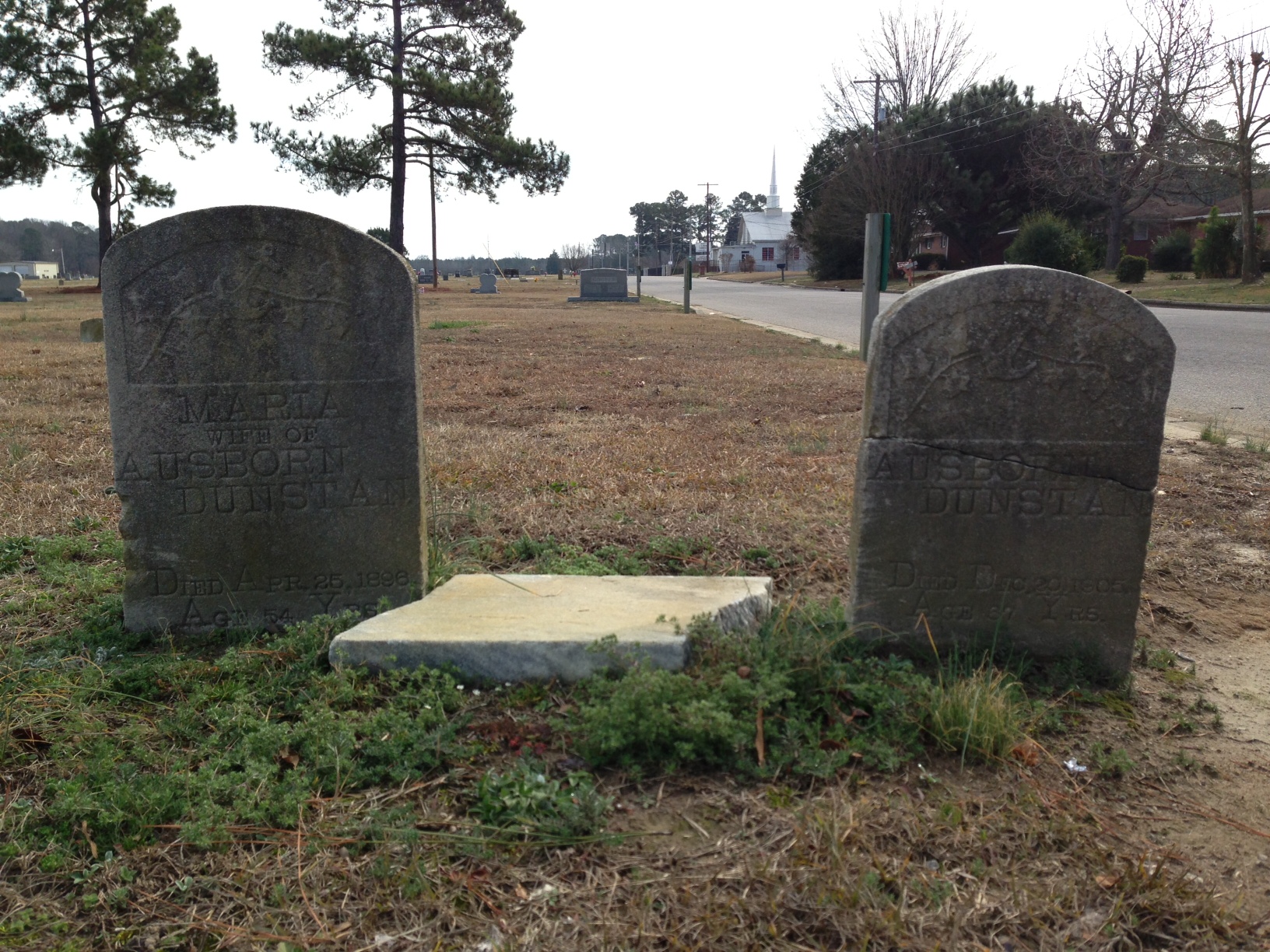
Ausborn and Mariah Dunstan.

The headstones of Ausborn Dunstan and wife, Maria Dunstan, are found in Row E of Rest Haven Cemetery, Wilson, North Carolina’s African-American cemetery.  Unless reinterred from Rountree cemetery –  the earlier graveyard serving Wilson’s black folks, abandoned circa 1950 – they are among the earliest burials in Rest Haven.

Though both were free-born, and accordingly not subject to legislation creating a path to legitimation of slave marriages, Orsborn Dunson and Mariah Monday registered their five-year marriage on 24 August 1866 in Wilson County.

In the 1860 census of Wilson, Wilson County:  Asburn Dunstan, 23, laborer, in the household of H.L. Winton, who kept a boarding house.

In the 1850 census of North Side of the Neuse, Wayne County: Moriah Munda, 9, black, listed as farmhand in the household of John G. Barnes, 33, white, farmer.

Image

Malaga Moll’s great-grandson sues for freedom.

William Dowry ag’t Francis Thomas   } Pet’o for freedom in the General Court.

The deposition of Ann Ridgely of Anne Arundel County aged between fifty seven and fifty eight years being first sworn on the holy Evangely of Almighty God, saith that she has seen William Dowry the petitioner but does not know much of him; that she knew Fanny who it is said, is Mother of the petitioner, very well; and this deponant also knew Mary Dove, the Mother of Fanny ever since she knew her own Mother, and she knew Fanny who is of about the age of the deponant from the time she was a child until she was a woman; this deponant is the daughter of Eliazar Burkhead who was the son of Abraham Burkhead, to whom Mary and Fanny both belonged when this deponent first knew them; and he gave Fanny to his daughter Frances Shekell the wife of John Shekell; this deponant further saith that Mary was a tall spare woman, of a brown complexion, and was the grand daughter of the woman, who came, or was imported into this Country and belonged to this deponants great grand Father as she has been informed and understood from her mother and her grand Father beforementioned: that her grand Father was the only child of his Father and possessed the whole estate; that this deponant has always understood that the Grand Mother of Mary Dove was a yellow woman and had long black hair; but this deponant doth not know whether she was reputed to be an East Indian or a Madagascarian, but she has understood that she was called in the family Malaga Moll, her name being Mary; and Mary Dove the Grand-daughter claimed her Sirname from her said Grand Mother; this deponant further saith that the Mother of Mary Dove (whose name she does not remember) died before her Mother, and whilst her daughter Mary Dove aforesaid was a small girl; and this deponant saith after the death of her father, her Mother intermarried with Leonard Thomas and the aforesaid Mary Dove then lived in the family and belonged to this deponant’s Brother James Birkhead, and upwards of forty years ago she sued for her freedom, and before any determination of the suit the aforesaid Leonard Thomas moved with his family and effects to North Carolina, about twenty miles from New Burn and carried the aforesaid Mary Dove with him, this deponants Brother James being then about five or six years of age: that the said Mary Dove prosecuted her claim to freedom at Newburn in North Carolina soon after she was removed there, and obtained her freedom upon trial at this deponant understood, together with three of her Children and two of her Grand Children and they were all discharged from the possession of the said Leonard Thomas; that the Children were named James, Nell and Sue, and the Grand Children, Will and Sal; that this deponant has heard her father in Law Leonard Thomas say that a certain Alexander Sands, who was the Son of an East Indian woman; and was commonly called Indian Sawny, was a Witness for the said Mary Dove, and that he proved that the Grand Mother of Mary Dove was an East Indian Woman; that this deponant does not recollect to have heard her father in law mention any other witness in particular who was sworn for the petitioner, but thinks he mentioned that one John Wells was sworn on her behalf; that the said Mary Dove had a brother named Dowry who belonged to this deponants uncle. That the aforesaid Leonard Thomas removed back to Maryland in a few years and sometime afterwards returned to North Carolina near the Yadkin and died about twelvemonth ago: — sworn to in open Court 16 Octo. 1791.    True Copy     Jno. G. [illegible]

Miscellaneous Records, Craven County Records, North Carolina State Archives.

[It is a reasonable conjecture that Mary Dove was the forebear of all the free colored Craven, and later Onslow and Jones, and later still Lenoir County Doves.]

Shew cause why he keepeth her in a state of slavery.

State of North Carolina, Edgcombe Countye   }  To the Sheriff of sd. County greeting you are hereby commanded that you Summon James Williams if to be found in your Bailiwic to make his Personal Appearance at the next county court of pleas &c., to be held for the County of Edgcombe afores’d on the first monday in May next then and there to shew Cause why he keepeth in a State of Slavery, Sarah Rogers, who by her petition to the Justices of the county court afores’d allegeth that she is a free woman And have you then there this Writ — Witness Edward Hall Clerk afs’d court the 7th Day of Feby. 1785.  Edward Hale Clk.

Slave Records, Edgecombe County Records, North Carolina State Archives.

Lucy sues for all.

Thomas v. Palmer, 54 US 249 (1854).

Nathiniel P. Thomas of Caswell County, among other things, devised and bequeathed as follows:

“My mill tract of land, situate in Caswell county, containing eighty-five acres, on the waters of Pumpkin Creek, adjoining the lands of Carter Powell, and others, and the Crowder tract of land, containing about sixty-six acres, adjoining the same. I do hereby devise to my executor, to be sold on a liberal credit, and the proceeds of the said sale to be placed at interest, after investing a portion of the same in purchasing a suitable home for my mulatto woman, Lucy, and children, purchased of the trustees of Robert A. Crowder; the interest in the said two tracts to be appropriated towards their support, and until the amount of said sale becomes due, I direct my executor to appropriate a sufficient amount out of the proceeds of my estate generally, for their maintainance and support.

3rd. My mulatto woman, Lucy, as aforesaid, I do hereby devise and bequeath, to Nathaniel J. Palmer, together with her children, Mary Jane, James and Newton, and any other children that she may have, in trust and confidence, nevertheless, that he will provide for them a suitable home, as aforesaid, and for her support, and that of her children, until they are able to support themselves, out of the proceeds of the real estate aforesaid. And in the event of the death of the said Nathaniel J. Palmer, the said woman, and children are to be held by my friend, William Bryant, of Pittsylvania county, Virginia, as trustee aforesaid, and in the event of his death, they are to be held by such trustee as he may select, and the County Court of Caswell approve and appoint, it being understood that the said woman and children are not to be removed from the county of Caswell, without her free will and consent, and a copy of this will recorded in the clerk’s office of the county, to which she may remove.”

In a codicil to this will, Thomas provided: “In the event that the laws of North Carolina, or the policy of the same, as construed by the Supreme Court, shall present any obstacle to the fulfillment of the trust mentioned in the foregoing will in relation to my mulatto woman, Lucy, and her children, I do hereby authorise and direct my executor, to send them to such State, territory or country as she may select, and he may think best, and I do hereby charge my estate with a sum sufficient to provide for their removal to such State, territory, and country, and for their comfortable settlement there; it being my will and desire, that she shall not be continued in slavery.”

When Lucy was advised that North Carolina’s laws forbade her to remain in the State and obtain any of the advantages proposed in Thomas’ will or codicil, she moved with her children to Ohio.

In her suit, Lucy Thomas and her children alleged that they were able to get to Ohio, but had not been provided with a home or settlement as the will directed, and “that they are in want, and destitution, and that the children being small, the mother is unable to support herself and them, without the assistance of the fund provided in the will.” They argued that the codicil of the will validated the provision made for them in the will and that they are entitled to the proceeds of the sale of the two tracts of land, which amounts to some $1,500; to the expenses of their removal; and to a comfortable settlement out of the Thomas’ estate.

Palmer, the executor, objected to this construction, arguing that there is nothing in the codicil to validate the deficient and illegal devises in the body of the will, and the plaintiffs are not entitled to any thing but the expenses of their removal and a comfortable settlement in Ohio.  He asserted that he had already advanced funds to them to assist their move, and as soon as the condition of the estate allowed, would provide for their comfortable settlement.

The Supreme Court determined: “Emancipation is not forbidden by our laws; but a negro, who is set free, is required forthwith to leave the State; for it is against public policy to have the number of free negroes increased, or to allow negroes to remain among us in a qualified state of slavery. … It follows that the provision in the will by which Lucy and her children were to remain in this State under the care and protection of one, who was to act nominally as master, but was to provide a house for them to live in, and apply the interest of a certain fund for their support and maintenance, so as to let them have the control of their own time, is void. Fortunately for the complainants, the testator became aware of this in time to make provision by a codicil for their emancipation and removal to another country….”

The complainants insisted, in error, that the codicil had the further effect of making valid the provision that is made for them in the will, and that they were entitled to the provisions of both.  “In other words, that besides having the expenses of their removal and comfortable settlement in another country paid out of the estate of the testator, they are entitled to the fund produced by the sale of the two tracts of land. We do not think so.”

The provision made by the codicil was intended as a substitute for the provision made by the will in the event that the will could not be carried out. “The intention is clearly this: If the negroes can be kept in this State, they are to be provided for as directed by the will. If they cannot remain here and be so provided for; then, they are to be provided for as directed by the codicil. There is not the slightest intimation that the two modes of providing for them are in any degree, or to any extent, to be cumulative.”

In the 1860 census of Ward 6, Cleveland, Cuyahoga County, Ohio: Lucy Thomas, 35, nurse, daughter Mary J., 14, and Lucy B. Hill, 25.  The Thomases were born in North Carolina, and Hill in England.  No color designation was marked.
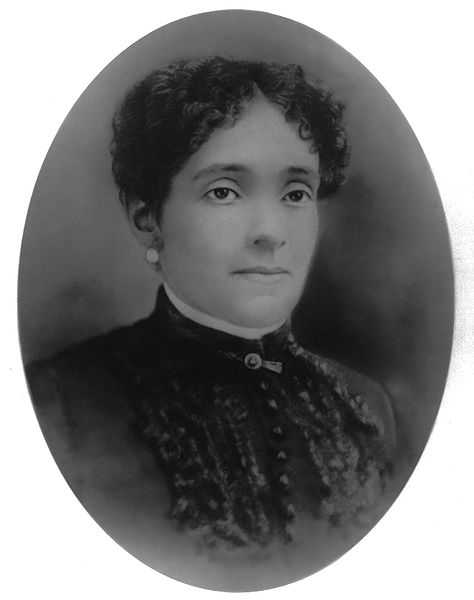
She was fully 5/8ths white.

“Facts in matter of James Lamms Children –

“Joe Horne – Great Grandmother of these children was Ezrit Locas _ She was about [sic] _ I think her father was a white man _ Grandmother was Wealthy Locas Think her father was a white man _ Know mother of children, Jane Lamm. Think her father was a white man _ said to be Van B. Carter _ Father of children James Lamm white _

“H.M. Rowe – Know Ezrit Locas _ she was fully 5/8 white _ her father a white man _ Grandmother is practically white. Her father was a white man. Mother of child, her father was a white man _ Jane Lamm father white _ Jane Lamm Great Grandmother was 5/8 white at least _ Grandmother _ Her father was Dallas Taylor a pure blooded white man _ Mother of child _ Her father pure blooded white man.”

This unsigned handwritten note is found among papers related to the matter of James Lamm v. J.S. Horne, Fred B. Boswell, A.A. Aycock, School Committeemen of Black Creek Township, filed in November Term, 1909, in Wilson County Superior Court.  Lamm complained that his children had been barred from the white public school in Black Creek, though they had attended for many years prior.  Based on the evidence above, a judge determined that the children, though descended from free women of color, were sufficiently white to attend white schools, and so ordered.  School Records, 1909; Wilson County Miscellaneous Records; North Carolina State Archives.

In the 1900 census of Black Creek, Wilson County: James Lamm, born 1837; wife Jane, 1869; and children Robert L., 1890, James C., 1892, Mamie, 1895 and Leona, 1897; all described as white.  Nearby: Wealthy Locas, born 1849, single, mother of eight (six living), and her children Zacariah, 1886, and Fannie, 1890; all black.  

Jane Carter Lamm died 21 February 1945 in Wilson, Wilson County.  Her death certificate lists her parents as Van Carter and Wealthy Joyner, and she is classified as white.

Like all his race, a true union man.

James C. Skinner, Administrator, filed claim #477 on behalf of the estate of Isaac Towlson.  Skinner, age 62, lived in Hertford, Perquimans County.  Elizabeth Towlson, age 62, widow, testified that she lived near Woodville, Perquimans County.  Her husband died in December 1867 and left four children, all born free before the war.  She stated that in July 1864, United States cavalry soldiers took a horse and saddle from her husband.  “My husband was like all his race a true union man.”

Allowed: $140.00.