Fourth Generation Inclusive

Historical Documents of Genealogical Interest to Researchers of North Carolina's Free People of Color

Category: Free Women of Color

An act to emancipate Betty.

An Act to emancipate Betty, a slave

Sec. 1. Be it enacted by the General Assembly of the State of North Carolina, and it is hereby enacted by the authority of the same, That Betty, a slave, the property of Joshua Carman, of Cumberland county, be, and she is hereby emancipated and set free by the consent and at the request of her master, and by the name of Betty Barbee, shall possess and exercise all the rights and privileges of other free persons of color in this State: Provided, nevertheless, that before this act of emancipation shall take effect, the owner of said slave Betty, or some person for him, shall file in the clerk’s office of the court of pleas and quarter sessions of Cumberland county, a bond with good security, in the sum of five hundred dollars, payable to the Governor of the State and his successors in office, that the said Betty shall demean herself correctly while she remains in the State and not become a county charge, which bond may be put in suit in the name of the Governor for the time being, to the use of the county or person injured by a breach of its condition: Provided, that she do not reside out of the county aforesaid, more than thirty days at any time; also that she give bond in such an amount as will be approved of by the county court, that she will not become a public charge. [Ratified the 14th day of February, 1855]

Chapter 108, Private Laws of North Carolina Passed by the General Assembly 1854-55, State Library of North Carolina.

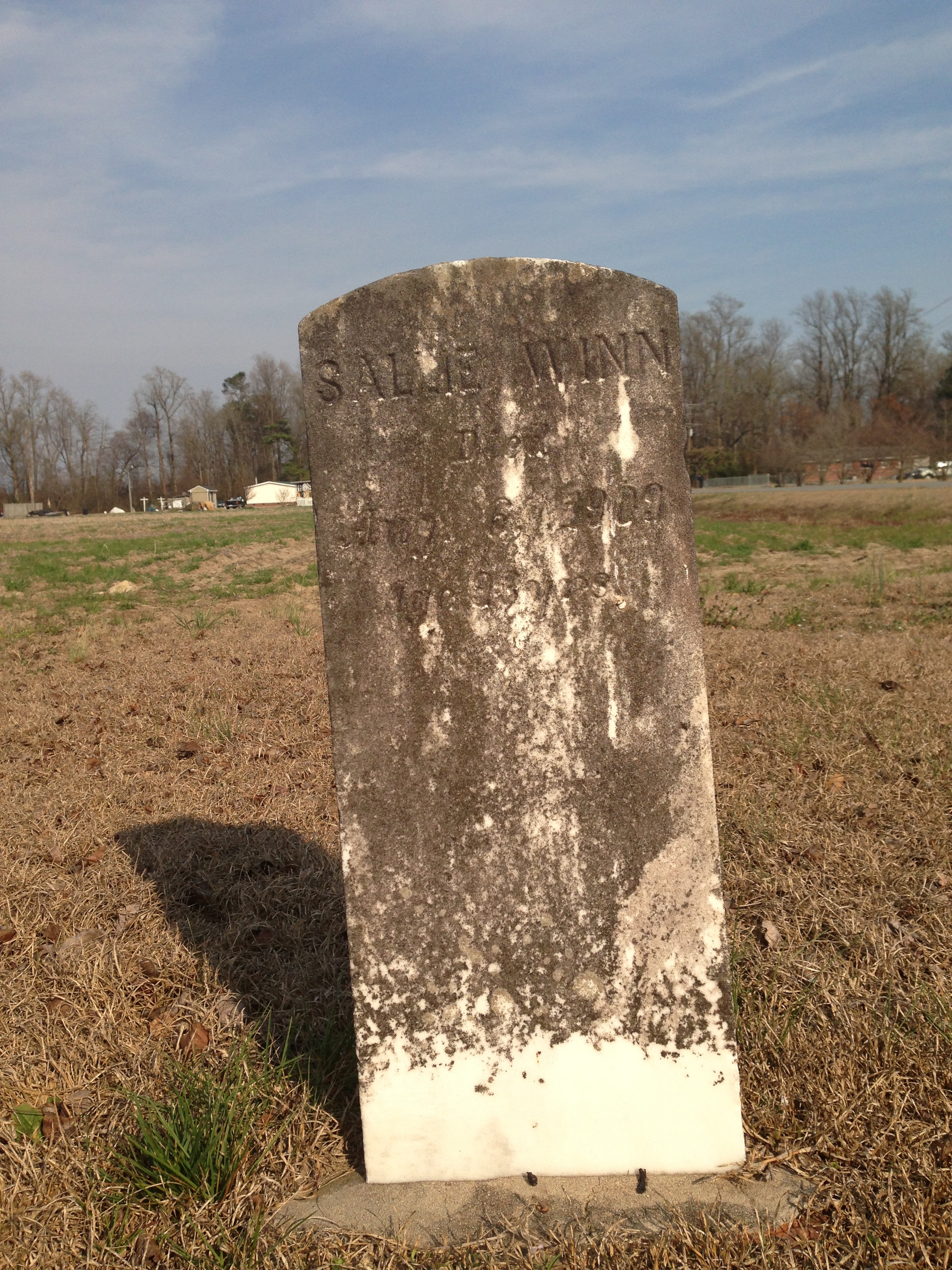
Sarah “Sallie” Greenfield Winn.

Image

SARAH GREENFIELD WINN was born about 1820, probably in southeast Wayne County.  She married Gray Winn about 1835 and was widowed in 1850.  Their children were Elizabeth Winn Simmons, Edward James Winn, Eliza Winn, Penny Winn Simmons, Ally Winn and Washington Francis Winn. She died in 1909 and is buried near her son Edward in a small family graveyard near Dudley in Wayne County.

Photograph by Lisa Y. Henderson, March 2013.

In the 1850 census of South Side of the Neuse, Wayne County: Sally Winn, 30, and children Betsey, 14, Edw’d J., 12, Eliza, 10, Penny, 6, Ally, 4, and Washington, 1.

She put her pretty gold head on his shoulder, and …

An Interview with Adora Rienshaw of 431 South Bloodworth Street, Raleigh.

I wuz borned at Beulah, down hyar whar Garner am now, an’ my parents wuz Cameron an’ Sally Perry. When I wuz a month old we moved ter Raleigh.

We wuz called ‘Ole Issues’, case we wuz mixed wid de whites. My pappy wuz borned free, case his mammy wuz a white ‘oman an’ his pappy wuz a coal-black nigger man. Hit happened in Mississippi, do’ I doan know her name ‘cept dat she wuz a Perry.

She wuz de wife of grandfather’s marster an’ dey said dat he wuz mean ter her. Grandfather wuz her coachman an’ he often seed her cry, an’ he’d talk ter her an’ try ter comfort her in her troubles, an’ dat’s de way dat she come ter fall in love wid him.

One day, he said, she axed him ter stop de carriage an’ come back dar an’ talk ter her. When he wuz back dar wid her she starts ter cry an’ she puts her purtty gold haid on his shoulder, an’ she tells him dat he am her only friend, an’ dat her husban’ won’t eben let her have a chile.

Hit goes on lak dis till her husban’ fin’s out dat she am gwine ter have de baby. Dey says dat he beats her awful an’ when pappy wuz borned he jist about went crazy. Anyhow pappy wuz bound out till he wuz twenty-one an’ den he wuz free, case no person wid ary a drap of white blood can be a slave.

When he wuz free he comed ter Raleigh an’ from de fust I can remember he wuz a blacksmith an’ his shop wuz on Wolcot’s Corner. Dar wuz jist three of us chilluns, Charlie, Narcissus, an’ me an’ dat wuz a onusual small family.

Before de war Judge Bantin’s wife teached us niggers on de sly, an’ atter de war wuz over de Yankees started Hayes’s school. I ain’t had so much schoolin’ but I teached de little ones fer seberal years.

De Southern soldiers burned de depot, which wuz between Cabarrus an’ Davie Streets den, an’ dat wuz ter keep de Yankees from gittin’ de supplies. Wheeler’s Cavalry wuz de meanest troops what wuz.

De Yankees ain’t got much in Raleigh, case de Confederates has done got it all an’ gone. Why fer a long time dar de way we got our salt wuz by boilin’ de dirt from de smoke house floor where de meat has hung an’ dripped.

I’m glad slavery is ober, eben do’ I ain’t neber been no slave. But I tell yo’ it’s bad ter be a ‘Ole Issue.’

In the 1860 census of Raleigh, Wake County: Cameron Perry, 48, blacksmith, wife Sarah, and children Adora, 7, Narcissa, 5, Charley, 3, plus Susan Cuffy, 70, and Henderson Duntson, 21; all mulatto except Susan, whose color designation was left blank.

A good deal of human interest.

There is a good deal of human interest to be found in many of the experiences of these colored slaveholders and in their relations with those whom they held in bondage. Rose Petepher, of the neighborhood of New Bern, N.C., was a free colored woman who was married to a slave named Richard Gasken, who had taken the name of his master. He ran away and was in the woods for years, when his wife finally bought him to take possession. When she could find him this change of owners brought him in at once. They lived together for many years afterward, raising many children whom they hired out just as slaves were hired out. Thus they all prospered. Near the town mentioned above, on their own land, some of the grandchildren are now living and doing well.

Judge William Gasken, who owned the man of whom we have just told, was thrice married, one of his wives being a daughter of Colonel McClure of New Bern. After his death, one of the slaves, Jacob, became the property of Mrs. Gasken. This Jacob’s wife was a free woman, and they had a son Jacob, then a young man and free of course, as the child of a free woman. Aided by his mother’s efforts, he managed to purchase his father at a very reasonable price as negroes were then held. All went smoothly for awhile, when young Jacob did not act as his father thought he should and his parent reproved him with fatherly love. Young Jacob was so disgruntled that he went off to a negro speculator named John Gildersleeve, who was from Long Island and was then in New Bern. This trader bought the father at a high price and at once sent him off south. Young Jacob afterward boasted that “the old man had gone off to the corn fields about New Orleans where they might learn him some manners.”

From Calvin D. Wilson, “Negroes Who Owned Slaves,” Popular Science Monthly, vol. LXXXI (1912).

In the 1850 census of Craven County: Richard Pettiford, 80, wife Rose, 69, children Dinah, 27, and Bryan, 25, and Elizabeth Pettiford, 100. (!!!) (Note that Richard adopted his wife’s surname. Wright Pettiford, 38, living alone nearby may have been another son.)

Perhaps: in the 1850 census of Craven County: Jacob Gaskins, 64, farmer, Penelope Gaskins, 88, Sarah Wiggans, 25, and her children Martha, 5, Elizabeth, 3, and Sabeah, 1 month.

An Act to Emancipate Phillis.

CHAPTER XVIII.

An Act to Emancipate a certain Negro Slave named Phillis, late the Property of George Jacobs, of the town of Wilmington, Deceased.

Whereas it is represented to the General Assembly that the aforesaid George Jacobs, deceased, in his last illness, did earnestly request that his negro slave named Phillis should be liberated for her great attention to her said master during her continuance with him, and more especially for her care and assiduity in his last illness: In order therefore to carry into effect the dying request of the said George Jacobs, deceased:

I. Be it Enacted by the General Assembly of the State of North Carolina, and it is hereby Enacted by the authority of the same, That from and after the passing of this Act, the aforesaid negro woman named Phillis, shall be emancipated and forever discharged from her bondage, in as full and ample manner as if she had been born free; any law, usage or custom to the contrary notwithstanding: And the said negro woman shall forever hereafter be known by the name of Phillis Freeman.

Acts of the North Carolina General Assembly, 1788, Colonial and State Records of North Carolina. 

He wished to go after his wife.

RAN AWAY, From Raleigh on the 25th Instant, A BLACK MAN, by the name of ABRAM about five feet two inches high, well set, and about 40 years of age, a tolerably good Shoemaker and Cooper – at the Shoemaking he has worked the year past with Mr. Joseph G. Bacon of this place. I expect he will make to Murfreesborough in Hertford County, in this State, where he is well known, as he was bro’t to this place by a Mr. Allen Clark, and sold to me in June, 1813. I expect he has a Pass, as I understand he was wishing to get one wrote, as he said he wished to go after his wife Nancy, a free mulatto, who is said to be in the neighbourhood of the Borough with one of her children. – I forewarn all persons from harbouring or employing him in any way, or from carrying him either by land or water, as I shall be under the disagreeable necessity of putting the law in force against all such persons – but will satisfy any reasonable person who may bring him to me, or deliver him in Jail, so that I get him again.  J. SCOTT Raleigh, March 28.

Raleigh Register and North Carolina Weekly Advertiser, 29 March 1816.

Setting free Maria and her four children.

State of North Carolina, New Hanover County  } Court of Pleas & quarter Sessions, June Term 1797

Know all men by these Presents that We John McLellan, George Hooper, Henry Urquhart and John Allan all of the County aforesaid, are held and firmly bound unto his Excellency Samuel Ashe esq’r Governor, Captain General and Commander in Chief in and over the State aforesaid in the just and fill sum of One thousand Pounds, for the which payment will and truly to be made to his Excellency the Governor aforesaid his successors or assigns We do hereby jointly and severally, firmly by these presents, bind our seves and each of us our Heirs Executors and Administrators, Sealed with our Seals and dates as above –

The Condition of the above Obligation is such, that Whereas, the Justices presiding in the Court aforesaid at the Term aforesaid have on the Petition of the aforesaid John McLellan, emancipated and sett free, as fully and amply, as by the Laws of this State they are entitled, a certain female Negroe Slave, belonging to the said John McLellan named Maria and her four Children named William Elizabeth Margaret and Mary; And in case the said female Negroe Slave Maria and her four Children William, Elizabeth, Margaret and Mary or either of them shall not in any manner whatsoever become chargeable to or on this or any other County within this State, then the above Obligation to be void otherwise to remain in full force and Virtue.   /s/ John Mclellan, G. Hooper, Henry Urquhart, John Allan

Signed Sealed & Delivered in presence of /s/ James W. Walker

Slave Records, New Hanover County Records, North Carolina State Archives.

An Act to Emancipate Certain Negroes.

CHAPTER XXXV.

An Act to Emancipate Certain Negroes Therein Mentioned.

Whereas, it hath been represented to this General Assembly, that Robert Shaw, in his life-time, did receive a valuable consideration for the further services of a certain negro woman named Amelia, and has certified the same and declared her to be free: And by petition of Thomas Lovick, it appears to be his desire that a certain negro woman by the name of Betty, belonging to him, should be set free; also a petition of Monsieur Chaponel, desiring to have set free a mulatto slave belonging to him, by the name of Lucy, of three and half years old: And whereas, it appears by the petition of Ephraim Knight, of Halifax county, that he is desirous to emancipate two young mulatto men, called Richard and Alexander, the property of said Ephraim: And it hath also been represented to this Assembly by John Alderson, of Hyde County, that it is his desire to set free a mulatto boy belonging to him, called Sam: And whereas, it hath been made appear to this Assembly by the petition of Thomas Newman, of Fayetteville, that he hath a mulatto boy belonging to him, which he is desirous to emancipate, and known by the name of Thomas:

I. Be it enacted by the General Assembly of the State of North Carolina, and it is hereby enacted by the authority of the same, That the said negro women called Amelia and Betty, and the mulatto girl Lucy, and the said mulatto men Richard and Alexander, and the said mulatto boy called Sam, and the negro boy named Thomas Clinch, shall be, and each of them are hereby emancipated and declared free; and the said Richard and Alexander shall take and use the surname of Day, and the mulatto boy Sam shall be known and called by the name of Samuel Johnson; and the said slaves so liberated, and each of them, are hereby declared to be able and capable in law to posses and enjoy every right, privilege and immunity, in as full and ample manner as they could or might have done if they had been born free.

Acts of the North Carolina General Assembly, 1789, Colonial and State Records of North Carolina.


He was a soldier of the Revolution.

State of North Carolina

Granville County

On this 8th day of November 18 Hundred and Fortytwo (1842) personally appeared before James Cozart — one of the acting Magistrates and a member of the Court of Pleas and Quarter Sessions for said County & State — Abigail Guy the widow of William Guy, a resident of said County & State, aged Eighty years, who having first sworn according to Law, doth on her oath make the following declaration, in order to obtain the benefit of the provision made by the act of Congress passed July 4th, 1836.

That she is the widow of William Guy, who was a Pensioner, that lived in the county of Granville NC, at the rate of Forty Dollars per annum & who was a soldier of the Revolution that served in the Virginia Continental Line that was placed on the pension roll in May 1833.

She further declares that she was married to the said Wm. Guy on the 12th day of June, 17 Hundred and Eighty, and that her husband the aforesaid Wm. Guy died on the 30th day of January 1837.  And that she has remained a widow ever since that Period as will more fully appear above to the proofs here unto annexed.

Sworn and Subscribed before me the day and date first above written before —   Abigail X Guy

James C. Cozart (seal)

The said Abigail Guy is a woman of truth and by old age & and bodily infirmity is unable to attend court to make her Declaration.  James C. Cozart

From the file of William Guy, Revolutionary War Pension and Bounty-Land Warrant Application Files, National Archives and Records Administration.

In the 1830 census of South Regiment, Granville County: William Guy, head of a household consisting of one free man of color.  Listed separately, “Mrs. Guy,” head of a household consisting of one 60-70 year-old white woman.

She mixed his blood with whiskey and drank it.

EX-SLAVE STORY AS TOLD BY MILLIE MARKHAM OF 615 ST. JOSEPH ST., DURHAM, N.C.

I was never a slave. Although I was born somewhere about 1855, I was not born in slavery, but my father was. I’m afraid this story will be more about my father and mother than it will be about myself.

My mother was a white woman. Her name was Tempie James. She lived on her father’s big plantation on the Roanoke River at Rich Square, North Carolina. Her father owned acres of land and many slaves. His stables were the best anywhere around; they were filled with horses, and the head coachman was named Squire James. Squire was a good looking, well behaved Negro who had a white father. He was tall and light colored. Tempie James fell in love with this Negro coachman. Nobody knows how long they had been in love before Tempie’s father found it out, but when he did he locked Tempie in her room. For days he and Miss Charlottie, his wife, raved, begged and pleaded, but Tempie just said she loved Squire. ‘Why will you act so?’ Miss Charlottie was crying. ‘Haven’t we done everything for you and given you everything you wanted?’

Tempie shook her head and said: ‘You haven’t given me Squire. He’s all I do want.’

Then it was that in the dark of the night Mr. James sent Squire away; he sent him to another state and sold him.

But Tempie found it out. She took what money she could find and ran away. She went to the owner of Squire and bought him, then she set him free and changed his name to Walden, Squire Walden. But then it was against the law for a white woman to marry a Negro unless they had a strain of Negro blood, so Tempie cut Squire’s finger and drained out some blood. She mixed this with some whiskey and drank it, then she got on the stand and swore she had Negro blood in her, so they were married. She never went back home and her people disowned her.

Tempie James Walden, my mother, was a beautiful woman. She was tall and fair with long light hair. She had fifteen children, seven boys and eight girls, and all of them lived to be old enough to see their great-grandchildren. I am the youngest and only one living now. Most of us came back to North Carolina. Two of my sisters married and came back to Rich Square to live. They lived not far from the James plantation on Roanoke River. Once when we were children my sister and I were visiting in Rich Square. One day we went out to pick huckleberries. A woman came riding down the road on a horse. She was a tall woman in a long grey riding habit. She had grey hair and grey eyes. She stopped and looked at us. ‘My,’ she said, ‘whose pretty little girls are you?’

‘We’re Squire Walden’s children,’ I said.

She looked at me so long and hard that I thought she was going to hit me with her whip, but she didn’t, she hit the horse. He jumped and ran so fast I thought she was going to fall off, but she went around the curve and I never saw her again. I never knew until later that she was Mis’ Charlottie James, my grandmother.

I don’t know anything about slavery times, for I was born free of free parents and raised on my father’s own plantation. I’ve been living in Durham over sixty-five years.

From Slave Narratives: A Folk History of Slavery in the United States from Interviews with Former Slaves (1841).

Squire Walden married Tempy James on 28 March 1832 in Halifax County. John Keemer was bondsman, and clerk of court J.H. Harwell witnessed. 

In the 1850 census of Northampton County: Squire Walden, 38, laborer, wife Temperance, 34, and children Samuel, 14, William, 13, Amanda, 12, Martha, 11, James, 9, Hester, 8, Peyton, 5, and Whitman, 1, plus William Walden, 78, farmer. All born in NC, except the elder William, who was born in Virginia. All were described as mulatto.