Fourth Generation Inclusive

Historical Documents of Genealogical Interest to Researchers of North Carolina's Free People of Color

Month: April, 2013

Register of (NC-Born) Negroes and Mulattos: Bartholomew County, Indiana, no. 5.

Catharine Hill, age 32, born Perquimans County NC; mulatto woman; 5’3”; small scar over each eye; resided Johnson County IN; witness Joshua A. Horn; registered 20 Mar 1854.

Abraham Augustus Hill, age 2, born Bartholomew County IN; negro boy; “a plump little darkie, and, if nothing happens to prevent will make a big one some day”; resided Johnson County IN; witness Joshua A. Horn; registered 20 Mar 1854.

Andrew Jackson Hill, age 8, born Bartholomew County IN; negro boy; appears sprightly; small scars over left eye and on left cheek; resided Johnson County IN; witness Joshua A. Horn; registered 20 Mar 1854.

Susan Henrietta Hill, age 4, born Bartholomew County IN; negro girl; “a rightly sprightly little girl”; resided Johnson County IN; witness Joshua A. Horn; registered 20 Mar 1854.

Alexander Leevy, age 6, born Robeson County NC; mulatto boy; bright, active and intelligent; no marks; father’s name Louis Leevy; Edward A. Herod; registered 21 Sep 1853.

In the 1860 census of Columbus, Bartholomew County, Indiana: John Blanks, 60, farmer, Milly Blanks, 75, and Eli Blanks, 21, plus Alexander Levy, 14, all born in NC except Milly, who was born in Maryland.

Priscilla Mitchell, age 45, born Halifax County NC; negro woman; hair slightly gray; widow, no children; witness William H.H. Terrell; registered 10 Nov 1853.

Jemima Newby, age 15; born Jackson County IN; negro girl; 5’5”; witness Joshua V. Horn; registered 20 Mar 1854.

Penina Newby; age 50-60; born Perquimans County NC;  5’3”; witness Joshua V. Horn; registered 20 Mar 1854.

John Newby, age 21; born Jackson County IN; negro’ 5’5”; small scar on right forehead and on knuckle of right little finger; witness Joshua V. Horn; registered 20 Mar 1854.
An act to emancipate Jerry.

An Act to emancipate Jerry, a slave.

Sec. 1. Be it enacted by the General Assembly of the State of North Carolina, and it is hereby enacted by the authority of the same, That Jerry, a slave, the property of H.B Williams and S.A. Davis, of Mecklenburg county, be, and he is hereby, with the consent and at the request of his said owner, emancipated and set free; and, by the name of Jerry Bethel, shall hereafter possess and exercise all the rights and privileges which are enjoyed by other free persons of color in this State: Provided nevertheless, that before said slave shall be emancipated, the said Williams and Davis, or either of them, shall give bond and good security, to the Governor and his successors in office, in the county court of Mecklenburg county, in the sum of one thousand dollars, that the said Jerry shall honestly and correctly demean himself as long as he shall remain in the State, and shall not become a county charge; which bond may be sued upon in the name of the governor for the time being, to the use of the said county, and of any person injured by the misconduct of said slave hereby emancipated. [Ratified the 8th day of January, 1855.]

Chapter 108, Public and Private Laws of North Carolina Passed by the General Assembly 1854-55, State Library of North Carolina.

In the 1860 census of Western Division, Mecklenburg County: Jerry Bethel, 45, barber, “manumitted,” wife Mary Bethel, 40, and Robison Reid, 8.  Bethel reported $2300 of real property and $1250 of personal property.

Sentenced to the gallows for stealing a slave.

At the late session of the Superior Court of Currituck County, N.C. a free negro man named Moses FULLER was sentenced to the gallows for seducing and stealing in conjunction with several other persons, a certain negro woman slave, contrary to a statute of the state of North Carolina, making the offense death without benefit of clergy.  He is to be executed on the 29th ins.

Baltimore Patriot & Commercial Gazette, 20 November 1822.

Jesse Jacobs.

Image

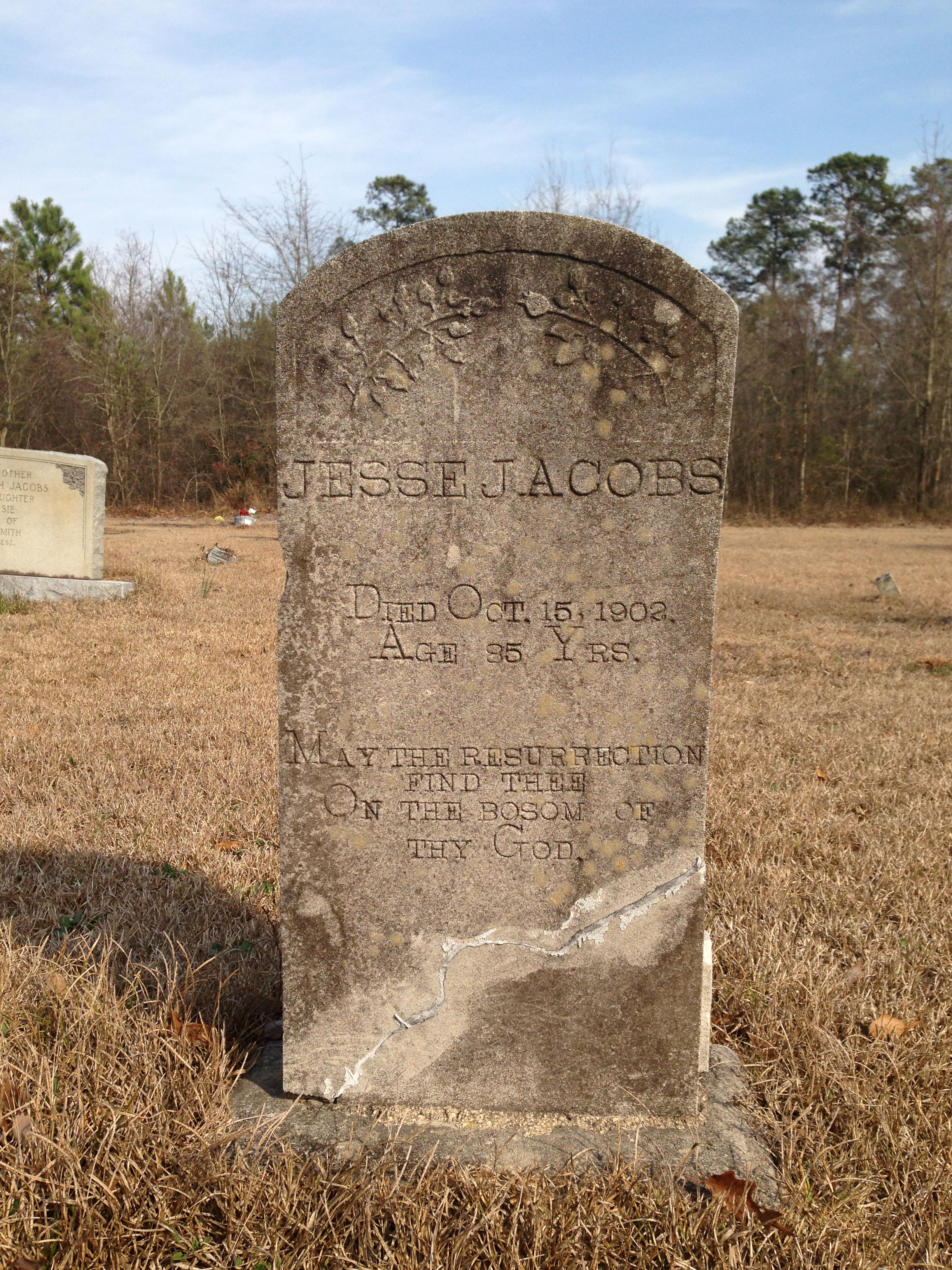
JESSE ADAMS JACOBS (1817-1902) was born in Sampson or Cumberland County. His parentage is unclear. Circa 1845, he married Abigail Gilliam, who may have been white. The family lived in the Honeycutts area of Sampson County until the 1880s, when they migrated a few miles north to Dudley, Wayne County. Their children were: James Edward Jacobs, Elizabeth A. Jacobs Maynor, John R. Jacobs, Martha Jacobs, Solomon Jacobs, Jesse Adams Jacobs Jr., Abigail Jane Jacobs Brewington, and Margaret Frances Jacobs Carter.  Jesse is buried in the cemetery of the First Congregational Church in Dudley. “May the resurrection find thee on the bosom of thy God.”

Photo taken by Lisa Y. Henderson, March 2013.

Joseph C. Price.

Image

Image

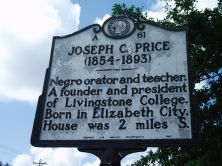
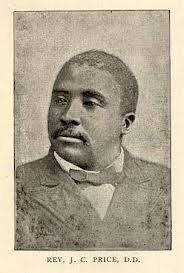
Joseph C. Price was born in Elizabeth City, the child of a free mother and a slave father. When his natural father was sold away, his mother, Emily Pailin, married David Price. In 1863 the Prices moved to New Bern where Joseph was enrolled in St. Andrew’s School, opened by James Walter Hood, later the bishop of the A.M.E. Zion Church. Young Price, though late in beginning his formal education, made exceptional progress. After St. Andrew’s, he attended Cyprian Episcopal School and Lowell Normal School. After completing his own education, he taught in Wilson, becoming the principal at a school there in 1871. In 1873, Price enrolled at Shaw University to study law, but shortly thereafter transferred to Lincoln University (Oxford, Pennsylvania) to prepare for the ministry in the A.M.E. Zion Church. He was valedictorian of his class at Lincoln in 1879 and stayed on at the school to complete the seminary course.

In 1881 Price distinguished himself as an orator, speaking on prohibition and later on education and race issues. On a speaking tour in Europe, Price raised nearly $10,000 to establish a college for blacks in North Carolina. With the additional support of Salisbury residents, he became president of Zion Wesley College in 1882. The name was changed to Livingstone College in 1885. Price gained national attention during his tenure at the college. He was offered a variety of prestigious positions, but chose to remain at Livingstone. In 1890 Price was elected president of the Afro-American League and the National Equal Rights Association.

Price’s promising life ended abruptly October 25, 1893, after he contracted Bright’s disease, a disease affecting the kidneys. He was buried in a mausoleum on the campus of Livingstone College. He was survived by his wife, the former Jennie Smallwood, and their five children, one of whom was yet unborn at the time of her father’s death.

Adapted from http://www.ncmarkers.com

UPDATE, 8 August 2014: Joseph Price’s archives were recently unearthed at a yard sale in Cornelius, North Carolina.

They are very well known.

$200 Reward. Ranaway from the subscriber, on the 22nd inst., FOUR NEGRO BOYS, named as follows: CHARLES WINN, aged about 24; WILLIAM, aged about 17 years; JOHN, aged 14 years; JIM, aged about 12 years.

The above boys are very well known as the children of Adam Winn. I think they intend trying to get to some free state. The above reward will be given for their delivery, or for their confinement in any jail in the State.   THOMAS BENNETT. Mt. Olive, Wayne co., July 25, 1854.

Fayetteville Observer, 3 August 1854.

[Sidenote: Adam Winn was a free man. Several of his sons were slaves. — LYH]

They had to leave home more than 100 times.

THE EFFECTS OF SLAVERY ON THE FREE COLORED PEOPLE OF THE SOUTH. – Mary Morgan, of No. 59 King-Street, New-York, widow of James Morgan, who died in the spring of 1834, with the small pox, says that she and her husband owned a farm of 250 acres of land in Pasquotank County, about five or six miles from Elizabeth City, North Carolina; that they had hogs, cattle, and horses, and were well to live; that they were both born free, as were both their parents; that as many as six or seven years ago [before they had been provoked to it by northern abolition] a number of the lower class of the whites went about the country to disturb the free colored people; that they frequently came to their dwelling, broke their table, and cups, and saucers, and beat James Morgan a number of times, sometimes with a club, at other times with a cowhide, and at one time so severely that his life was despaired of.

Some of the better class of whites called at the house, and said they thought he was so badly hurt he could not live. For a fortnight after, he was not able to cut a stick of wood. Seven places on his head were shaved to put on plasters, and his back and legs were also much bruised. So frequently were they attacked, that they had to leave their dwelling more than one hundred times, often in showers of rain. At one time, Mary was put on horseback, behind one of the ruffians, who rode off violently for about a mile, took her off, and placed her in a mud puddle up to her waist, in a dark night, and there left her to get as she could. These things happened so frequently that the Friends, commonly called Quakers, (who were really friends to them,) advised them to sell their property and come to the North. Those who caused them to suffer, gave no other reason for their conduct than that they were free negroes, and ought to go to the North, and that there was no law for free negroes in Carolina. Joseph Elliott, Thomas Elliott, and Aaron Elliott, of the society of Friends, were their near neighbors, and were often very kind to them, and did their best to prevent the abuse. Miles White, a merchant of Elizabeth city, knows this statement to be true; other free colored people of that neighborhood suffered pretty much in the same way. They came to New-York, where her husband was taken sick and died; Mary and the children were taken to the Almshouse, where they staid about seven weeks, and were then turned out, penniless, and had it not been for the charity of some humane persons, they might have perished from want.

The farm in Carolina was sold for the small sum of $350, which was soon eaten up by the expense of coming to New-York, and the maintenance of the family while here.

Mary Morgan has to support, by day’s work, five small children. The friends of the oppressed, who have any sympathy to spare, will do well to render her some assistance – at least, by furnishing her with work.  No. 59 King street is her residence.

The First Annual Report of the New York Committee of Vigilance (1837).

No. 1 negro woman takes up with free negro man.

$100 Reward

Ranaway from Mr. N. Carpenter, on the Charlotte Rail Road, near Brown Marsh, in November last, my negro Girl BELL.  The said girl is a No. 1 negro, about 5 feet 6 or 8 inches high, very well put up, and with a smooth black skin.

She is supposed to have taken up with a free negro man in the Brown Marsh neighborhood. I will give the above reward for her delivery to me in Fayetteville, or $50 for her confinement in any jail so that I can get her.   James P. Robertson. Jan. 23.

Fayetteville Observer, 26 January 1863.

He built a house in this gap.

Footnote 41. Ambrose Gap is a few miles southwest [of Cut Laurel gap], and is so called because a free negro of that name built a house across the State line in this gap, and when he died his grave was dug half in Tennessee and half in North Carolina, according to local tradition. 

From John Preston Arthur, Western North Carolina: A History, 1730-1913 (1914).

To prevent him being sold into slavery.

Chap. 486.

AN ACT to remunerate James Bennett for expenses incurred and services rendered in procuring the release of Anthony Adams, a colored citizen of this State, from imprisonment in the jail of Edenton, North Carolina, to prevent him being sold into slavery.

Passed April 15, 1857, three-fifths being present.

The People of the State of New-York, represented in Senate and Assembly, do enact as follows:

SECTION 1. The treasurer shall pay on the warrant of the comptroller, out of any moneys in the treasury not otherwise appropriated, to James Bennett, the sum of two hundred and sixty-eight dollars, being four dollars per diem for eighteen days service, and for moneys expended in procuring the release of Anthony Adams, a free colored citizen of the town of Deerpark, county of Orange, state of New-York, from the jail of Edenton, state of North Carolina, where he was confined.

Sec.2. This act shall take effect immediately.

Laws of the State of New-York Passed at the Eightieth Session of the Legislature, Vol. II (1857).