Fourth Generation Inclusive

Historical Documents of Genealogical Interest to Researchers of North Carolina's Free People of Color

Tag: Fayetteville

Find her mother and send her Wilmington!

Fayetteville, No. Carolina, Aug. 21st, 1792

Sir:

On my way to Charleston, I came across a free girl in this place, by the name of Sally Valentine. Her mother lives, I believe, in Norfolk by the name of Amy Valentine; she was stolen from that place about eight years ago by Jacob Abraham, a Butcher, and one James Bishop, and brought to this place and sold as a slave. I am well acquainted with the girl – having lived with my mother about three years. I apply’d to a Magistrate to get her liberated by my testimony and the testimony of a Lady in this place, who has known the girl ever since her birth, and is also well acquainted with her mother, but the magistrate informed me he could do nothing before Court, which is next October; and as it will not be in my power to be hear then, beg the favour of you to find out her mother if possible, and send her to Wilmington by water – from whence she can easily get to this place, and it will be necessary she should bring credentials of her freedom, and by which means she may recover her child. These people brought of some other young negroes at the same time, which in all probability are either free or stolen from their masters.

The people that have this girl in possession treat her in the most barbarous manner. If you will write to Mr. John Nevison or Doct’r Taylor at Norfolk to this effect, I make no doubt they will interest themselves in the affair, as they know the mother, and I believe the Daughter, and it will, I hope, be a means of bringing the villains to Justice. As soon as you can get any information respecting the matter, please write to Mr. Lee DeKeyson, of this place, who has promised me to see the Girl Justice done. Knowing your humanity and desire to do Justice, makes me trouble you on this occasion.

I am, sir, with Respect, Y’r ob’t Servant, DAVID MILLER

Col. Champion Travis, W’msburg, Va.

From Sherwin McRae, ed., Calendar of Virginia State Papers … from August 11, 1792, to December 31, 1793, v. 6 (1886).

For more on this crime, see http://www.norfolkhistory.com/Abrahams
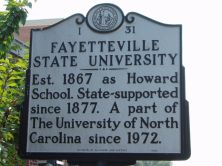
 

Fayetteville State founders.

Image

Fayetteville State University, now part of the University of North Carolina system, was the first normal school for African Americans in North Carolina. The university’s founding dates to 1867, when David A. Bryant, Nelson Carter, Andrew J. Chestnutt, George Grainger, Matthew Leary, Thomas Lomax and Robert Simmons paid $140 for a lot on Fayetteville’s Gillespie Street and named themselves into a board of trustees to maintain the property as a permanent site for the education of black children. General O. O. Howard, an early supporter of black education, erected a building on the site, and the school was named the Howard School in his honor.

The education center was chartered by the legislature as the State Colored Normal School in 1877. In 1880 Charles W. Chesnutt was appointed principal of the school after the death of principal Robert Harris. Chesnutt served the institution for three years before resigning and moving to Cleveland, Ohio.

Ezekiel Ezra Smith was appointed as Chestnutt’s replacement in 1883. E. E. Smith had a long and distinguished career at the school. During his span as principal (and eventually president) at the institution, he served in a host of other positions. Smith was appointed Minister Resident and Consul General of the U. S. to Liberia by President Grover Cleveland in 1888. George H. Williams assumed the duties of principal in Smith’s absence. After serving in Liberia for two years, Smith returned to North Carolina to organize the state’s first newspaper for African-Americans, The Carolina Enterprise, in Goldsboro. During Smith’s tenure, he saw the school the school move to its permanent location on Murchison Road in 1907. The high school curriculum was discontinued by the state in 1929 and Smith’s title change to president. He retired in 1933.

Adapted from http://www.ncmarkers.com.

In the 1850 census of Fayetteville, Cumberland County: Angus Carter, 45, boatman, wife Dezda, 38, and children Nelson, 16, Angus, 15, John, 13, Margaret A., 12, Betsy, 10, Jane, 8, Alonzo, 5, Mellissa, 2, and Ann, 2 months.

In the 1850 census of Fayetteville, Cumberland County: John Terry, 13, Ellen Terry, 16, Sally Lucus, 12, and Thos. Lomack, 18, in the household of Jesse W. Powers, merchant.

In the 1850 census of Eastern Division, Cumberland County: Griscilla Simmons, 35, Robert, 12, Samuel, 8, and Mary A., 2.

She is probably with her mother. Or a free negro.

$20 REWARD. Ranaway from the subscriber, on the evening of the 18th inst., a mulatto woman by the name of LUCY. Said woman is about 23 years old, slender frame, but now quite corpulent, of ordinary bright, and will probably weight 120 to 140 lbs., short hair, with rather a bony face, and is quite intelligent.

Said woman is probably harbored by her mother, owned by J.A. Worth, and Bill Bruinton, a free negro, with whom she has been very intimate. I will pay the above reward of $20 if she is delivered to me or lodged in the Jail of this County, or I will pay $50 if she is taken in any other county and confined in the Jail of the same.  JNO. D. WILLIAMS. Fayetteville, July 12, 1862.

Fayetteville Observer, 4 August 1862.

———-

Ranaway, a mulatto woman by the name of LUCY, about 23 years old, of medium size, but now quite corpulent.

Said woman is probably in or near Town, but may have been led off in the direction of Newbern by Bill Bruinton, a free mulatto man who has been at work as a Carpenter probably on the Wilmington & Weldon Railroad at a Depot North of Warsaw. I will pay $25 for the delivery of the girl to me or lodged in Jail in town, if found in this County, or $50 if said girl is found in any other County and confined in the Jail of the same, the party arresting giving me early information of the same.  JNO. D. WILLIAMS. Fayetteville, Aug, 25, 1862.

Fayetteville Observer, 14 November 1862.

An Act to Emancipate Certain Negroes.

CHAPTER XXXV.

An Act to Emancipate Certain Negroes Therein Mentioned.

Whereas, it hath been represented to this General Assembly, that Robert Shaw, in his life-time, did receive a valuable consideration for the further services of a certain negro woman named Amelia, and has certified the same and declared her to be free: And by petition of Thomas Lovick, it appears to be his desire that a certain negro woman by the name of Betty, belonging to him, should be set free; also a petition of Monsieur Chaponel, desiring to have set free a mulatto slave belonging to him, by the name of Lucy, of three and half years old: And whereas, it appears by the petition of Ephraim Knight, of Halifax county, that he is desirous to emancipate two young mulatto men, called Richard and Alexander, the property of said Ephraim: And it hath also been represented to this Assembly by John Alderson, of Hyde County, that it is his desire to set free a mulatto boy belonging to him, called Sam: And whereas, it hath been made appear to this Assembly by the petition of Thomas Newman, of Fayetteville, that he hath a mulatto boy belonging to him, which he is desirous to emancipate, and known by the name of Thomas:

I. Be it enacted by the General Assembly of the State of North Carolina, and it is hereby enacted by the authority of the same, That the said negro women called Amelia and Betty, and the mulatto girl Lucy, and the said mulatto men Richard and Alexander, and the said mulatto boy called Sam, and the negro boy named Thomas Clinch, shall be, and each of them are hereby emancipated and declared free; and the said Richard and Alexander shall take and use the surname of Day, and the mulatto boy Sam shall be known and called by the name of Samuel Johnson; and the said slaves so liberated, and each of them, are hereby declared to be able and capable in law to posses and enjoy every right, privilege and immunity, in as full and ample manner as they could or might have done if they had been born free.

Acts of the North Carolina General Assembly, 1789, Colonial and State Records of North Carolina.


Apprentice barber runs away.

DESERTED From my service on the night of the 24th inst. a free man of color named WILLIE ROD, bound to me as an apprentice to the Barbers trade.  He is about five feet six inches high, of a pleasing countenance, and about 24 or 25 years old.  I will give Five Dollars Reward and pay all expense for his delivery to me in Fayetteville or committed to Raleigh Jail. I expect he is lurking about Raleigh.  — EPHRAIM HAMMONS, Fayetteville, Oct. 26, 1814.

The Star, Raleigh, 28 October 1814.

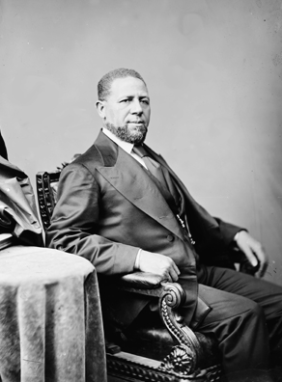
Hiram Rhodes Revels.

Image

Hiram Rhodes Revels was the first person of color to serve in the United States Congress.

Revels was born free in 1827 in Fayetteville, North Carolina. In 1838 he moved to Lincolnton, North Carolina to apprentice in his brother Elias B. Revels’ barber shop. After attending seminary in Indiana and Ohio, Revels was ordained as a minister in the African Methodist Episcopal Church in 1845 and served as a preacher and religious teacher throughout the Midwest.

Revels served as a chaplain in the United States Army during the Civil War and helped recruit and organize black Union regiments in Maryland and Missouri. He took part at the battle of Vicksburg in Mississippi. In 1865, Revels left the AME Church and joined the Methodist Episcopal Church. In 1866, he was given a permanent pastorship in Natchez, Mississippi, where he settled with his wife and five daughters, became an elder in the Mississippi District, continued his ministerial work, and founded schools for black children.

In 1869, Revels was elected to represent Adams County in the Mississippi State Senate. In 1870 he was elected to finish the term of one of the state’s two United States Senators, vacant since Mississippi seceded from the Union.

When Revels arrived in Washington, Southern Democrats opposed seating him in the Senate, basing their arguments on the Dred Scott decision, which ruled that people of African ancestry were not and could not be citizens. Because no black man was a citizen before the 14th Amendment was ratified in 1868, they argued, Revels could not satisfy the requirement for nine years’ prior citizenship.

Revels’ supporters of Revels made a number of arguments, including: (1)  that Revels was of mixed black and white ancestry (an “octoroon”) and the Dred Scott decision applied only to blacks who were of purely African ancestry; (2) that Revels had been  considered a citizen (and indeed had voted in Ohio) before Dred Scott; and (3) that the Civil War and the Reconstruction Amendments had voided Dred Scott. On February 25, 1870, Revels, on a strict party-line vote of 48 to 8, became the first black man to be seated in the United States Senate.

Revels resigned two months before his term expired to accept appointment as the first president of Alcorn Agricultural and Mechanical College (now Alcorn State University). In 1873, Revels took a leave of absence from Alcorn to serve as Mississippi’s secretary of state ad interim.  He died on January 16, 1901.

Adapted from Wikipedia. 

In the 1850 census of Cambridge City, Wayne County, Indiana: Robert Freeman, 34, laborer, born Virginia; Jane Freeman, 30, born Virginia; Malinda Freeman, 14, born Ohio; Hannah, 13, William H., 10, Robert, 4, and Margaret Freeman, 3, all born in Indiana; Charles Guinea, 18, born Virginia; and Hiram Revels, 25, and wife Phebe Revels, 17, both born in NC.

In the 1860 census of Ward 11, Baltimore, Baltimore County, Maryland: Hiram Revels, 35, Prest’n clergyman O.S., born North Carolina; wife Phoebe, 25, born Ohio; Elizabeth, 5, and Emma Revels, 3 months, born in Maryland; and Mary Brooks, 16, born in Maryland.

The freed man frees. Maybe.

M.N. Leary, Executor, v. S.W. Nash and others, 56 NC 356 (1857)

This case the Court of Equity of Cumberland County and involved the interpretation of a Solomon W. Nash‘s will.  The clause at issue:

Item 6. “I further leave my negro slave woman Venice, to serve my daughters ten years from the time of my death, and after the expiration of that time, I desire her to be freed; and if she wishes to remove to any free State, I wish her to be permitted to do so; and if she may be permitted to remain in North Carolina, that she may enjoy all the privileges that can be, or may be, allowed by law to slaves left by their masters or mistresses to be freed. The way I desire Venice to serve my daughters is, for her to be hired out for the term of ten years, and the proceeds of the same to be equally divided amongst them.”

Venice had no children at the time the will was made, but later had two, Jack and Festus. Executor Matthew N. Leary asked the court (1) if Venice was entitled to freedom and, if so, under what terms and (2) if Jack and Festus were entitled to freedom. The court was also asked if John Nash, born after his father made his will, was entitled to any of the estate.

The decision:

1. John, who was born after Nash made the will, but before his death, was entitled to a filial portion.

2. Venice can elect either to leave the State and be emancipated, or to remain here as a slave.

3. Venice’s two children, born after the will was made, are slaves. “There is no ground upon which they are entitled to their freedom” because Nash did not include Venice’s future increase in his bequest.

Ruptured, but faithful.

State of North Carolina, Cumberland County   }  I Thomas J. Robeson Lately a Major 4th Rifle Reg’t United States Army, now resident in the Town of Fayetteville, county and State aforesaid Do hereby certify that corporal Josiah Abshier (a man of coulor) now resident in Anson county and State of North Carolina, was a corporal of the Poineirs and attached to Capt. Parkers company 3rd Rifle Regiment United States Army under Lieut Col’o Wm. S. Hambleton on a march from Camp Bottoms Bridge Below Richmond Va. to Washington City (green leaf Point) Maryland.   That at or near Alexandra Va in January A.D. 1815 while in the actual performance of his duty on a march [illegible] did fall from one of the Bagage Wagons thereby became Ruptured and was in consequence [illegible] from the Army of the United States, as Invalid. I further certify that I did march with the 3rd Rifle Regiment from Charlotte No Ca in the winter A.D. 1814 to Washington city as aforesaid that during the Said march & while in quarters that the said Corporal Josiah Abshier did faithfully perform his duty as Corporal and Soldier of the United States Army, and deserve the aid of his Country; that the said corporal Abshier is now in the fifty Six year of his age,  and So disabled by the Ruptor as aforesaid to provent him from Manual Labour. Given under my hand in Fayetteville this 15th December 1825. Thomas L. Robeson Lately Major 4th Rifle Reg’t U.S.A.

File of Josiah Abshier, War of 1812 Pension & Bounty Land Warrant Application Files, National Archives and Records Administration.

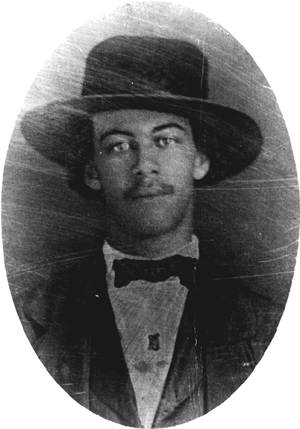
Lewis Sheridan Leary.

Image

Lewis Sheridan Leary (1835–1859), a harnessmaker from Oberlin, Ohio, joined John Brown’s unsuccessful raid on Harpers Ferry, where he was killed.  Leary was born in Fayetteville, North Carolina, to Matthew N. Leary, also a harnessmaker, and Julia Memril Leary.  His paternal grandfather was an Irishman, Jeremiah O’Leary, who fought in the American Revolution under General Nathanael Greene. A paternal great-grandparent, Abram Revels, a free man of color, was also a Revolutionary War veteran. His mother’s grandmother was “French Mary,” a freed West Indian who was a well-regarded cook in Fayetteville.

In the mid-1850s, Leary moved to Oberlin, Ohio, where two of his sisters had settled. One sister, Sarah, had married Henry Evans, whose sister Delilah Evans Copeland, the mother of John A. Copeland Jr., another John Brown follower.  Leary married Oberlin College graduate Mary Patterson, and had a daughter, Louise.  Leary became involved with abolitionists in Oberlin, which had an active community. Later, he met John Brown in Cleveland, Ohio.

In 1858, Leary joined in the Oberlin-Wellington Rescue, when fugitive slave John Price was forcibly taken from the custody of a U.S. Marshal to prevent his being returned to slavery . He was not among the 37 men (twelve of them free men of color) who were indicted and jailed for their actions.

Accompanied by Copeland, Leary joined John Brown at Chambersburg, Pennsylvania.  Leary died eight days after the attack on Harper’s Ferry from wounds suffered in the conflict. Copeland was captured, tried and later executed.

Leary’s family remained in Fayetteville during the Civil War.  During Reconstruction, his father and a brother served as city councilmen and county commissioners, and his brother Matthew Leary Jr. was an early trustee of the college that became Fayetteville State University. Leary’s youngest brother, John Sinclair Leary, graduated from Howard University in 1871 and was one of the earliest black attorneys admitted to the bar in North Carolina. He served in the state legislature for two terms as a Republican representative for Cumberland County during Reconstruction, and in 1884 was sent as a delegate to the National Republican Convention. He later founded and served as the first dean of the Shaw University Law School, and in the 1890s moved his family and practice to Charlotte. Today the Charlotte chapter of the North Carolina Association of Black Lawyers is named the John S. Leary Bar Association in his honor.

 Adapted from Tar Heels at Harper’s Ferry, October 16-18, 1859,”  http://www.nccivilwar150.com/history/john-brown-nc.htm, published by the North Carolina Department of Cultural Resources.

Photograph, c. 1850s, courtesy of Oberlin College Archives, Oberlin, Ohio.

In the 1860 census , Fayetteville, Cumberland: Matthew Leary, 48, wife Julia A., 42, Matthew, 17, Lewis S., 15, Julia A., 12, John S., and Mary E., 13.

Runaway bound boy, no. 4.

$10 Reward.  WILL be paid for the apprehension and delivery to me of HENRY ALONZO, a mulatto free boy, about 16 years of age.  He is bound to me as an apprentice.  I hereby forewarn all persons from harboring said boy.  H. WHALBY.  Fayetteville, Jan’y 1, 1864.

Fayetteville Observer, 11 January 1864.