Fourth Generation Inclusive

Historical Documents of Genealogical Interest to Researchers of North Carolina's Free People of Color

An Act to Emancipate Certain Negroes.

CHAPTER XXXV.

An Act to Emancipate Certain Negroes Therein Mentioned.

Whereas, it hath been represented to this General Assembly, that Robert Shaw, in his life-time, did receive a valuable consideration for the further services of a certain negro woman named Amelia, and has certified the same and declared her to be free: And by petition of Thomas Lovick, it appears to be his desire that a certain negro woman by the name of Betty, belonging to him, should be set free; also a petition of Monsieur Chaponel, desiring to have set free a mulatto slave belonging to him, by the name of Lucy, of three and half years old: And whereas, it appears by the petition of Ephraim Knight, of Halifax county, that he is desirous to emancipate two young mulatto men, called Richard and Alexander, the property of said Ephraim: And it hath also been represented to this Assembly by John Alderson, of Hyde County, that it is his desire to set free a mulatto boy belonging to him, called Sam: And whereas, it hath been made appear to this Assembly by the petition of Thomas Newman, of Fayetteville, that he hath a mulatto boy belonging to him, which he is desirous to emancipate, and known by the name of Thomas:

I. Be it enacted by the General Assembly of the State of North Carolina, and it is hereby enacted by the authority of the same, That the said negro women called Amelia and Betty, and the mulatto girl Lucy, and the said mulatto men Richard and Alexander, and the said mulatto boy called Sam, and the negro boy named Thomas Clinch, shall be, and each of them are hereby emancipated and declared free; and the said Richard and Alexander shall take and use the surname of Day, and the mulatto boy Sam shall be known and called by the name of Samuel Johnson; and the said slaves so liberated, and each of them, are hereby declared to be able and capable in law to posses and enjoy every right, privilege and immunity, in as full and ample manner as they could or might have done if they had been born free.

Acts of the North Carolina General Assembly, 1789, Colonial and State Records of North Carolina.
 

Apprentice barber runs away.

DESERTED From my service on the night of the 24th inst. a free man of color named WILLIE ROD, bound to me as an apprentice to the Barbers trade.  He is about five feet six inches high, of a pleasing countenance, and about 24 or 25 years old.  I will give Five Dollars Reward and pay all expense for his delivery to me in Fayetteville or committed to Raleigh Jail. I expect he is lurking about Raleigh.  — EPHRAIM HAMMONS, Fayetteville, Oct. 26, 1814.

The Star, Raleigh, 28 October 1814.

Lurking about John Stanly’s.

20  Dollars REWARD

RAN AWAY, from the subscriber, at Smith’s Creek, on the 23d of July last, his Negro Man SAM, He is about twenty years of age, black complexion, likely appearance, and has a pleasant look, — Has a scar, occasioned by a cut, on or near one of his knees.  SAM was at the late Camp Meeting, at Adams’ Creek, whence he ran away, after having been flogged for stealing several different articles.  It is supposed he is lurking about the plantation of Mr. John C. Stanly and between there and Kinston, near which place he has a sister. — The above reward will be paid on his being delivered at, the Jail in Newbern, or at any Jail, so that I get him.  GIDEON CARRAWAY. August 26th, 1820.

Carolina Centinel, New Bern, 26 August 1820.

He was a soldier of the Revolution.

State of North Carolina

Granville County

On this 8th day of November 18 Hundred and Fortytwo (1842) personally appeared before James Cozart — one of the acting Magistrates and a member of the Court of Pleas and Quarter Sessions for said County & State — Abigail Guy the widow of William Guy, a resident of said County & State, aged Eighty years, who having first sworn according to Law, doth on her oath make the following declaration, in order to obtain the benefit of the provision made by the act of Congress passed July 4th, 1836.

That she is the widow of William Guy, who was a Pensioner, that lived in the county of Granville NC, at the rate of Forty Dollars per annum & who was a soldier of the Revolution that served in the Virginia Continental Line that was placed on the pension roll in May 1833.

She further declares that she was married to the said Wm. Guy on the 12th day of June, 17 Hundred and Eighty, and that her husband the aforesaid Wm. Guy died on the 30th day of January 1837.  And that she has remained a widow ever since that Period as will more fully appear above to the proofs here unto annexed.

Sworn and Subscribed before me the day and date first above written before —   Abigail X Guy

James C. Cozart (seal)

The said Abigail Guy is a woman of truth and by old age & and bodily infirmity is unable to attend court to make her Declaration.  James C. Cozart

From the file of William Guy, Revolutionary War Pension and Bounty-Land Warrant Application Files, National Archives and Records Administration.

In the 1830 census of South Regiment, Granville County: William Guy, head of a household consisting of one free man of color.  Listed separately, “Mrs. Guy,” head of a household consisting of one 60-70 year-old white woman.

Not considered white.

61 N.C. Confederate Levi Cummings.  Cap’t Francis D. Koonce’s Co. (Koonce’s State Guerillas) N.C. Volunteers. Appears on Company Muster-In and Descriptive Roll of the organization named above. Dated Jones County, July 22, 1862. Born Duplin Co., N.C. Age 26. Laborer. Enlisted July 14, 1862 in Jones County by F.D. Koonce.  … Note: This company is mustered in the service of the State of North Carolina as “guerillas” for local service, to operate east of the Wilmington & Weldon Rail Road, between the Neuse and Cape Fear Rivers.

———-

61 N.C. Confederate Levi Cummings.  Pvt. Co. K, 61 Reg’t N.C. Inf. (State Troops). Cap’t Francis D. Koonce’s Co. (Koonce’s State Guerillas) N.C. Volunteers. Appears on Company Muster Roll of the organization named above. Dated May and June 1863. Enlisted August 30, 1862, Jones County, by Capt. Koonce. Last paid by Capt. Anderson, April 30, 1863. “Detailed as ambulance driver.”

———-

61 N.C. Confederate Levi B. Cummings. Pvt. Co. K, 61 Reg’t N.C. Inf. (State Troops). Cap’t Francis D. Koonce’s Co. (Koonce’s State Guerillas) N.C. Volunteers. Appears on Company Muster Roll of the organization named above. Dated July and August 1863. Enlisted August 30, 1862, Jones County, by Capt. Koonce for 3 years. “Not considered white and dropped by order.”

Compiled Service Records of Confederate Soldiers Who Organized For the State of North Carolina, National Archives and Records Administration.

In the 1850 census of North Division, Duplin County: James C. Cummings, 47, farmer, wife Rebecca, 42, and children Levi W., 13, John J., 11, Betsey A., 9, Sarah L., 7, and Mary J., 5, all mulatto.

In the 1860 census of Tuckahoe, Jones County: Levi Commins, 20, and sister Sallie, 15; described as black.

In the 1870 census of Tuckahoe, Jones County: Levi Cummings, 34, mulatto, cooper.

In the 1880 census of Richlands, Onslow County: Levi Cummings, 50, works on farm, wife Caroline, 25, and children William H., 9, Minnie J., 6, and Lydia A., 2.  Levi is described as mulatto; his wife and children, as white.

She mixed his blood with whiskey and drank it.

EX-SLAVE STORY AS TOLD BY MILLIE MARKHAM OF 615 ST. JOSEPH ST., DURHAM, N.C.

I was never a slave. Although I was born somewhere about 1855, I was not born in slavery, but my father was. I’m afraid this story will be more about my father and mother than it will be about myself.

My mother was a white woman. Her name was Tempie James. She lived on her father’s big plantation on the Roanoke River at Rich Square, North Carolina. Her father owned acres of land and many slaves. His stables were the best anywhere around; they were filled with horses, and the head coachman was named Squire James. Squire was a good looking, well behaved Negro who had a white father. He was tall and light colored. Tempie James fell in love with this Negro coachman. Nobody knows how long they had been in love before Tempie’s father found it out, but when he did he locked Tempie in her room. For days he and Miss Charlottie, his wife, raved, begged and pleaded, but Tempie just said she loved Squire. ‘Why will you act so?’ Miss Charlottie was crying. ‘Haven’t we done everything for you and given you everything you wanted?’

Tempie shook her head and said: ‘You haven’t given me Squire. He’s all I do want.’

Then it was that in the dark of the night Mr. James sent Squire away; he sent him to another state and sold him.

But Tempie found it out. She took what money she could find and ran away. She went to the owner of Squire and bought him, then she set him free and changed his name to Walden, Squire Walden. But then it was against the law for a white woman to marry a Negro unless they had a strain of Negro blood, so Tempie cut Squire’s finger and drained out some blood. She mixed this with some whiskey and drank it, then she got on the stand and swore she had Negro blood in her, so they were married. She never went back home and her people disowned her.

Tempie James Walden, my mother, was a beautiful woman. She was tall and fair with long light hair. She had fifteen children, seven boys and eight girls, and all of them lived to be old enough to see their great-grandchildren. I am the youngest and only one living now. Most of us came back to North Carolina. Two of my sisters married and came back to Rich Square to live. They lived not far from the James plantation on Roanoke River. Once when we were children my sister and I were visiting in Rich Square. One day we went out to pick huckleberries. A woman came riding down the road on a horse. She was a tall woman in a long grey riding habit. She had grey hair and grey eyes. She stopped and looked at us. ‘My,’ she said, ‘whose pretty little girls are you?’

‘We’re Squire Walden’s children,’ I said.

She looked at me so long and hard that I thought she was going to hit me with her whip, but she didn’t, she hit the horse. He jumped and ran so fast I thought she was going to fall off, but she went around the curve and I never saw her again. I never knew until later that she was Mis’ Charlottie James, my grandmother.

I don’t know anything about slavery times, for I was born free of free parents and raised on my father’s own plantation. I’ve been living in Durham over sixty-five years.

From Slave Narratives: A Folk History of Slavery in the United States from Interviews with Former Slaves (1841).

Squire Walden married Tempy James on 28 March 1832 in Halifax County. John Keemer was bondsman, and clerk of court J.H. Harwell witnessed. 

In the 1850 census of Northampton County: Squire Walden, 38, laborer, wife Temperance, 34, and children Samuel, 14, William, 13, Amanda, 12, Martha, 11, James, 9, Hester, 8, Peyton, 5, and Whitman, 1, plus William Walden, 78, farmer. All born in NC, except the elder William, who was born in Virginia. All were described as mulatto.


Porch detained.

Ordered that Francis McBride be cited to appear at this court tomorrow to show cause if any he can why he detains a mulatto boy named porch in his service when it is supposed he ought to have his freedom.

Minutes, August Term 1781, Court of Pleas and Quarter Sessions, Guilford County Records, North Carolina State Archives.

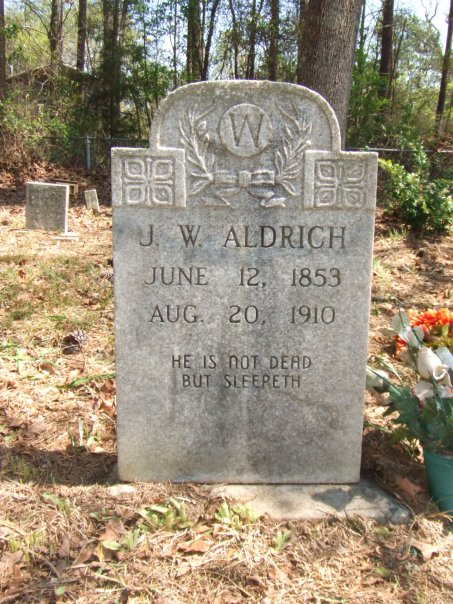
John W. Aldridge.

Image

JOHN WILLIAM ALDRIDGE (1853-1910) was born in Sampson County to Robert Aldridge and Mary Eliza Balkcum Aldridge. In the 1870s, he and his brothers Mathew Aldridge and George Aldridge were among former free men of color hired to teach in Wayne County colored schools. (Another was E.E. Smith.) John and George were posted near Fremont, in northern Wayne County, where John met and married one of his students, Louvicey Artis.  The couple settled among his family near Dudley, in southern Wayne County.  The original site of John’s grave is now forgotten, but he now lies in a family cemetery on land still owned by Aldridge descendants. (The W on the headstone is a bit of a mystery, but suggests that the marker was second-hand.  The spelling of his surname, “Aldrich,” is that preferred by his son, Thomas, who paid for it.)

An Act to Emancipate Hannah.

CHAPTER LVIII.

An Act to Emancipate Hannah, Alias Hannah Bowers, a Person of Mixed Blood, Belonging to the Estate of the Late Alexander Gaston Deceased.

Whereas it appears to this General Assembly, That the late Alexander Gaston, of the town of New Bern, did in his lifetime frequently express a desire that the said girl Hannah should be set free, and did certify the same in his own handwriting, which certificate has been since found among the papers of the deceased: And whereas the widow of the said Alexander Gaston has also signified her desire that the said girl should in compliance with her husband’s wishes in his lifetime be set free:

I. Be it therefore Enacted by the General Assembly of the State of North Carolina, and it is hereby Enacted by authority of the same, That the said molatto girl called Hannah, alias Hannah Bowers, shall be, and is hereby declared to be emancipated and made free to all intents and purposes, and shall be entitled to all the privileges and benefits of a free person in as full and absolute manner, as if she the said Hannah had been born of a free woman. (Passed Jan. 6, 1787.)

Acts of the North Carolina General Assembly, 1786-1787, Colonial and State Records of North Carolina. 

Surname swap, no. 5.

In 1860, Wayne County Court of Pleas & Quarters Sessions bound James Newsom, 7, and Norfleet Newsom, 5, to Barny D. Yelverton to serve as apprentices.

But, in the 1860 census of Davis, Wayne County: Barney Yelverton’s household includes Nervy Artis, 27, and sons James Artis, 6, and Norphlet Artis, 4.