Fourth Generation Inclusive

Historical Documents of Genealogical Interest to Researchers of North Carolina's Free People of Color

A good deal of human interest.

There is a good deal of human interest to be found in many of the experiences of these colored slaveholders and in their relations with those whom they held in bondage. Rose Petepher, of the neighborhood of New Bern, N.C., was a free colored woman who was married to a slave named Richard Gasken, who had taken the name of his master. He ran away and was in the woods for years, when his wife finally bought him to take possession. When she could find him this change of owners brought him in at once. They lived together for many years afterward, raising many children whom they hired out just as slaves were hired out. Thus they all prospered. Near the town mentioned above, on their own land, some of the grandchildren are now living and doing well.

Judge William Gasken, who owned the man of whom we have just told, was thrice married, one of his wives being a daughter of Colonel McClure of New Bern. After his death, one of the slaves, Jacob, became the property of Mrs. Gasken. This Jacob’s wife was a free woman, and they had a son Jacob, then a young man and free of course, as the child of a free woman. Aided by his mother’s efforts, he managed to purchase his father at a very reasonable price as negroes were then held. All went smoothly for awhile, when young Jacob did not act as his father thought he should and his parent reproved him with fatherly love. Young Jacob was so disgruntled that he went off to a negro speculator named John Gildersleeve, who was from Long Island and was then in New Bern. This trader bought the father at a high price and at once sent him off south. Young Jacob afterward boasted that “the old man had gone off to the corn fields about New Orleans where they might learn him some manners.”

From Calvin D. Wilson, “Negroes Who Owned Slaves,” Popular Science Monthly, vol. LXXXI (1912).

In the 1850 census of Craven County: Richard Pettiford, 80, wife Rose, 69, children Dinah, 27, and Bryan, 25, and Elizabeth Pettiford, 100. (!!!) (Note that Richard adopted his wife’s surname. Wright Pettiford, 38, living alone nearby may have been another son.)

Perhaps: in the 1850 census of Craven County: Jacob Gaskins, 64, farmer, Penelope Gaskins, 88, Sarah Wiggans, 25, and her children Martha, 5, Elizabeth, 3, and Sabeah, 1 month.
Seemingly white predominating their features.

Image

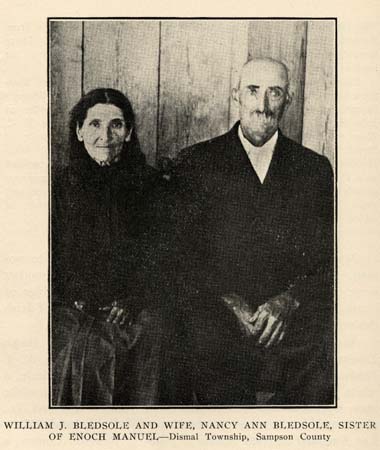
William J. Bledsole, one of the most prominent Indians of Sampson County, was evidently a white man with only a small degree of Indian blood. His wife was Nancy Emanuel, the This couple reside in Dismal Township, Sampson County. The father of William was a Croatan and his mother was Mary Bledsole, a white woman. Nancy, his wife, was Nancy Manuel, a sister of Enoch Manuel, and youngest daughter of Michael Manuel. The Manuels were large land owners in Sampson County prior and since the Revolutionary War. There is no record in their family history or family tradition for over 150 years showing any mixture of negro blood. This couple have seven children: Docia, wife of Enoch Manuel. Jr.; Rutha, wife of Ollin Brewington; Molsy, wife of Matthew Burnette; Isabella, wife of Erias Brewington; Lou Berta, wife of Jonah Manuel; W. L. Bledsole, who married Amandy Warrick; James Henry Bledsole, who married Hannah Warrick. Amandy and Hannah were daughters of William J. Warrick and wife Betsie Manuel Warrick, prominent Croatans of Robeson County. The Bledsole family are good specimens of white and Indian blood.  His oldest son, Luther Bledsole, married Amandy Warrick, a woman of white and Indian blood. Her father was William J. Warrick and her mother, Betsie Emanuel. James Henry Bledsole, his youngest son, married Hannah Warrick, the daughter of the above named William J. Warrick.

The Bledsole families are fine specimens of pure white and Indian, seemingly white predominating their features.

From George E. Butler, “The Croatan Indians of Sampson County, North Carolina. Their Origin and Racial Status. A Plea for Separate Schools,” (1916).

In the 1860 census of Westbrooks, Sampson County: Robin Bedsole, 80, Polly Bedsole, 35, Eliza Bedsole, 16, and William Bedsole, 12. William is described as mulatto; the others, white.

In the 1850 census of Northern District, Sampson County: Michael Manuel, 63, cooper; wife Fereby, 49; and children Gideon, 19, Cintilla, 16, Drusilla, 15,Michael, 13, Eden, 11, John, 9, William, 7, Enoch, 4, and Nancy, 1; all described as mulatto.

In the aftermath of Nat Turner …

The Edenton Gazette states, upon information received from an undoubted source, that there have been killed in Southampton county upwards of one hundred negroes, consequent upon the late insurrection in that county. Fourteen of the thoughtless, savage wretches have been tried, of whom, thirteen were convicted, and are to be hung during the present week — there are thirty more now in the jail at Jerusalem yet to be tried, besides others in jail at Bellfield.

We understand that about twenty-one negroes have been committed to jail in Edenton, on a charge of having been concerned in concerting a project of rebellion. A slave has also been arrested and imprisoned in Duplin county, upon a similar allegation. He had communicated his knowledge of the scheme in agitation to a free man of color, who gave immediate information to the whites. Serious reports in relation to a revolt of the slaves in Wilmington and Sampson county, reached this city, by the way of Smithfield, on Monday night and Tuesday morning last. On Tuesday evening, certain intelligence from various sources reached us of an insurrection having occurred on Sunday night last in a part of Sampson and Duplin counties. Its extent or the damage done is unknown to us. But, as the militia have been called out in the adjacent counties, we flatter ourselves that it will be speedily suppressed, and that the deluded wretches who are concerned in the diabolical attempt will be made to suffer severely for their temerity.…

The miserable deluded and fiendish band in Southampton have paid dearly for their stupidity and atrocious wickedness; and such will inevitably be the late of all who may ever be so silly and depraved as to intimate their example. But there are some, it seems, reckless enough to attempt it. Vigilance, therefore, becomes necessary for perfect security.

North Carolina Star, Raleigh,15 September 1831.

We ain’t knowed so much ’bout slavery.

An Interview with Anthony Ransome of 321 S. Tarboro St., Raleigh, N.C.

I reckon dat I is eighty years old, an’ I wus borned in Murfreesboro in Hertford County. My mammy wus named Annice an’ my father wus named Calvin Jones. My brothers wus named Thomas, Wesley, Charlie, Henry an’ William.

We wus borned free, my mammy bein’ de daughter of a white ‘oman, an’ my paw’s paw onct saved do life o’ his master’s chile, an’ wus freed.

My paw wus a shoemaker an’ he made a putty good livin’ fer us. Course we ain’t knowed so much ’bout slavery, but Doctor Manning who lived near us owned some slaves an’ he treated ’em bad. We could hyar ’em screamin’ at de top of dere voices onct in a while, an’ when dey got through beatin’ ’em dey wus tied down in de cellar. Dey ain’t had much ter eat nother.

Dar wus a preacher what tol’ us ’bout a member of his congregation durin’ de war. De wife wus sold from de husban’ an’ he married ag’in. Atter de war his fust wife comed back an’ atter his secon’ wife died he married de fust one ober ag’in.

From Slave Narratives: A Folk History of Slavery in the United States from Interviews with Former Slaves (1841).

Free-Issue Death Certificates: MISCELLANEOUS, no. 9.

W.H. (Willon Hatch) Brooks. Died 21 May 1925, Mitchell, Bertie County. Colored. Married. Farmer. Born 29 April 1860 in Wayne County to Wright Casey and Caline Brooks. Informant, Dave Brooks.

In the 1860 census of Indian Springs, Wayne County: Annis Brooks, 51, Caroline, 20, Bassel, 14, Elizabeth, 10, and Hatch, 2 months.

Louisa Davis. Died 23 August 1915, New Hope, Wayne County. Colored. Widow. Born 19 July 1840 in NC to Peter Ward and Milly Smith. Buried New Hope township. Informant, Clarisy Davis, Goldsboro.

Isham Smith. Died 12 February 1914, Fork, Wayne County, Colored. Married. Undertaker. Born North Carolina to unknown parents. Buried in Goldsboro. Informant, W.W. Faison.

In the 1860 census of Buck Swamp, Wayne County: Milly Smith, 45, and children Louisa, 25, Bitha, 15, Frances, 8, Clarissa, 4, Eliza, 5, Isam, 3, and Virginia, 1. [Sidenote: Isham Smith married Nancy Henderson, daughter of James and Louisa Armwood Henderson and sister or half-sister to Lewis and John Henderson and others. Isham and Nancy’s daughter Annie Smith married James Guess, who took over his father-in-law’s undertaking business and operated James Guess Funeral Home into the mid-20th century. — LYH]

Fannie S. Norwood.  Died August 1930, Wilmington, New Hanover County. Resided 520 Walnut. Negro. Widowed. Teacher. Born in 1846 in Wilmington to James D. Sampson of Sampson County and Francinea Kellogg of Wilmington. Buried in Pine Forest. Informant, Mrs. S.E. Merrick, 520 Walnut.

In the 1850 census of Wilmington, New Hanover County: Jas. Sampson, 44, carpenter, wife Fanny, 39, children Jas., 20, Jos., 18, and Benj’a, all apprentices, John, 14, Mary, 12, M.A., 10, George, 8, Fanny, 4, and Nathan, 2.

William Petapher. Died 4 May 1910, New Bern, Craven County. Colored. Married. Shoemaker. Born 1843 to Wright Petapher and unknown mother. Buried Greenwood cemetery. Informant, Rosa Petapher.

Cesero Wiggins. Died [no day] April 1924, New Bern, Craven County. Negro. Carpenter. Resided 24 Crooked.  Widower of Clarncie Wiggins. Born 1860 in New Bern to Wright Pettipher and Sarah Wiggins. Buried at Pettiphords cemetery. Informant Louisa Wiggins.

In the 1860 census of Neuse River, Craven County: Sarah Wiggins, 35, day laborer, Martha, 14, Julia, 12, Sabine, 10, Rebecca, 8, and Cicero, 6.

Theophilus George. Died 26 February 1918, #5, Craven County.  Negro.  Married to Hepsey George. Born 10 July 1850 to Theophilus George and Sarah Harkley. Informant, Oscar Frazier.

Mary F. Carter. Died 27 July 1915, North Harlour, Craven County. Negro. Married. Born 10 April 1863 in Craven County to Lige George and Sarah Fenner, both of Craven County.  Buried Cohogue. Informant, A.V. George.

In the 1860 census of Goodings, Craven County: Elijah George, 50, farmer, wife Sarah, 30, Theophilus, 20, Timothy, 8, Nancy, 10, J.P., 4, and T.J., 2.

Bailey Godette. Died 22 June 1915, No. 5, Craven County. Negro. Married. Farmer. Born 15 May 1861 in North Harlowe to Andrew Godette and Debah George, both of North Harlowe. Buried North Harlowe cemetery. Informant, Debah Jackson, 99 Bern Street.

In the 1860 census of Goodings, Craven County: Andrew Godett, 24, day laborer, Mary F., 27, William B., 6, Nancy, 4, and Sarah A., 3 months.

An Act to Emancipate Phillis.

CHAPTER XVIII.

An Act to Emancipate a certain Negro Slave named Phillis, late the Property of George Jacobs, of the town of Wilmington, Deceased.

Whereas it is represented to the General Assembly that the aforesaid George Jacobs, deceased, in his last illness, did earnestly request that his negro slave named Phillis should be liberated for her great attention to her said master during her continuance with him, and more especially for her care and assiduity in his last illness: In order therefore to carry into effect the dying request of the said George Jacobs, deceased:

I. Be it Enacted by the General Assembly of the State of North Carolina, and it is hereby Enacted by the authority of the same, That from and after the passing of this Act, the aforesaid negro woman named Phillis, shall be emancipated and forever discharged from her bondage, in as full and ample manner as if she had been born free; any law, usage or custom to the contrary notwithstanding: And the said negro woman shall forever hereafter be known by the name of Phillis Freeman.

Acts of the North Carolina General Assembly, 1788, Colonial and State Records of North Carolina. 

William Goyens.

William Goyens (or Goings), early Nacogdoches settler and businessman, was born in Moore County, North Carolina, in 1794, the son of free mulatto William Goings and a white woman. He came to Texas in 1820 and lived at Nacogdoches for the rest of his life. Although he could not write much beyond his signature, he was a good businessman. He was a blacksmith and wagonmaker and engaged in hauling freight from Natchitoches, Louisiana. On a trip to Louisiana in 1826, he was seized by William English, who sought to sell him into slavery. In return for his liberty, Goyens was induced to deliver to English his slave woman and to sign a note agreeing to peonage for himself, though reserving the right to trade on his own behalf. After his return to Nacogdoches, he successfully filed suit for annulment of these obligations.

During the Mexican Texas era, Goyens often served as conciliator in the settlement of lawsuits under the Mexican laws. He was appointed as agent to deal with the Cherokees, and on numerous occasions he negotiated treaties with the Comanches and other Indians. He also operated an inn near the site of what is now the courthouse in Nacogdoches. In 1832, he married Mary Pate Sibley, who was white. Sibley had one son, Henry Sibley, from a former marriage, but Goyens and Mary had no children together.

During the Texas Revolution, Goyens was interpreter for Gen. Sam Houston and his party in negotiations for a treaty with the Cherokee. After the revolution he purchased what was afterwards known as Goyens’ Hill, four miles west of Nacogdoches. He built a large two-story mansion with a sawmill and gristmill west of his home on Moral Creek, where he and his wife lived until their deaths. During his later life Goyens amassed considerable wealth in real estate, despite constant efforts by his white neighbors to take it away. He always employed the best lawyers in Nacogdoches, including Thomas J. Rusk and Charles S. Taylor, to defend him and was generally successful in his litigation. He died on June 20, 1856, soon after the death of his wife; they were both buried in a cemetery near the junction of Aylitos Creek with the Moral. At his grave a marker was erected by the Texas Centennial Commission in 1936. Many traditions grew up in Nacogdoches about this unusual man, and sometimes it is hard to tell just what is true and what is tradition.

Adapted from Texas State Historical Association, tshaonline.org

He wished to go after his wife.

RAN AWAY, From Raleigh on the 25th Instant, A BLACK MAN, by the name of ABRAM about five feet two inches high, well set, and about 40 years of age, a tolerably good Shoemaker and Cooper – at the Shoemaking he has worked the year past with Mr. Joseph G. Bacon of this place. I expect he will make to Murfreesborough in Hertford County, in this State, where he is well known, as he was bro’t to this place by a Mr. Allen Clark, and sold to me in June, 1813. I expect he has a Pass, as I understand he was wishing to get one wrote, as he said he wished to go after his wife Nancy, a free mulatto, who is said to be in the neighbourhood of the Borough with one of her children. – I forewarn all persons from harbouring or employing him in any way, or from carrying him either by land or water, as I shall be under the disagreeable necessity of putting the law in force against all such persons – but will satisfy any reasonable person who may bring him to me, or deliver him in Jail, so that I get him again.  J. SCOTT Raleigh, March 28.

Raleigh Register and North Carolina Weekly Advertiser, 29 March 1816.

A very considerable technical exception.

In our generalizations upon American history — and the American people are prone to loose generalization, especially where the Negro is concerned — it is ordinarily assumed that the entire colored race was set free as the result of the Civil War. While this is true in a broad, moral sense, there was, nevertheless, a very considerable technical exception in the case of several hundred thousand free people of color, a great many of whom were residents of the Southern States. Although the emancipation of their race brought to these a larger measure of liberty than they had previously enjoyed, it did not confer upon them personal freedom, which they possessed already. These free colored people were variously distributed, being most numerous, perhaps, in Maryland …. In the year 1850, according to the [federal census], there were in the state of North Carolina 553,028 white people, 288,548 slaves, and 27,463 free colored people. In 1860, the white population of the state was 631,100, slaves 331,059, free colored people, 30,463.

This free colored population was by no means evenly distributed throughout the state, but was mainly found along or near the eastern seaboard, in what is now known as the “black district” of North Carolina. In Craven county, more than one-fifth of the colored population were free; in Halifax county, where the colored population was double that of the whites, one-fourth of the colored were free. In Hertford county, with 3,947 whites and 4,445 slaves, there were 1,112 free colored. In Pasquotank county, with a white and colored population almost evenly balanced, one-third of the colored people were free. In some counties, for instance in that of Jackson, a mountainous county in the west of the state, where the Negroes were but an insignificant element, the population stood 5,241 whites, 268 slaves, and three free colored persons.

The growth of this considerable element of free colored people had been due to several causes. In the eighteenth century, slavery in North Carolina had been of a somewhat mild character. There had been large estates along the seaboard and the water-courses, but the larger part of the population had been composed of small planters or farmers, whose slaves were few in number, too few indeed to be herded into slave quarters, but employed largely as domestic servants, and working side by side with their masters in field and forest, and sharing with them the same rude fare. The Scotch-Irish Presbyterian strain in the white people of North Carolina brought with it a fierce love of liberty, which was strongly manifested, for example, in the Mecklenburg declaration of independence, which preceded that at Philadelphia; and while this love of liberty was reconciled with slavery, the mere prejudice against race had not yet excluded all persons of Negro blood from its benign influence. Thus, in the earlier history of the state, the civil status of the inhabitants was largely regulated by condition rather than by color. To be a freeman meant to enjoy many of the fundamental rights of citizenship. Free men of color in North Carolina exercised the right of suffrage until 1835, when the constitution was amended to restrict this privilege to white men. It may be remarked, in passing, that prior to 1860, Jews could not vote in North Carolina. The right of marriage between whites and free persons of color was not restricted by law until the year 1830, though social prejudice had always discouraged it.

The mildness of slavery, which fostered kindly feelings between master and slave, often led to voluntary manumission. The superior morality which characterized the upper ranks of white women, so adequately protected by slavery, did not exist in anything like the same degree among the poorer classes, and occasional marriages, more or less legal, between free Negroes and slaves and poor white women, resulted in at least a small number of colored children, who followed the condition of their white mothers. I have personal knowledge of two free colored families of such origin, dating back to the eighteenth century, whose descendants in each case run into the hundreds. There was also a considerable Quaker element in the population, whose influence was cast against slavery, not in any fierce polemical spirit, but in such a way as to soften its rigors and promote gradual emancipation. Another source of free colored people in certain counties was the remnant of the Cherokee and Tuscarora Indians, who, mingling with the Negroes and poor whites, left more or less of their blood among the colored people of the state. By the law of partitus sequitur ventrem, which is a law of nature as well as of nations, the child of a free mother was always free, no matter what its color or the status of its father, and many free colored people were of female Indian ancestry.

I may add that North Carolina was a favorite refuge for runaway slaves and indentured servants from the richer colonies north and south of it. It may thus be plainly seen how a considerable body of free colored people sprang up within the borders of the state. The status of these people, prior to the Civil War, was anomalous but tenable. Many of them, perhaps most of them, were as we have seen, persons of mixed blood, and received, with their dower of white blood, an intellectual and physical heritage of which social prejudice could not entirely rob them, and which helped them to prosperity in certain walks of life. The tie of kinship was sometimes recognized, and brought with it property, sympathy and opportunity which the black did not always enjoy. Many free colored men were skilled mechanics. The State House at Raleigh was built by colored workmen, under a foreman of the same race. I am acquainted with a family now living in the North, whose Negro grandfather was the leading tailor, in Newbern, N. C. He owned a pew on the ground floor of the church which he attended, and was buried in the cemetery where white people were laid to rest. In the town where I went to live when a child, just after the Civil War, nearly all the mechanics were men of color. One of these, a saddler by trade, had himself been the owner, before the war, of a large plantation and several slaves. He had been constrained by force of circumstances to invest in Confederate bonds, but despite this loss, he still had left a considerable tract of land, a brick store, and a handsome town residence, and was able to send one of his sons, immediately after the war, to a Northern school, where he read law, and returning to his native state, was admitted to the bar and has ever since practiced his profession. This was an old free family, descended from a free West Indian female ancestor. For historical reasons, which applied to the whole race, slave and free, these families were, before the war, most clearly traceable through the female line.

The principal cabinet-maker and undertaker in the town was an old white man whose workmen were colored. One of these practically inherited what was left of the business after the introduction of factory-made furniture from the North, and has been for many years the leading undertaker of the town. The tailors, shoemakers, wheelwrights and blacksmiths were men of color, as were the carpenters, bricklayers and plasterers. …

Excerpt from Charles W. Chesnutt, “The Free Colored People of North Carolina,” The Southern Workman, vol. 31, no. 3 (1902).

Craven County Apprentices, 1810.

On 13 June 1810, Joseph Long, a free boy of color aged 16 years on 30 June 1810, was bound to Andrew Worron as a Taylor and habit maker.

On 10 September 1810, Jacob Lewis, a free boy of color aged 8 years, was bound to Joseph Robeson as a pilot and mariner.

On 10 September 1810, Smith Lewis, a free boy of color aged 10 years, was bound to Joseph Nelson as a pilot and mariner.

On 14 September 1810, William Manning, a boy of color aged 16 years on 30 June  1810, was bound to Andrew Worron as a tailor and habit maker.

On 10 December 1810, Jesse Gaudet, a free boy of color aged 3 years, was bound to William Physioc as a cooper.

On 12 December 1810, London Howard, 13, and John Gaudett, 10, free boys of color, were bound to Horatio Dade as coopers.