Fourth Generation Inclusive

Historical Documents of Genealogical Interest to Researchers of North Carolina's Free People of Color

Scuffletown avenger.

One of these curiously mixed people left his mark upon the history of the state — a bloody mark, too, for the Indian in him did not passively endure the things to which the Negro strain rendered him subject. Henry Berry Lowrey was what was known as a “Scuffletown mulatto,” Scuffletown being a rambling community in Robeson county, N. C., inhabited mainly by people of this origin. His father, a prosperous farmer, was impressed, like other free Negroes, during the Civil War, for service upon the Confederate public works. He resisted and was shot to death with several sons who were assisting him. A younger son, Henry Berry Lowrey, swore an oath to avenge the injury, and a few years later carried it out with true Indian persistence and ferocity. During a career of murder and robbery extending over several years, in which he was aided by an organized band of desperadoes who rendezvoused in inaccessible swamps and terrorized the county, he killed every white man concerned in his father’s death, and incidentally several others who interfered with his plans, making in all a total of some thirty killings. A body of romance grew up about this swarthy Robin Hood, who, armed to the teeth, would freely walk into the towns and about the railroad stations, knowing full well that there was a price upon his head, but relying for safety upon the sympathy of the blacks and the fears of the whites. His pretty yellow wife, “Rhody,” was known as “the queen of Scuffletown.” Northern reporters came down to write him up. An astute Boston detective who penetrated, under false colors, to his stronghold, is said to have been put to death with savage tortures. A state official was once conducted, by devious paths, under Lowrey’s safeguard, to the outlaw’s camp, in order that he might see for himself how difficult it would be to dislodge them. A dime novel was founded upon his exploits. The state offered ten thousand, the Federal government, five thousand dollars for his capture, and a regiment of Federal troops was sent to subdue him, his career resembling very much that of the picturesque Italian bandit who has recently been captured after a long career of crime. Lowrey only succumbed in the end to a bullet from the hand of a treacherous comrade, and there is even yet a tradition that he escaped and made his way to a distant state. Some years ago these mixed Indians and Negroes were recognized by the North Carolina legislature as “Croatan Indians,” being supposed to have descended from a tribe of that name and the whites of the lost first white colony of Virginia. They are allowed, among other special privileges conferred by this legislation, to have separate schools of their own, being placed, in certain other respects, upon a plane somewhat above that of the Negroes and a little below that of the whites.

Excerpt from Charles W. Chesnutt, “The Free Colored People of North Carolina,” The Southern Workman, vol. 31, no. 3 (1902).
Church roots.

St. Matthews Church History (1890-1992)

St. Matthews Presbyterian Church was organized October 5, 1890 under the auspices of The Reverend Clarence Dillard. Reverend Dillard was then moderator of Shiloh Presbyterian Church in Goldsboro, North Carolina and saw the need for and future success of a Presbyterian Church in Dudley.

Reverend Dillard worked diligently to get the Church organized and was its first Moderator, serving the Church from 1890 until 1913. There were nine known original members, most of whom have descendants who are members today. The original members were Mr. Washington Simmons, a teacher in Dudley; Mrs. Amanda Hagans, Mr. Wesley Budd and wife Julia, Mr. William Newkirk and wife Hattie Ann, Mr. Isaac Griswold and wife Cherry, and Mrs. Tempsy Boseman.

From http://www.faithpcgold.org

Babies’ daddies, no. 2.

At August term, 1800, Allen Mann ordered to pay Sarah Boon $15 for first year and $10 annually for next six years for support of her child of which he is the reputed father.

At August term, 1820, Benjamin Reynolds ordered to pay Lurany Hagans $15 for first year and $10 annually for next six years for support of her child of which he is the reputed father. Jesse Pridgen was bondsman.

At February term, 1821, Ben Reynolds ordered to pay Milly Locas $15 for first year and $10 annually for next six years for support of her child of which he is the reputed father.

In the 1850 census of Nash County: Milly Locust, 47, and Albert Locust, 6.

At August term, 1830, Moses Hagans ordered to pay Thena Locus $15 for first year and $10 annually for next six years for support of her child of which he is the reputed father.

In the 1850 census of Nash County: Mosis Hagans, 48, farmer, wife Pitty, 38, and Gray B. Hagans, 19.

At November term, 1830, Allen Brantley ordered to pay Patsey Bird $15 for first year and $10 annually for next six years for support of her child Lecy of which he is the reputed father.

At May term, 1831, Solomon Tabourn ordered to pay Elizabeth Howard $15 for first year and $10 annually for next six years for support of her child of which he is the reputed father.

Minutes of Pleas & Quarters Sessions, Court Records, Nash County Records, North Carolina State Archives.

Woman, stolen, asks for support in old age.

Headquarters Bureau Refugee Freedmen and Abandoned Lands SC

Charleston SC Aug. 11th 1866

Major General O. O. Howard

Commissioner

General:

I have the honor to present the case of Mary Richardson an aged half breed now living in Manningsville this state.

She states that when she was about thirteen years of age and living with her parents in a village in North Carolina the name of which she has forgotten she was sent to a slave for articles and while there a stranger named Jacob Whitehead immediately caught her and placing her on a saddle with him carried her away against her will, riding all day and night crossing into SC, sleeping in the woods days and riding nights, in this manner until they arrived at his home in Manningsville SC. That Jacob Whitehead kept her as a servant in his house until she arrived at the age of puberty when he kept her as his mistress with the knowledge of his wife. After living with him for about seven years, she had a son born of him and the wife took charge of the child. 

About ten years after the child was born the father Whitehead tried to sell her at auction in Charleston City SC but was unable to do so, she being free born of Indian parents and Whitehead being unable to show title.

Eight or ten years after this went the wife of Whitehead died and she (Mary) and Mr. W. were quarreling continually, and by some arrangement she was transferred to a Mr. John Reams of Manningsville, with whom she lived as a slave until Gen. Sherman went through.

She orates that her son is still living a man grown on the Santee River this state, but she has not seen him for many years nor has she heard anything of her parents since she was kidnapped. All of her repeated effort to learn of them and to tell them of her fate being intercepted before she began to grow old, by the post masters and others who were relatives and friends of Mr. Whitehead. After Mr. Whitehead sold or transferred her to Reams he married a second wife: Mr. W. died during the war and his widow now lives on the estate at Manningsville as does Nath’ Whitehead the son of the first wife of Jacob Whitehead.

She now asks that some measures may be taken to secure to her from Jacob Whitehead’s estate means of support in her old age as also to the son she had by Whitehead his just position and standing among his people.

I am General, very respectfully, your Obd. Servant

Brevet Major General, Asst. Com. SC

Records of Assistant Commissioner of the State of South Carolina; Bureau of Refugees, Freedmen and Abandoned Lands; National Archives Microfilm Publication M869.

One way or the other, salt-making.

WANTED IMMEDIATELY.

75 Hands to Cut and Cord Wood and boil SALT. Being in the employ of the State making Salt, exempts from Military duty. Free negroes will be hired and paid promptly soldiers wages, and furnished rations, and should they fail to come up, I am authorized to impress them, and will do so immediately. Any one noticing this advertisement will confer a favor upon those wanting Salt, by explaining to and sending forward any hands, white or black, address or call on me at the office of T.C. & B.G. Worth, Wilmington.

J.M. WORTH, State Salt Com’r. May 28.

Carolina Observer, Fayetteville, 9 June 1862.

For the suppression of disorderly conduct.

Town Ordinance.

At a meeting of the Board of Commissioners of the town of Hillsborough, held on the 3d of February, 1849, it was ordered that the following Ordinance be published in the Hillsborough Recorder and North Carolina Democrat:

Sect. 18: And be it further ordained, That is shall be the duty of the Town Constable, and the Captain of each company of patrol, to disperse all collections or assemblies of negroes and mulattoes, in the streets, and to quall all rioting, quarrelling, loud and profane cursing and swearing, whether by free persons or slaves, and to suppress all disorderly behavior of every kind, by whomsoever done; to effect which purpose, they shall have it in their power to call to their assistance any citizen of said town, who, on refusing to give his assistance, shall be fined, not exceeding four dollars; and the Magistrate of the Police shall fine not exceeding ten dollars, or imprison at his discretion, all free persons behaving in such riotous and disorderly manner, and commit him, her or them to jail, until such fine and costs thereon be paid.

It was also ordered, that the officers of the town be especially required to enforce the above ordinance, and also the following, viz: the ordinance to prevent shooting within the limits of the town; the ordinance to prevent galloping, or riding or driving immoderately through the streets; the ordinance to prevent the throwing, pitching or flinging of stones, sticks, bricks, &c., within the limits of the town; and also the ordinance to prevent the carrying of fire, unless covered, through the lots, streets, &c. of said town.

By order of the Board, E.A. HEARTT, Town Clerk. February 5.

Hillsborough Recorder, 7 February 1849.

A slave for eight years.

A PECULIARLY HARD CASE. – Frank Johnson, a free man of colour, has just returned to Newcastle, Pa., after having been a slave in the South for eight years. He was decoyed to Lynchburg, Va., about 1850; since which time he has been a kind of circulating evidence through out the whole region extending from Virginia to South Carolina. He has been sold twelve times, at priced ranging from $500 to $1,000. At length, being identified, his case came up for trial in the court of Moore county, N.C., by which time was set at liberty.

Frederick Douglass’ Paper, 17 September 1858.

Competition? Drive it out.

The Mechanics of Washington, N.C., have formed an association, and published resolutions declaring that hereafter they will not give employment to any negro mechanic, or learn any negro boy a trade. They condemn the practice of masters letting slaves hire their own time. They refer to the influx of free negroes from Virginia, driven out by the laws of that State; and they express a determination to petition the Legislature of North Carolina to pass a similar act, or tax free negroes to raise a fund to send them to Africa. – North Carolinian.

Carolina Watchman, 15 August 1850.


Void and of no effect.

AMENDMENTS to the Constitution of the State of North Carolina.

ARTICLE III.

So much of the constitution as entitles free persons of colour to vote for members of the Senate, and of the House of Commons, is hereby made void and of no effect.

Proposed amendments published in Carolina Watchman, 23 March 1833.

[Sidenote: Free people of color ultimately were stripped of the right to vote in 1837. — LYH]

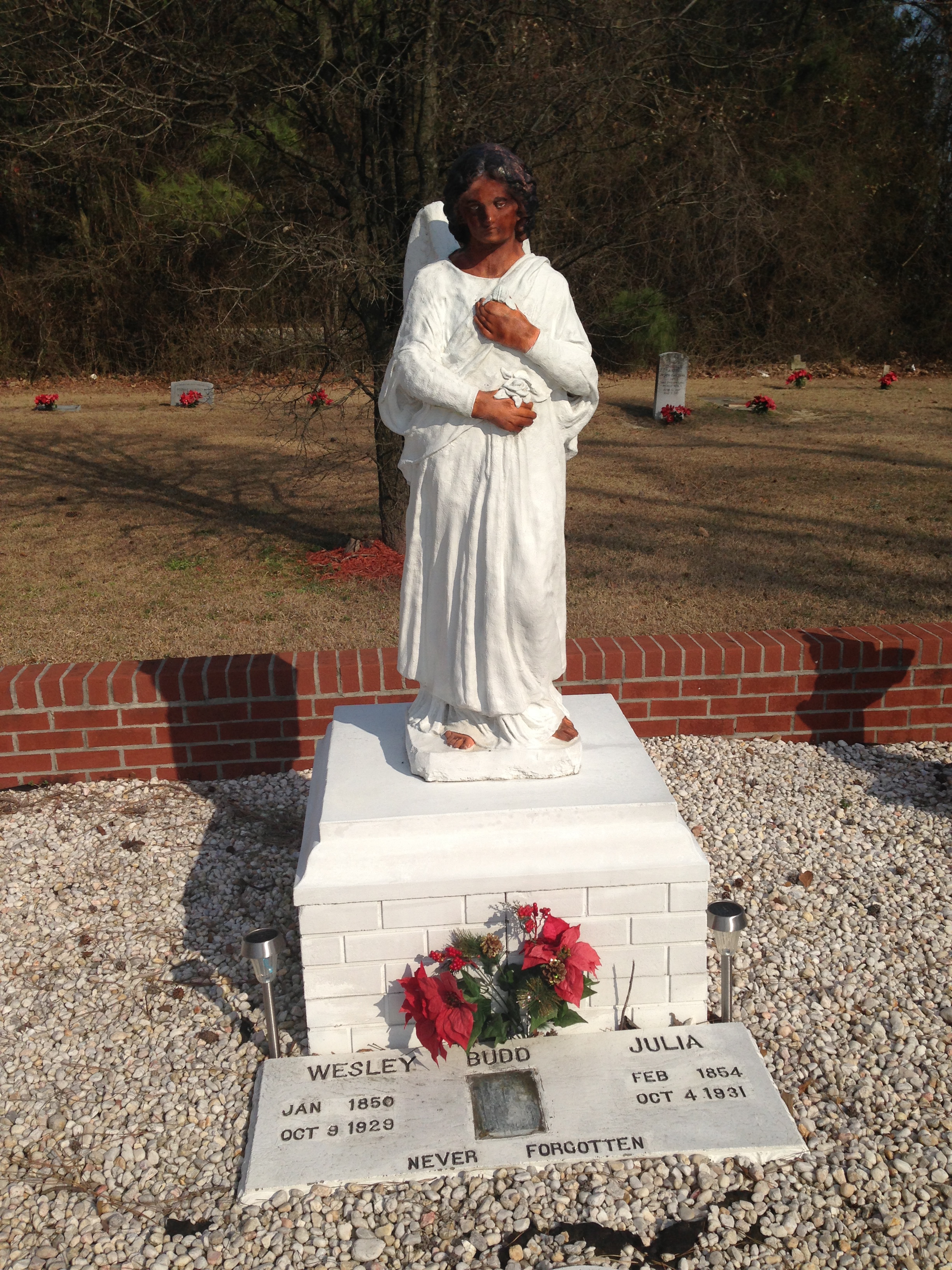
Julia Boone Budd.

ImageJULIA BOONE BUDD was born in 1854 in Sampson County to William and Susan Boone. She married Wesley M. Budd on 24 July 1873 in Wayne County.  They are buried in the Budd cemetery near Dudley, Wayne County.

Photo taken by Lisa Y. Henderson, March 2013.

In the 1860 census of McDaniels, Sampson County: Wm. Boon, 33, farm laborer; wife Susan, 31; Hezekiah, 6; Julia, 5; Azariah, 3; and Benamma Boon, 1.