Fourth Generation Inclusive

Historical Documents of Genealogical Interest to Researchers of North Carolina's Free People of Color

Category: Rights

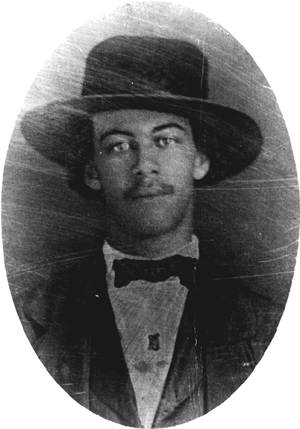
Lewis Sheridan Leary.
Image

Lewis Sheridan Leary (1835–1859), a harnessmaker from Oberlin, Ohio, joined John Brown’s unsuccessful raid on Harpers Ferry, where he was killed.  Leary was born in Fayetteville, North Carolina, to Matthew N. Leary, also a harnessmaker, and Julia Memril Leary.  His paternal grandfather was an Irishman, Jeremiah O’Leary, who fought in the American Revolution under General Nathanael Greene. A paternal great-grandparent, Abram Revels, a free man of color, was also a Revolutionary War veteran. His mother’s grandmother was “French Mary,” a freed West Indian who was a well-regarded cook in Fayetteville.

In the mid-1850s, Leary moved to Oberlin, Ohio, where two of his sisters had settled. One sister, Sarah, had married Henry Evans, whose sister Delilah Evans Copeland, the mother of John A. Copeland Jr., another John Brown follower.  Leary married Oberlin College graduate Mary Patterson, and had a daughter, Louise.  Leary became involved with abolitionists in Oberlin, which had an active community. Later, he met John Brown in Cleveland, Ohio.

In 1858, Leary joined in the Oberlin-Wellington Rescue, when fugitive slave John Price was forcibly taken from the custody of a U.S. Marshal to prevent his being returned to slavery . He was not among the 37 men (twelve of them free men of color) who were indicted and jailed for their actions.

Accompanied by Copeland, Leary joined John Brown at Chambersburg, Pennsylvania.  Leary died eight days after the attack on Harper’s Ferry from wounds suffered in the conflict. Copeland was captured, tried and later executed.

Leary’s family remained in Fayetteville during the Civil War.  During Reconstruction, his father and a brother served as city councilmen and county commissioners, and his brother Matthew Leary Jr. was an early trustee of the college that became Fayetteville State University. Leary’s youngest brother, John Sinclair Leary, graduated from Howard University in 1871 and was one of the earliest black attorneys admitted to the bar in North Carolina. He served in the state legislature for two terms as a Republican representative for Cumberland County during Reconstruction, and in 1884 was sent as a delegate to the National Republican Convention. He later founded and served as the first dean of the Shaw University Law School, and in the 1890s moved his family and practice to Charlotte. Today the Charlotte chapter of the North Carolina Association of Black Lawyers is named the John S. Leary Bar Association in his honor.

 Adapted from Tar Heels at Harper’s Ferry, October 16-18, 1859,”  http://www.nccivilwar150.com/history/john-brown-nc.htm, published by the North Carolina Department of Cultural Resources.

Photograph, c. 1850s, courtesy of Oberlin College Archives, Oberlin, Ohio.

In the 1860 census , Fayetteville, Cumberland: Matthew Leary, 48, wife Julia A., 42, Matthew, 17, Lewis S., 15, Julia A., 12, John S., and Mary E., 13.

They have hunted with dog and gun and have never done any injury.

We the undersigned having understood that Benjamin Morgan and his Son George Morgan who lives in our Neighbourhood have lately had their Guns taken away By Patrols agreeably to an Act of the General Assembly we also certify that we have known the said Benjamin and George Morgan for about Fifteen years during which time they have lived directly in our Neighbourhood and hunted with Dog and Gun and we never have heard neither have we any reason to believe the said Morgans have done any Injury to any person for and by reason of their having been priviledged to hunt.  We therefore pray the Worshipful County Court of Craven now siting to grant the said Benjamin Morgan and his son George Morgan the priviledge to keep their Fire arms and also the Said Court to restore their Guns to them again.  Nov 8th 1841.  /s/ Wm Simmons, John Harris, John Fearrand, Obed Palmer, Burton Carson, James M. Beasley

Records of Slaves and Free Persons of Color, Craven County Records, North Carolina State Archives.

We think they are very good.

GOOD TOWN ORDINANCES.

The Charlotte Whig publishes several new town ordinances for the town of Charlotte, which we think are very good. 1st. Every free negro of twelve years and upwards, is required to present him or herself for registration, stating age, occupation, &c., &c., upon heavy penalty for failing to do so.  Those who comply, will obtain a certificate, under the protection of which they will be allowed to dwell in safety, upon their good behavior.  They are to pay one dollar for the certificate.  2d. No slave, under any pretence whatever, allowed to hire his or her own time; nor shall any slave go at large at his or her own discretion, by permission of the owner, working for his or herself where and when they please. 

Carolina Watchman, Salisbury, 24 June 1861.

Voter Registration Under the Grandfather Clause: Wayne County

Public Laws of North Carolina, 1899, chapter 218.

(Sec. 4.) Every person presenting himself for registration shall be able to read and write any section of the constitution in the English language and before he shall be entitled to vote he shall have paid on or before the first day of March of the year in which he proposes to vote his poll tax as prescribed by law for the previous year. Poll taxes shall be a lien only on assessed property and no process shall issue to enforce the collection of the same except against assessed property.

(Sec. 5.) No male person who was on January one, eighteen hundred and sixty-seven, or at any time prior thereto entitled to vote under the laws of any states in the United States wherein he then resided, and no lineal descendant of any such person, shall be denied the right to register and vote at any election in this state by reason of his failure to possess the educational qualification prescribed in section four of this article….

The following colored men registered to vote in Wayne County in 1902.  In accordance with Section 5, each was required to name the ancestor who “grandfathered” him in.

Joseph Aldridge, 36, Brogden, Robert Aldridge.

M.W. Aldridge, 45, Goldsboro, Robert Aldridge.

Robert Aldridge, 33, Brogden, Robert Aldridge.

In the 1860 census of Newton Grove, Sampson County: Robert Aldridge, farmer, $260, illiterate, with wife Mary E., and children George W., John J., Armelia, Matthew L., David S., and a one month-old infant.

A.B. Artis, 29, Nahunta, Absalom Artis.

Joseph Artis, 21, Nahunta, Absalom Artis.

Mack Artis, 52, Nahunta, Absalom Artis.

Nathan Artis, 42, Saulston, Absalom Artis.

In the 1860 census of North Side of the Neuse, Wayne County: Absolom Artis, 70, wife Clarkey, 55, and Absalum, 23, Joseph, 19, Jane, 17, Eveline, 14, and Albert, 12.

Albert Artis, 58, Nahunta, Edwin Artis.

Donnie Artis, 21, Nahunta, Edwin Artis.

In the 1860 census of Buck Swamp, Wayne County: Edwin Artis, 50, Emily, 35, Albert, 16, Elvira, 14,  Absalom, 12, Clarkey, 10, George, 8, William Edwin, 6, and Baby, 9 months.

J.F. Artis, 58, Buck Swamp, James Artis.

John Artis, 39, Buck Swamp, William Hagans.

Oscar Artis, 22, Buck Swamp, Jim Pig.

Will Artis, 47, Buck Swamp, Jim Pig.

In the 1880 census of Pikeville, Wayne County: Willey Artis, 24, wife Charlotte, 24, and son Oschar L., 2 months.

G.W. Barnes, 33, Pikeville, Asey Artis.

In the 1860 census of Wayne County: Asa Artis, 35, wife Phereby, 34, and Lumizer, 20, Mary, 18, Penninah, 15, Lewis, 12, William G., 7, Zilpha J., 3, and Benaja, 1.

Calvin Brock, 52, Brogden, Fred Gibson.

Calvin V. Brock, 24, Brogden, Fred Gibson.

In the 1860 census of the Northern Division of Duplin County: Cassy Smith, 45, with Charlott, 25, Dorcas, 19, Rebecca, 16, Richard, 14, Mary G., 12, Ezekiel, 8, and Thear Smith, 4; plus Calvin Brock, 10, and Samuel Purvie, 35.

Calvin V. Brock was Calvin Brock’s son.

Marshall Carter, 42, Brogden, Mike Carter.

Williby Carter, 22, Brogden, Mike Carter.

In the 1860 census of Clinton, Sampson County: Michael Carter, 57, and wife Patience, 47. Next door, Wm. Carter, 26, wife Mary, 34, and children Cornelia, 6, Francenia, 6, Thos. G., 5, Sarah J., 2, and Archibald, 9 months.  In a duplicate listing in Piney Grove, Sampson County: William Carter, 27, turpentine laborer, Mary 27, Cornelia, 12, Francenia, 6, Isaiah T., 4, Sarah J., 2, and Archy M., 6 months. (Archibald “Archy” M. Carter was Marshall Carter.)

Williby Carter was Marshall Carter’s son.

George Hagans, 48, Nahunta, William Hagans.

H.E. Hagans, 34, Goldsboro, Napoleon Hagans.

W.S. Hagans, 31, Nahunta, Dr. Ward.

Napoleon Hagans, age 6, was apprenticed in 1845 to William Thompson in Wayne County NC.  Apprenticeship Records, Records of Wayne County, North Carolina State Archives.

In the 1850 census of North of the Neuse, Wayne County: Aaron Seaberry, 32, farmhand, wife Louisa, [stepson] Napoleon [Hagans], 10, Frances, 5, and Celia Seaberry, 17. In a duplicate listing, Leacy Hagans with  [grandson] Napoleon Hagans. 

Henry E. and William S. Hagans were Napoleon Hagans’ sons.  (Dr. Ward was David G.W. Ward, father of Henry and William’s mother Apsaline “Appie” Ward Hagans.)

R.H. Hagans, 22, Nahunta, Everett Hagans.

Edwin Hall, 53 Nahunta, Dempsey Hall.

In the 1860 census of Wayne County, North Side of the Neuse: Dempsey Hall, 26, wife Martha, 26, and children Vina, 2, Edwin, 1, and Eveline, 2 months.

John H. Jacob, 52, Brogden, Jesse Jacob.

In the 1860 census of Honeycutts, Sampson County: Jesse Jacobs, 43, wife Abba, 31, and children Edward J. 14, Betsey A., 13, John R., 11, Martha, 8, Solomon, 6, Jesse, 4, and Abba J., 6, plus William, 10, Eliza, 8, and John Jacobs, 6.

George Linch, 22, Buck Swamp, Haywood Linch.

Haywood Linch, 56, Buck Swamp, self.

Morrow J. Linch, 26, Buck Swamp, Haywood Linch.

In the 1850 census of Wayne County, North Side of the Neuse: Raiford Linch, 38, wife Rebeca, 38, and children Bryant, 17, Eveline, 15, Bud, 13, Sarah, 11, Eliza, 10, Haywood, 8, Aley, 5, and John, 2.

Morrow (Marion?) and George Haywood Lynch were Haywood Lynch’s sons.

Wiley Mozingo, 76, Goldsboro, Christopher Mozingo.

In the 1850 census of Northern District, Sampson County: C. Mazingo, 50, mulatto, with Wiley, 18, Joshua, 16, and William, 14.

David Reed, 87, Fork, self.

In the 1860 census of Nahunta, Wayne County: Rhody Reid, 50, son Isaac, 26, and husband David Reid, 65. 

George W. Reid, 32, Goldsboro, Washington Reid.

In the 1850 census of Wayne County, North Side of the Neuse: Washington Read, farmhand, 28, wife Penninah, 25, and Lewiser, 2 months.

Soft-hearted? Soft-headed.

To the General Assembly of North Carolina

It is desirable that you should adopt a course of policy, and pass a system of laws to induce, if not compel, the free negroes in North Carolina to emigrate to the Abolition and Free Soil states.  It appears to me that Negrophobia, which is now raging and rousing up a large number of people in the non-Slaveholding states cannot be cured more effectually than by giving them some strong black medicine out of their own black Bottle: and therefore, the members of the Legislature ought in my Judgment to enact all the constitutional laws in their power to effect the object I have indicated.  I do not intend to offer reasons and arguments in favor of such Laws.  Every man who has a southern head on his shoulders and a southern heart in his bosom must see the propriety and the necessity of such legislation.

I propose that you pass a law making the ownership of land on which free negroes reside liable to pay all the taxes, contracts, damages, Penalties, fines and costs, and other legal liabilities which colored persons may contract or incur while living thereon. That it, I would make the actual possession of the free negro, a lein, on the land on which he lived, and let that lein continue until his public and private liabilities were paid and satisfied.

There is a numerous class of the worst sort of Abolitionists dwelling in our midst in the southern states who clandestinely trade with slaves and receive stolen good in payment for ardent spirits and other articles, thereby corrupting and destroying the value of servants.  Many of these malefactors are insolvent persons and some of them are agents of men of property, who select such deputies to do their dirty work, hoping that prudent laws cannot reach and punish them.  I propose that the offense just stated shall be punished, not only with fine and imprisonment, but, by one of more whippings on the bare back at the whipping post.  I am aware some persons have an aversion, through a sort of sickly sympathy, to inflict corporal punishment for the commission of any offences, hoping to gain for themselves the character of being very soft hearted, but I think all such might with much more propriety be considered very soft headed.  When offences proceed from the conception of the human heart, let no honest man sympathise with the offender.  But when the frailty of [illegible] nature is to be punished for deeds done without deliberation, then, kind and generous feelings may be justly excercised.  Society can only be carried on and preserved through the influence of example.  Those persons who live by corrupting and hiring negroes to steal for their benefit, deserve and ought to receive the most severe and exemplary punishments.

All our laws on the subject of Slavery, and the officious intermedling with it, which is the sin of the age, require revision, amendment and improvement.

I make another suggestion; I would make the land on which white Tenants live, liable to pay all fines, penalties and costs that they may be liable to pay while living on these landlords land; Then, the honest taxpayers and good citizens of the state & county would not so often be taxed, unjustly, to pay costs after the conviction of insolvent malefactors and old sinners.

Respectfully presented by James Graham.

Petition of James Graham, Lincoln County, dated 29 December 1850.  Petitions, North Carolina General Assembly, North Carolina State Archives.

Carrying Nat Turner in their little carts.

To the Honbl the General Assemby of N. Carolina

Your memorialists respectfully shew unto your Honorable Body: That the County of Lenoir has been for many years regularly visited on all public occasions, by free negroes & slaves hiring their time, from the adjoining Counties, & particularly from the Town of Newbern.  The ostensible object of these persons has been to retail cakes, tobacco & spiritous liquors.  The good citizens of the County have always believed that the [illegible] and within the last five years have been firmly convinced, that the visits of such characters, have not only produced serious loss & inconvenience by the temptations which are thus held out to their slaves, to steal lambs, pigs & poultry to barter with them, but is calculated to do a far more serious and incalculable injury by the facilities offered for the [illegible] among their slaves.  Enjoying the privilege of travelling in their little carts from one County town to another, these black pedlars have it within their power to distribute, without suspicion, in any nook & corner of the Country, the pamphlets of [illegible] as well as communicate verbally the murderous plans of a Nat Turner. The acquaintances your memorialists have with these characters, completely satisfies them that they are fit instruments for such purposes.

An application has heretofore been made to your Honourable Body for relief on the subject & a remedial act had been passed which your memorialists to believe was intended to meet this case, but which unfortunately was so farmed as to prove entirely nugatory.

That act authorized the slaves & free negroes of Newbern to trade on Lenoir County, under a license taken out in Craven.  As the tax imposed by the late law does not amount to a prohibition, its chief consequence is to enlarge the revenue of Craven  without affording any relief to to Lenoir.  In tender consideration of the previous, Your memorialists to earnestly request of your Honourable Body, that you will further legislate on this matter, and authorise the County of Lenoir to exclude all coloured retailers of cakes, spirits &c. from its limits, but such as may be licensed by the Court of Pleas & Quarter Sessions, or impose a prohibitory tax & if [illegible] of these modes of restraint shall seem fit, that you will adopt some measure which will annihilate the grievance.  /s/ Matthew H. Carr, John B. Kennady [and others]

Chapter 111. An Act Concerning Slaves and Free People of Color.

Section 50.  All negroes, Indians, mulattoes, and all persons of mixed blood, descended from negro and Indian ancestors, to the fourth generation inclusive, (though one ancestor of each generation may have been a white person) whether bond or free, shall be deemed and taken to be incapable in law to be witnesses in any case whatsoever, except against each other.  In all pleas of the State, except where the defendant may be a negro, Indian or mulatto, or person of mixed blood, descended from negro or Indian ancestors, to the fourth generation inclusive, (though one ancestor of each generation may have been a white person,) whether such defendant be bond or free, the evidence of a negro or negroes, Indian or Indians, mulatto or mulattoes, and of all persons of mixed blood, descended from negro or Indian ancestors, to the fourth generation inclusive,) though one ancestor of each generation may have been a white person,) whether the person or persons, whose evidence is offered be bond or free, shall be admissible and the witnesses competent, subject nevertheless to be excluded upon any other grounds of incompetency which may exist.

We are pleased with him.

Wayne County Nov 16th 1852

To the Members Comprising both houses of the legislature for the State of North Carolina 1852

We the Undersigned Say to you as our representatives that we have a Coloured person living in Goldsboro whose name is Hilary Croom Ailias Coor who was born of a woman of reputable parentage though his father was reputed to have been a Slave of Colour We know the raising of Sd Croom and his Standing now he is Now of fair Standing he is one of the best blacksmiths we have he was born and raised in our County.  When he grew to be a Man he intermarried with a girl of colour the property of one Graddy Herring.  Soon after their Covenant as man and wife sd Herring Removed to the State of Alabama this Character Croom also moved with sd Herring after remaining there some years the legislature of the State of Alabama past a law that all Colourd person which were free Should leave that State within a certain period of time during this time this Citizen Croom purchased his wife and children of Sd Herring and J.B. Herring one of the Subscribers have seen his bill of Sale which can be produced at any time.  In consequence of which the said Croom returned back to his Native State and his wife and family with proper papers from Sd Herring showing he had purchased his Wife and Children.  When he returned to our State our Legislature had pasd a law to the purpost that all Coloured person which had left this State if They returned Should leave this State or forfeit a large sum. Now we are well acquainted with this man Croom he lived by our town Goldsboro in Wayne County we are pleased with him as a blacksmith we pray that he Sustains a fair industrious character he has [blank] children whose names are Ann Charles Temperance

We the undersignd knowing that under our present laws there are many coloured persons among us of more more bass character Must and does remain with us petition to you as our representative, that you pass and act which will be attended by our friend W.H. Washington that said Hilary Croom be Sufferd to remaine  with us that his above named Children before at their arriving to the age of twenty one years and Enjoy all the rights of Citizenship of their Colour to which we the Undersigned have assigned our names the above date.  Hillory X Croom, Benajah Herring, W.C. Bryan, Wm. Smith, L. Cogdell, Wm. Thompson.

The 1850 census of the South Side of the Neuse River, Wayne County, shows Hillery Croom, 41, blacksmith, with children Annie, 14, Charles, 13, Tempy, 10, and John, 9.  All were described as mulatto.  The 1850 slave schedule shows that Hillery owned two slaves, a 55 year-old woman and a 32 year-old man.

Chapter 111. An Act Concerning Slaves and Free People of Color.

Section 81.  If any free negro or mulatto shall entertain any slave in his or her house, during the sabbath, or in the night, between sunset and sunrise, he or she shall, for entertaining such slave, be subject to a fine of two dollars for the first offence, and four dollars for every subsequent offence, to be recovered on conviction before any one justice of the peace, and applied to the use of the poor of the county, in which the offence shall be committed, saving to the party the right of appealing.

Revised Statutes of North Carolina, 1837.

Tax them and send them to Liberia.

ImageMEMORIAL.

JUNE 29th, 1850.

We, the undersigned citizens of the county of Beaufort, and of the State of North Carolina, do respectfully represent to the General Assembly of the State, that the White Mechanics of our State are laboring under a serious injury, inflicted upon them by the competition they experience from negro mechanics, which is not only an injury to them, but to every portion of the community, because it places a check against the advancement of Architecture, and forbids genius and talent from entering its employment on account of the degradation it may experience, by being brought down side by side with negro labor, or the small pittance it may receive for its industry from such a competition.  We therefore beg the General Assembly to take into consideration the propriety of laying a tax upon all colored Mechanics in the State, so as to guard more effectually against its increase.

There is another grievance to which we would call your attention, the free negro population which has increased to an alarming extent.

The law lately enacted by the Legislature of the State of Virginia, for the purpose of colonizing them in Africa, has made this grievance insupportable, because it drives large numbers of her free negroes into our borders, which is not only a burden on the white population of our State, but an injury to the slave interest itself.

Therefore we pray the General Assembly to pass an act, laying a tax upon free negroes which shall be applied for the purpose of colonizing them in Liberia, and if necessary, an additional sum from the State Treasury.

And your petitioners will ever pray, &c.

/s/ Arthur Morgan, John B. Ross and 40 others.