State Fair Entries.
The following are some of the entries in the First Department:
THOROUGHBREDS.
…
Moses Simmons, Cleveland, Gelding “Frank Greyson.”
…
Plain Dealer, Cleveland OH, 11 September 1863.
———-
WAS BORN A SLAVE
And Freed by His Master Half a Century Ago.
MOSES SIMMONS’ CAREER.
CAME TO CLEVELAND PENNILESS AND AMASSED A FORTUNE.
SHREWDNESS AND THRIFT
POSSESSED BY HIM, THOUGH HIS EDUCATION WAS LIMITED.
Earned His First Money by Cleaning Horses at Ten Cents a Head – A Member of Several Fraternal Organizations.
For forty-eight years the face of Moses Simmons, who died Saturday, was a familiar one in this city. “Mose,” as he was familiarly known, was a unique character. And well known in the public places of the city, partly on account of his portly figure and partly because of his genial disposition. He had the ability to make money. He was business first, last, and all the time.
Born a slave and held in slavery until twenty-nine years of age, when in a sudden burst of generosity his master freed him, Simmons was compelled to LOOK OUT FOR HIMSELF. So well did he learn the lesson of self-dependency that his fortune at the time of death is estimated at anywhere from $20,000 to $70,000. He was extremely reticent about his business affairs and made a confidant of no one. It is known that he owned valuable real residence property on Laurel street near Scovill avenue and also an interest in several fast horses. He was a lover of horseflesh and always owned one or more high steppers.
“Mose” Simmons was seventy-eight years of age when he died. He was born in Mount Olive, N.C., on the plantation of a man named Richards. His master sustained a reverse of fortune and “Mose” with the rest of the slaves on the place was sold to a trader. He had been a great favorite of his master, and the latter, as soon as he could secure enough money to purchase his former slave again, did so. Mr. Richards brought “Mose” to Philadelphia when the latter was twenty-nine years of age. In that city the spirit of abolition was becoming more and more pronounced and Mr. Richards freed him. Fearing that his master might repent of the generous deed, Moses determined to take advantage of his liberty and secretly left the Quaker City. He came direct to this city. On his arrival he found himself without means and very hungry. For days he wandered about the city and in search of food. He often told his friends of later days of standing near the kitchen of the late “Joe” Richards’ restaurant AND BEGGING FOOD.
He secured work at last in a stable on Academy street cleaning horses at ten cents per head. This was his beginning. By untiring industry and careful frugality he succeeded in making himself comfortable. He was naturally shrewd and possessed with an intelligence which made up in great part for his lack of a school education. He delighted to discuss politics and became a representative of his race in local affairs. He was appointed inspector of catch basins under Mayor Gardner’s administration.
As a horse trader Simmons was known all over the city and his bargains were always reported to work to his own advantage. He engaged in the saloon business on Michigan street for a time but abandoned it, as he found it contrary to his inclinations. For many years he was proprietor of the barber shop under the Striebinger House and also of one on Ontario street. Fortune smiled on him and he became a money lender for the colored people of the city. He also was known as a professional bondsman. At the time of his death he lived alone at No. 423 Erie street, where he had a small barber shop and also conducted a coal business. Although twice married, he was destitute of near relatives. For the last eleven years of his life he referred to live alone, becoming almost a recluse, raking interest only in his business affairs. His only deviation from this rule was to attend to the meetings of several lodges of which he was a member. He belonged to the colored Odd Fellows, Masons, and Knights of Pythias. In the colored Masonic fraternity he had taken thirty-two degrees. He belonged to the rank of the colored Knights of Pythias.
His last sickness was a few weeks’ duration, but it was only a week ago that he was unable to leave his bed. He shared his bachelor home with a young man, Fred Dixon by name, whose father had been Simmons’ intimate associate. It was in Dixon’s arms that he died. Mrs. Eliza Bryant, of no. 23 Newton street, and Miss Effie Simmons, of No. 16 Waller street, are his only known relatives. The funeral will be conducted from the undertaking rooms of Black & Wright Wednesday afternoon under the auspices of the fraternal organizations with which he was intimately connected.
Cleveland Leader, 29 January 1900.
———-
HACKED WITH A KNIFE.
MOSES SIMMONS’ HORSE ALMOST CUT TO PIECES.
The Owner Was Dying When His Barn Was Entered and the Animal Wounded.
A cowardly brute Saturday night, evidently in a spirit of revenge, went to the barn of the late Moses Simmons, of No. 458 Erie street, and cut and hacked a brood mare in a horrible manner.
Saturday night Moses Simmons died at his home. It was later than usual before any member of the family entered the stable to care for the horses. When Fred Dixon, a young man who lived with Simmons, opened the stable door yesterday morning, he heard one of the horses moaning. He hurried to the stall of the favorite horse, a large gray brood mare. She was lying in a pool of blood and was bleeding from many wounds.
Some time during the night some one entered the barn and with a large knife cut and slashed the horse Her hide and flesh were laid open nearly to the ribs on one side, and there were deep cuts all over her body.
Patrolman Kiel was called and was asked to shoot the animal, as she was suffering intense agony. The mare had been a pet and favorite of Simmons for some year.
No reason for this dastardly deed is known. The police will try to locate the brute who committed the crime.
Cleveland Leader, 29 January 1900.
———-
Legal Notice.
STATE OF OHIO, CUYAHOGA COUNTY, ss. } In the Probate Court
Charles Bundy, as Administrator of the estate of Moses Simmons, deceased. } Plaintiff.
vs.
The Society for Savings, Maria Thompson and the Unknown heirs of Henry Simmons, of David Simmons and of Ferrebe Greenfield, respectively, deceased. } Defendants.
Maria Thompson, who resides at Goldsboro in Wayne county, North Carolina, and the unknown heirs of Henry Simmons, of David Simmons, of George Simmons, and of Ferrebe Greenfield, respectively, deceased, heirs at law of Moses Simmons, deceased, will take notice that Charles Bundy, as administrator of the estate of Moses Simmons, deceased, on the ninth day of March, A.D., 1900, filed his petition in the Probate Court within and for the County of Cuyahoga, and State of Ohio, alleging that the personal estate of said decedent is insufficient to pay his debts and the charges of administering his estate; that he died seized in fee simple of the following described real estate, situate in the City of Cleveland, County of Cuyahoga, and State of Ohio, to-wit: — known as being all of the sub-lots Nos. 104 and 105 in James M. Hoyt’s sub-division of ten-acre lot No. 37 in said city, and together makes a frontage of 30 feet upon the westerly line of Sterling avenue, and extends in rear to Laurel street 148 and 3/12 feet in depth. That the said defendant, the Society of Savings, holds a mortgage lien on said real estate by virtue of a certain mortgage executed to it as mortgagee by the said decedent during his life time, dated November 4, 1894, and recorded in Vol. 959, page 509, of Cuyahoga County records, that the amount recurred by said mortgage is Five Hundred Dollars, as indicated in exhibit “A,” attached to said petition. That the last half of the taxes for 1899 are unpaid and are alien on said real estate. That it would be for the best interests of the estate of the said Moses Simmons to sell said real estate at private sale for the reason that the character and location of said property leads plaintiff to believe that he could sell the same for greater sum at private sale than at public auction.
The prayer of said petition is that the plaintiff may be authorized to see said real estate to pay debts at a private sale, according to the statute in such case made and provided.
The persons first above mentioned will further take notice that they have been made parties defendant to said petition, and that they are required to answer the same on or before the 12th day of May, A.D. 1900. CHAS. BUNDY, Administrator as aforesaid.
March 9, 1900. ALEX. H. MARTIN, Attorney.
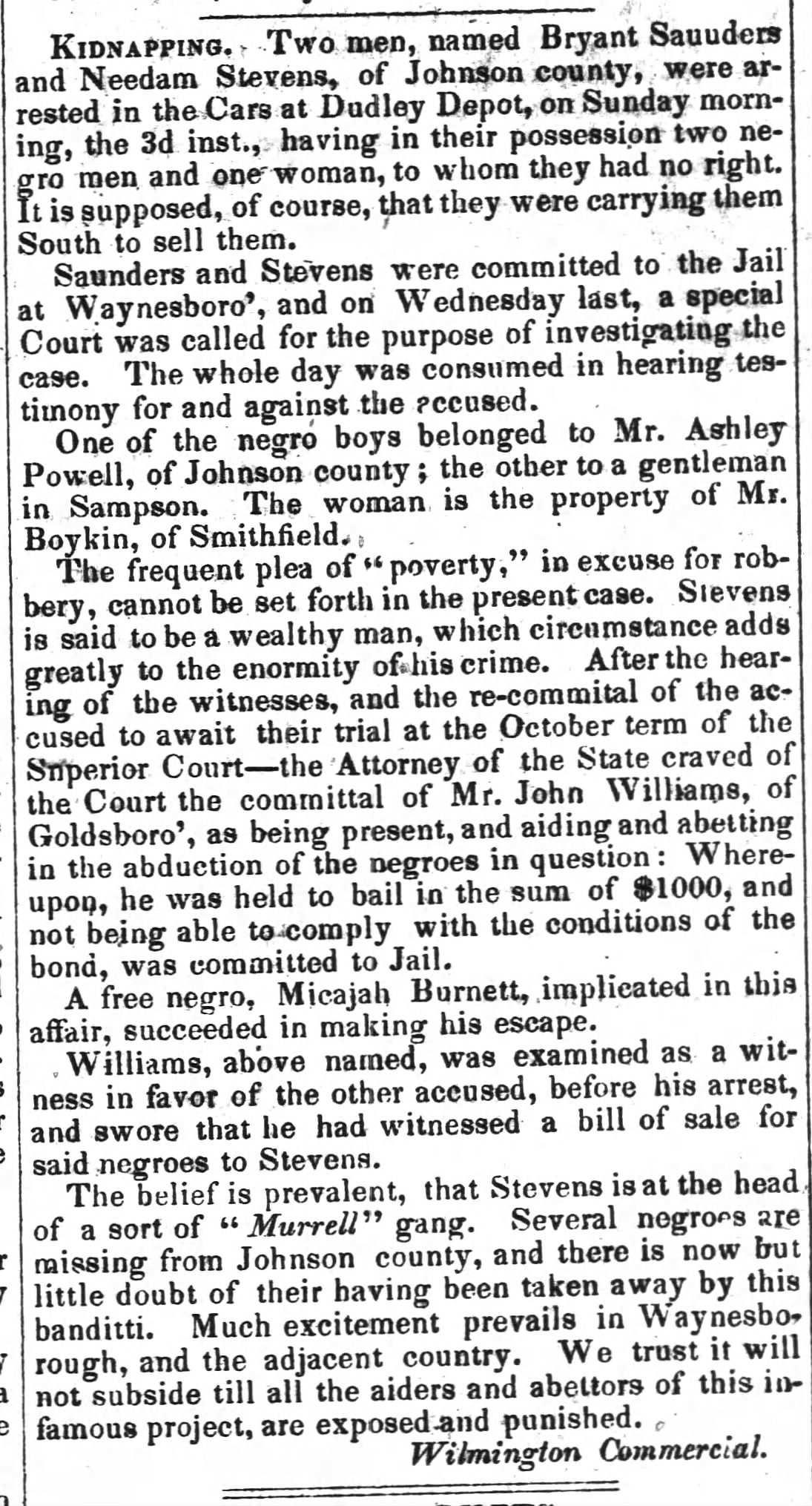
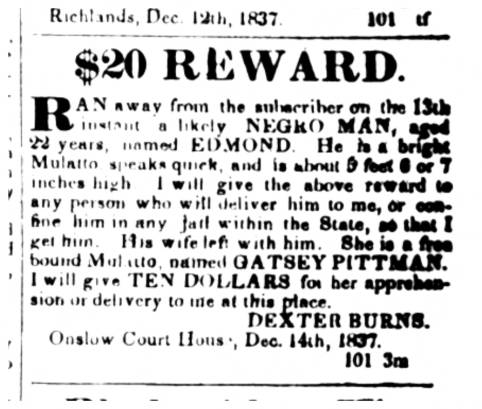
[Sidenote: The biography set forth in Moses Simmons’ obituary is peculiar in many particulars. First, his age is given as 78, though his death certificate lists it as 66. (An age within 0-5 years of those reported in census records.) Most startling, however, is the elaborate account of his alleged enslavement until age 29. Richards is an uncommon name in the Mount Olive area, and none appear in the 1840, 1850 or 1860 censuses of Wayne or Duplin County. That Moses was related to the large Simmons free family of color of Wayne County does not guarantee that he, too, was free, but all evidence indicates that in fact he was. He is listed in the 1850 census as an 18 year-old living in the household of Adam Winn in North Division, Duplin County. He was the son of Itey (or Ida) Simmons, who was free at least as early as 1854, when her son David conveyed to her a life estate in the land on which she was living. (Itey named David and Moses Simmons in her 1884 will – noting that she did not know if Moses were living – as well as the Maria Thompson named in Moses’ estate notice.) His kin Polly, Eliza and Buckner Simmons arrived in Cleveland in the early 1850s. Did he come with them? Why the myth of servitude? (And, speaking of myths, what happened to the fortune he was believed to have accumulated?)
P.S. Moses Simmons appears in dozens and dozens of Cleveland newspaper articles between 1863 and his death in 1900, with topics spanning his real estate and business dealings, his political maneuverings, his horses and his legal wrangling. Highlights: in 1877, an announcement for his bailbonding business; the same year, a notice that he was seeking divorce from wife Rettie, who had abandoned him; in 1884, an announcement for the opening of his tonsorial parlor; and in 1892, a report about a fire at his livery stable. – LYH]
 Fourth Generation Inclusive