Fourth Generation Inclusive

Historical Documents of Genealogical Interest to Researchers of North Carolina's Free People of Color

Category: Civil War

Free-born Delegates to North Carolina’s 1868 Constitutional Convention.

Parker David Robbins.

In the 1850 census of Gates County: John Robbins, 55, wife Mary, 37, and children Parker, 16, laborer, Augustus, 8, and Maranda, 4. In the 1860 census of Bertie County: Parker Robbins, 26, mechanic, wife Elizabeth, 18, and brother Augustus, 18.

Parker D. Robbins. Sgt. Maj., 2 Reg’t U.S. Col’d Cav. Field and Staff Muster Roll. Joined for duty, 1 Jan 1864, Fort Monroe, Virginia, for 3 years.

Parker David Robbins.  Died 1 November 1917, Magnolia, Duplin County. Colored. Married.  Born 1834 in Duplin County to John A. Robbins and an unknown mother.

For more about Parker Robbins: http://www.northcarolinahistory.org/encyclopedia/678/entry/

On January 16, 2012, the North Carolina Highway Historical Marker Program unveiled a marker in Duplin County dedicated to Robbins. http://www.ncmarkers.com/Results.aspx?k=Search&ct=btn

Cuffie Mayo.

In the 1820 census of Warren County: Cuffie Mayho listed as head of household of 4 free colored people.  In the 1840 census of Granville County: Cuffie Mayho listed as head of household of 7 free colored people.  In the 1850 census of Tar River, Granville County: Cuffy Maho, 35, blacksmith, wife Glatha, 35, and children Mary, 21, Parthenia, 14, Angeline, 12, Sarah, 6, Randelia, 4, and William, 3. In the 1860 census of Oxford, Granville County: Cuffee Mayo, 57, painter, wife Juliann, 36, and children Sarah, 16, and Ludelia Mayo, 15, plus Thomas Hawley, 19, farm laborer.

James Henry Harris.

In the 1850 census of Tabs Creek, Granville County: Charles T. Allen, 28, wife Elizabeth, 28, and children Benjamin, 8, Julia, 7, and Virginia Allen, 4, plus James Callahan, 12, Thomas Avery, 7, and James Harris, 17.

For information about all of North Carolina’s free-born and freed delegates: http://www.ncmuseumofhistory.org/collateral/articles/F08.african.american.political.pioneers.pdf

United States Colored Troops, no. 8.

37 U.S.C.T. Edward Hammonds. Co. T, 35 Reg’t U.S. Col’d Inf. appears on Company Descriptive Book of the organization named above. Description: age, 38 years; height, 5 feet 8 inches; complexion, light; eyes, dark; hair, dark; where born, Onslow County, NC; occupation, laborer. Enlistment: when, 30 August 1864; where, New Bern; by whom, A.P. Smith; term, 3 years. Remarks: mustered into U.S. Service at New Bern by Capt. Wm. Sweet 30 Aug 1864, bounty paid $100, due $200.

In the 1850 census of Lower South West, Onslow County: Edward Hammons, 24, in the household of Owen Jarrett, farmer.

14 H. Art’y U.S.C.T. Thomas Hammonds. Co. D, 14 Reg’t U.S. Col’d H. Art’y. appears on Company Descriptive Book of the organization named above. Description: age, 38 years; height, 5 feet 9 inches; complexion, black; eyes, black; hair, black; where born, Onslow County, NC; occupation, laborer. Enlistment: when, 23 May 1864; where, New Bern NC; by whom, Lt. Wheaton; term, 3 years.

In the 1850 census of Half Moon, Onslow County: Thomas Hammons, 55, wife Sena [no age], with Susan, 35, and Thomas Hammons, 24, Seana Littleton, 16, and Marthy White, 13.

2 Cav. U.S.C.T. Wilson Sawyer. Co. D, 2 Reg’t U.S. Col’d Cav. appears on Company Descriptive Book of the organization named above. Description: age, 17 years; height, 5 feet 2 inches; complexion, black; eyes, dark; hair, dark; where born, Camden County, NC; occupation, farmer. Enlistment: when, 24 December 1863; where, Fort Monroe; by whom, Col. Cole; term, 3 years. Remarks: engaged in action at Suffolk, Virginia, March 9, near Peterburgh June 6, 12 and 18, 1864.

In the 1850 census of Camden County: Mary Sayer, 30, with children Pricilla, 7, and Wilson, 2.

35 U.S.C.T. George Archer. Co. E, 35 Reg’t U.S. Col’d Inf. appears on Company Descriptive Book of the organization named above. Description: age, 25 years; height, 5 feet 7 ½ inches; complexion, light; eyes, grey; hair, dark; where born, Hertford, NC; occupation, government laborer. Enlistment: when, 22 May 1863; where, Newbern NC; by whom, Capt. Crofts; term, 3 years. Remarks: died at Gov’t Hosptl No. 5, Jacksonville, Florida, 18 August 1864, of chronic rheumatism; final statement papers forwarded to Adjt Genl’s office, Washington DC, 23 August 1864.

In the 1850 census of Southern District, Hertford County: Levi Archer, 43, laborer, wife Lucinda, 31, and children George T., 11, West, 9, Elizabeth, 7, Assirah, 2, and Bartelmus, 0.

36 U.S.C.T. Calvin Bow. Co. C, 36 Reg’t U.S. Col’d Inf. appears on Company Descriptive Book of the organization named above. Description: age, 20 years; height, 5 feet 5 ½ inches; complexion, black; eyes, black; hair, black; where born, Pasquotank County, NC; occupation, farmer. Enlistment: when, 13 June 1863; where, Roanoke Island NC; by whom, Lt. Shaw; term, 3 years. Remarks: mustered 28 Oct 1863 at Portsmouth, Virginia, by Lt. Horton; free on or about 19 April 1861; mustered out 13 June 1866 by reason of expiration of term of service at Brazos Santiago Texas.

In the 1850 census, Suttons Creek, Perquimans County: James Bow, 49, laborer, wife Penny, 35, and children Alfred, 18, Augustus, 15, Joshua, 12, Clarisa, 10, David, 8, Calvin, 6, and Timothy Bow, 1, and Isaiah Overton, 3 months.

11 H. Art’y U.S.C.T. Isiah Dove. Co. B, 11 Reg’t U.S. Col’d H. Art’y. appears on Company Descriptive Book of the organization named above. Description: age, 23 years; height, 5 feet 5 ½ inches; complexion, dark; eyes, black; hair, black; where born, Newbern, NC; occupation, seaman. Enlistment: when, 7 September 1863; where, Providence, Rhode Island; by whom, Capt. Simon; term, 3 years.

In the 1850 census of Craven County: Isaiah Dove, 22, laborer, wife Ann, 23, and son Levi, 3 months.

9 H. Art’y U.S.C.T. James R. Faithful. Co. E, 9 Reg’t U.S. Col’d H. Art’y. appears on Company Descriptive Book of the organization named above. Description: age, 40 years; height, 5 feet 8 ¾ inches; complexion, dark; eyes, brown; hair, dark; where born, unknown NC; occupation, farmer. Enlistment: when, 2 September 1864; where, Alliance, Ohio; by whom, Capt. Olliver; term, 1 year. 
United States Colored Troops, no. 7.

36 U.S.C.T. Nathan Dempsey. Co. C, 36 Reg’t U.S. Col’d Inf. appears on Company Descriptive Book of the organization named above. Description: age, 25 years; height, 5 feet 6 inches; complexion, black; eyes, black; hair, black; where born, Elizabeth City, NC; occupation, farmer. Enlistment: when, 10 November 1863; where, Norfolk VA.; by whom, Capt. Crofts; term, 3 years. Remarks: mustered 28 Dec 1863 at Fort Monroe VA by Lt. Horton.

36 U.S.C.T. Willis Dempsey. Co. C, 36 Reg’t U.S. Col’d Inf. appears on Company Descriptive Book of the organization named above. Description: age, 22 years; height, 5 feet 5 inches; complexion, black; eyes, black; hair, black; where born, Elizabeth City, NC; occupation, farmer. Enlistment: when, 11 December 1863; where, Portsmouth VA.; by whom, Lt. Gaskill; term, 3 years. Remarks: mustered 28 Dec 1863 at Fort Monroe VA by Lt. Horton; wounded in Deep Bottom Charge 29 Sept 1864; discharged the U.S. Service at Balfour Genl Hospl Portsmouth VA, 4 June 1865 on Smgs Cert of Dis; final statement given him by J.H. Frantz Asst Surg U.S.A. in charge.

In the 1850 census of Up River, Perquimans County: Willis Dempsey, 50, Martha, 35, Nathan, 9, and Willis Dempsey, 7.

36 U.S.C.T. Charles Spellman. Co. G, 36th Reg’t U.S. Col’d Inf. appears on Company Descriptive Book of the organization named above. Description: age, 18 years; height, 5 feet 1 ½  inches; complexion, dark; eyes, dark; hair, dark; where born, Camden Co., NC; occupation, farmer. Enlistment: when, 5 October 1863; where, Yorktown VA (mustered 28 October 1863, Portsmouth VA); by whom, Lt. J.N. North and Lt. Horton; term, 3 years.  Remarks: mustered out at New Orleans LA, 5 October 1866.

In the 1850 census of Pasquotank County: Millie Spellman, 50, with Jane, 16, Nixon, 8, and Charles Spellman, 6.

14 H. Art’y U.S.C.T. Morris White. Co. D, 14 Reg’t U.S. Col’d H. Art’y. U.S.C.T. appears on Company Descriptive Book of the organization named above. Description: age, 45 years; height, 6 feet 2 inches; complexion, light; eyes, grey; hair, black; where born, Onslow Co., NC; occupation, laborer. Enlistment: when, 1 June 1864; where, New Berne; by whom, Lt. Wheaton and Maj. Kennedy; term, 3 years.

14 H. Art’y U.S.C.T. Edward White. Co. D, 14 Reg’t U.S. Col’d H. Art’y. U.S.C.T. appears on COmpany Descriptive Book of the organizaton named above. Description: age, 45 years; height, 5 feet 5 inches; complexion, light; eyes, grey; hair, black; where born, Onslow Co., NC; occupation, laborer. Enlistment: when, 1 June 1864; where, New Berne; by whom, Lt. Wheaton and Maj. Kennedy; term, 3 years.

In the 1850 census of Cypress Creek, Jones County: Morris White, 32, with children John, 6, and Mary, 3. In the 1860 census of Lower South West, Onslow: Morris White 38, wife Penelope, 30, and children Mary E., 13, and Edward White, 9, plus Charity Morgan, 58.

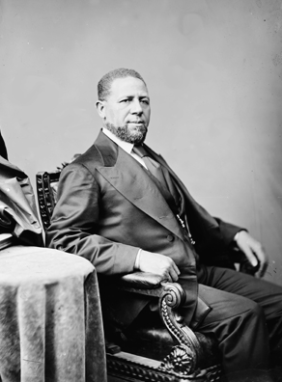
Hiram Rhodes Revels.

Image

Hiram Rhodes Revels was the first person of color to serve in the United States Congress.

Revels was born free in 1827 in Fayetteville, North Carolina. In 1838 he moved to Lincolnton, North Carolina to apprentice in his brother Elias B. Revels’ barber shop. After attending seminary in Indiana and Ohio, Revels was ordained as a minister in the African Methodist Episcopal Church in 1845 and served as a preacher and religious teacher throughout the Midwest.

Revels served as a chaplain in the United States Army during the Civil War and helped recruit and organize black Union regiments in Maryland and Missouri. He took part at the battle of Vicksburg in Mississippi. In 1865, Revels left the AME Church and joined the Methodist Episcopal Church. In 1866, he was given a permanent pastorship in Natchez, Mississippi, where he settled with his wife and five daughters, became an elder in the Mississippi District, continued his ministerial work, and founded schools for black children.

In 1869, Revels was elected to represent Adams County in the Mississippi State Senate. In 1870 he was elected to finish the term of one of the state’s two United States Senators, vacant since Mississippi seceded from the Union.

When Revels arrived in Washington, Southern Democrats opposed seating him in the Senate, basing their arguments on the Dred Scott decision, which ruled that people of African ancestry were not and could not be citizens. Because no black man was a citizen before the 14th Amendment was ratified in 1868, they argued, Revels could not satisfy the requirement for nine years’ prior citizenship.

Revels’ supporters of Revels made a number of arguments, including: (1)  that Revels was of mixed black and white ancestry (an “octoroon”) and the Dred Scott decision applied only to blacks who were of purely African ancestry; (2) that Revels had been  considered a citizen (and indeed had voted in Ohio) before Dred Scott; and (3) that the Civil War and the Reconstruction Amendments had voided Dred Scott. On February 25, 1870, Revels, on a strict party-line vote of 48 to 8, became the first black man to be seated in the United States Senate.

Revels resigned two months before his term expired to accept appointment as the first president of Alcorn Agricultural and Mechanical College (now Alcorn State University). In 1873, Revels took a leave of absence from Alcorn to serve as Mississippi’s secretary of state ad interim.  He died on January 16, 1901.

Adapted from Wikipedia. 

In the 1850 census of Cambridge City, Wayne County, Indiana: Robert Freeman, 34, laborer, born Virginia; Jane Freeman, 30, born Virginia; Malinda Freeman, 14, born Ohio; Hannah, 13, William H., 10, Robert, 4, and Margaret Freeman, 3, all born in Indiana; Charles Guinea, 18, born Virginia; and Hiram Revels, 25, and wife Phebe Revels, 17, both born in NC.

In the 1860 census of Ward 11, Baltimore, Baltimore County, Maryland: Hiram Revels, 35, Prest’n clergyman O.S., born North Carolina; wife Phoebe, 25, born Ohio; Elizabeth, 5, and Emma Revels, 3 months, born in Maryland; and Mary Brooks, 16, born in Maryland.

The governor’s tricks.

A BAD INVESTMENT.  – Quite a stir appears to have been made in Harnett county by the receipt at the Post Office at Barclayville of two packages of “N.C. Standard Extra, Raleigh, N.C., July 12, 1864,” each containing five copies thereof, each copy containing an address to Mr. Holden’s “Fellow-Citizens,” and 40 Tickets for W.W. Holden for Governor.  The packages were addressed, in the fair hand writing of some one about the Standard Office, to “John Deane, Barclayville, N.C.” and “David Tucker, Barclayville, N.C.,” both free mulattoes, and one of them a minor at that!  On the packages the postage was paid.  So that Mr. Holden is minus 10 Circulars, 400 Holden Tickets, and 10 cents in cash.  Rather an unprofitable investment! We have received two letters from gentlemen at Barclayville, enclosing the covers of packages and copies of the Extra. One of these letters says that Mr. Holden will have to come and read his Extra to his “colored brethren,” as they cannot read.  But he don’t think the accommodations in that section would be very agreeable to Mr. Holden.  – Fayetteville Observer.

The above is from the Observer of Thursday evening last, received here on Friday morning.  In our paper dated Wednesday, but printed and started to Fayetteville on Tuesday, we exposed this hoax, and the Editors of the Observer must have seen our exposure of it before their paper of Thursday went to press.  Yet they make no allusion to the exposure, but attempt to produce the impression that we are engaged in a correspondence with free negroes.

A week or so since we received a letter from Barclayville containing $8.65, as subscription for four persons to the Standard.  They professed to be warm friends of ours.  We supposed, of course, that the letter was from white persons and genuine in its character, and accordingly sent them the Standard with some tickets. We soon learned, however, that the names of the four persons sent were those of free negroes, and that we had been imposed upon by some mean white person or persons. Fortunately we had preserved the letter. – We have placed it in the hands of a friend, and if the author of it can be traced and discovered by the handwriting, we intend to hold him up in his true colors to our readers.

A friend writing us from Averasborough under date of July 20th, says:

“I wish to inform you of some of the tricks of the friends of Gov. Vance in this quarter.  I am informed there was a gathering on last Friday at J.A. Johnson’s, and that John Green, Esq., went there from Barclayville with two bundles, one marked to Dave Tucker, a free negro, containing one of your Standards and some tickets for you, and the other was marked to John Dean, another free boy.  I also learned that the reception of these bundles was to be magnified, and sent to the Observer for publication.  I have my own opinions as to this matter.  One J.A.J., who says you are Lincolnite, went on to Peterburg a few days before these bundles were received, and it is believed he caused them to be sent.”

So it seems the Editors of the Observer are parties to this free negro trick! They are welcome to all they may gain by the achievement.  We have heretofore entertained high respect for the Senior Editor as a gentleman, but we find now that he is as depraved and unscrupulous as the meanest Destructive in the State.  There is neither wit, nor humor, nor decency in this trick perpetrated by Mr. Hale and his friends.  A high tones, honorable gentleman would have scorned any allusion to such practiced on a brother Editor, save to condemn it as low and unworthy in its character. – But adversity is the test of character.  Defeat, loss of influence, and the prospect that the election of the peace candidate for Governor will shorten the war, and thus stop the enormous profits Mr. Hale is realizing by his manufacturing establishments, are staring him in the face, and like Gov. Vance, he is resorting to every desperate expedient, even using the names of free negroes to injure and defeat us.  Repeating the language of the poor cowards who wrote him from Barclayville, he says if we should go to that place the “accommodations in that section” would not be “very agreeable” to us. First, we are tricked, as say one could have been, by a set of unprincipled Destructives, and then we are threatened that if we should happen to visit the neighborhood of these people, we would be insulted and mobbed. This is the not the first time the Observer has justified mob law against us.  It did so in September last, soon after we were mobbed by the Georgia troops; and our estimate of the hearts of the Editors of that paper now is, that they would be pleased to hear to-morrow that our office had been laid in ashes by a band of desperadoes, and our life placed in peril, if not taken.  This is our estimate of the Editors of that journal.  We now leave them in the company they have deliberately chosen, with the remark that the odor which surrounds them as the result of their connection with this free negro hoax, is not more offensive to them than their conduct in this business will be to every decent person who may become fully acquainted with it.

We congratulate Gov. Vance on the character of the friends he has in Harnett.  They are worthy of him, and he is worthy of them.  Two years ago they called him a Lincolnite and a traitor, but now they love him so well that they even use the free negro to promote his election.  James A. Johnson, C.H. Cofield, and Z.B. Vance! You are welcome to them, Governor.  We should think we had committed some great crime if they were to vote for us.

Weekly Standard, Raleigh, 27 July 1864.

A guide for scouting parties of Union troops.

Willis M. Lewis filed claim #11536 with the Southern Claims Commission.  He was a farmer and resided on Trent Road in Craven County about three miles from New Bern.  “I frequently acted as a guide for scouting parties of United States troops, often aided and cared for sick and wounded soldiers.” Troops took his mare, hogs and corn and cut down pine trees for lumber to build barracks.  The 12th N.Y. Cavalry were encamped about ¾ mile from his place, and the 8th Connecticut were within 1 ½ miles. “I am a colored man, was free born, this property was my own.  The land from which the timber was cut I inherited from my father, the other property I purchased with moneys of my own.”

Calvin Bryan, age 34, testified to Lewis’ loyalty, confirming that Lewis had cared for sick Union soldiers and had guided scouting parties. He averred that Lewis “often said that he would go north if [the Confederacy] succeeded, he would not stay.” He witnessed Lewis’ property being hauled off to Camp Palmer.

In the 1860 census of Richardsons, Craven County: Willis Lewis, 74, farmer, with Sidney, 30, Willis, 22, Frederick, 8, Edward, 5, and Robinson Lewis, 4; plus James A. Morgan, 14; Frances Williams, 24; and Charles Sampson, 5.

I was born free but a colored man.

George Clark filed claim #2708 with the Southern Claims Commission.  Born in Guilford County, he was 61 years old and had lived six miles east of Lexington in Davidson County for 40 years.  He was a blacksmith. During the war, he piloted part of Stoneman’s command from his house in Davidson County to Salem in Forsyth County and fed union soldiers who had escaped from Salisbury prison.  “I had to leave my home and stay in the woods after I went to Salem with Gen’l Stonemans troops to show them the way.  I also had to move all my tools out of the shop because I was a Union man.”  Confederate soldiers took some of his tools and two of his horses. He believed that his brother Josiah Clark, who lived in Ohio, joined the Union army.  “I was born free but a colored man.”

Philip Ball testified to Clark’s loyalty and asserted that he and Clark “belonged to the Heroes of America.”

W.F. Henderson testified that “on the 10th day of April 1865 General Stonemans Army passed my house where I then lived six miles East of Lexington going towards the N.C. R. Road for the purpose of Destroying the Bridge across Abbots Creek (so They said) and they had with them the two Horses, the property of George Clark.  One sorrel  mare and one Gray mare.” “The claimant is a colored man which I have known for 30 years and is a unmistakable a Loyal Man and allywas has been and a poor man with a large family to support.”

Allowed: $200.00.

In the 1860 census of Northern Division, Davidson County: George Clark, 47, blacksmith; wife Elizabeth, 37; and children Marian, 20, Benjamin, 18, Jane, 12, Barbara, 8, Samuel, 6, Eli, 4, Lucinda, 2, and Obediah, 3.

The Confederates tried to get me again, but I dodged them.

Hugh Cale filed claim #12668 with the Southern Claims Commission.  He was 33 years old, resided in Elizabeth City, and engaged in trading. From 1861 to December 1862, he lived in Edenton.  He then moved to Plymouth until 1864.  He then “went in the United States service on board Steamer Massaint [Massasoit] a transport remained on her for five months. I then shipped on Steamer Pilot Boy still in the service of the United States and remained on her until after the close of the war.”

“I was taken in the Spring of 1861 & carried to Beatom Iland [Beacon Island] near Ocracoat-bar [Ocracoke] N.C. and was made to work on the fortifications for the Confederate Government against my will for I was a man of color. Was kept there two weeks and was then carried to Hatrass [Hatteras] to work on fortifications & was then kept there three months & three days.  We were then sent home, & remained home until the fall of Hatrass. I was then taken and put on board of the Schuner Cinaline and remained on her till the Capture of Roanoke Iland. I then went home the Confederate troops tried to get me again. I doged them.”  He “did all I could to get other collered people to leave home and to go the places held by the United States Authorities.”  “In 1862 I was arrested up the Chowan River as a spie for the United States. I was kept about five weeks under arrest and was not released until the Union troops took Winton.”  “The Confederate troops wanted me to go to Norfolk Va and get goods for them. I told them I couldnot do that. They said if I did not do it that I should not stay at Home. I faild to do it then Confederate soldiers came to my House & beat me so I was laid up for some time.” “After I became free I worked at the Masons trade. I made money after I went in [illegible] lines at Plymouth and paid for the property with it. Except the boat which I owned before the war. I never had a master.” Union soldiers took lumber, goods and a sail boat from him.

Cale worked as merchant from 1862 to 1864.  While absent, his clerk, Sam Skinner, conducted business for him.  After they captured Plymouth, United States authorities took such merchandise from Cale as butter, flour, tobacco, bacon, apples.

John Block estimated that Cale’s 26-foot boat, in good shape with sails and fixtures, was worth two hundred dollars.

Allowed: $602.50.

Report of the Secretary of War, Vol. I, 1865, “No. 20. List of vessels in service of Quartermaster’s department supplying General Sherman’s army” lists both the Massasoit and Pilot Boy.

Hugh Cale died July 22, 1910, in Elizabeth City, Pasquotank County.  He was about 75 years old.  His death certificate lists his occupation as merchant.

Colored Confederates — mostly cooks.

5 Cav. N.C. William Lynch, cook, Co. E., 63 Reg’t North Carolina Troops (Cavalry). Appears on Company Muster Roll of the organization named above, for March and April 1864.  Enlisted 12 Jan 1863 at Kinston, by Capt. Harris for duration of war. Remarks: “Enlisted as cook — free negro — has no horse”

3 N.C. Jackson Evans, Pvt., Co. F, 3 Reg’t North Carolina Inf. (State Troops). Appears on Company Muster Roll of the organization named above for November and December 1862.  Enlisted 15 July 1862 at Wayne as a conscript for duration of war.  Remarks: “This man was substituted for one J.W. Cox of Wayne Cty N.C. & proves to be a free negro”

5 Cav. N.C. William Rudd, cook, Co. E., 63 Reg’t North Carolina Troops (Cavalry). Appears on Company Muster Roll of the organization named above, for March and April 1864.  Enlisted 4 December 1862 at Hamilton by Capt. Harris for duration of war. Remarks: “Enlisted as cook — free negro — has no horse”

In the 1860 census of Western District, Halifax County: James Rudd, 55, farmer; wife Rebecca, 50, midwife; with Margaret Rudd, 26; Frances, 15, William, 14, and Ann M. Richardson, 9; and William Rudd, 23, carpenter, all mulatto.

3 Art.y N.C. Aurthur Reid, Pvt, Co. D., 40 Reg’t North Carolina Troops (Artillery). Appears on Company Muster Roll of the organization named above for July and August 1864.  Enlisted 16 June 1864 at Edgecombe by Capt. Lane for duration of war. Remarks: “Free Negro Cook for company since time of enlistment”

In the 1850 census of Edgecombe County: Arther Reid, 46, farmer; wife Pheby, 45; and children Brily, 22, Lucinda, 21, Louisa, 18, Sandy, 14, Jane, 10, Susan, 7, Arther, 5, and Ducan Reid, 2 months.

This alarm is altogether unfounded.

THE FREE NEGROES. – We understand that some of the free negroes in this community are alarmed for their personal safety.  This alarm is altogether unfounded, for we feel well assured that no free negro who conducts himself properly will suffer any harm.  We would suggest to the free negroes here to do as their brethren did at Newbern – volunteer to work in the cause of the State.  They can be made useful in working upon forts, magazines, arsenals, breastworks, &c. – Register.

Weekly Standard, Raleigh, 1 May 1861.