Fourth Generation Inclusive

Historical Documents of Genealogical Interest to Researchers of North Carolina's Free People of Color

Category: Biography

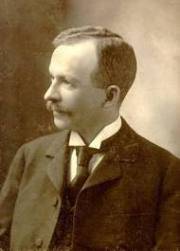
William Goyens.

William Goyens (or Goings), early Nacogdoches settler and businessman, was born in Moore County, North Carolina, in 1794, the son of free mulatto William Goings and a white woman. He came to Texas in 1820 and lived at Nacogdoches for the rest of his life. Although he could not write much beyond his signature, he was a good businessman. He was a blacksmith and wagonmaker and engaged in hauling freight from Natchitoches, Louisiana. On a trip to Louisiana in 1826, he was seized by William English, who sought to sell him into slavery. In return for his liberty, Goyens was induced to deliver to English his slave woman and to sign a note agreeing to peonage for himself, though reserving the right to trade on his own behalf. After his return to Nacogdoches, he successfully filed suit for annulment of these obligations.

During the Mexican Texas era, Goyens often served as conciliator in the settlement of lawsuits under the Mexican laws. He was appointed as agent to deal with the Cherokees, and on numerous occasions he negotiated treaties with the Comanches and other Indians. He also operated an inn near the site of what is now the courthouse in Nacogdoches. In 1832, he married Mary Pate Sibley, who was white. Sibley had one son, Henry Sibley, from a former marriage, but Goyens and Mary had no children together.

During the Texas Revolution, Goyens was interpreter for Gen. Sam Houston and his party in negotiations for a treaty with the Cherokee. After the revolution he purchased what was afterwards known as Goyens’ Hill, four miles west of Nacogdoches. He built a large two-story mansion with a sawmill and gristmill west of his home on Moral Creek, where he and his wife lived until their deaths. During his later life Goyens amassed considerable wealth in real estate, despite constant efforts by his white neighbors to take it away. He always employed the best lawyers in Nacogdoches, including Thomas J. Rusk and Charles S. Taylor, to defend him and was generally successful in his litigation. He died on June 20, 1856, soon after the death of his wife; they were both buried in a cemetery near the junction of Aylitos Creek with the Moral. At his grave a marker was erected by the Texas Centennial Commission in 1936. Many traditions grew up in Nacogdoches about this unusual man, and sometimes it is hard to tell just what is true and what is tradition.

Adapted from Texas State Historical Association, tshaonline.org

Now, you see, my father was a free man.

William Scott

William Scott: Ex-Slave Story, 401 Church St., 77 years old.

My name is William Scott. I live at 401 Church Street, Raleigh, North Carolina. I wuz born 1860, March 31st. I wuz free born. My father wuz William Scott. I wuz named after my father. My mother wuz Cynthia Scott. She wuz a Scott before she wuz married to my father. She wuz born free. As far back as I can learn on my mother’s side they were always free.

My mother and father always told me my grandfather wuz born of a white woman. My grandfather wuz named Elisha Scott. I have forgot her name. If I heard her name called I have forgot it. My grandfather on my mother’s side wuz a Waverly. I can’t tell you all about dese white folks, but some of ’em, when they died, left their property to mulattoes, or half-breed children, and several of them are living in this community now. I can tell you exactly where they are, and where they got their property. Some of them are over half white. They were by a Negro woman who wuz a mulatto and a white man. Dey air so near white you can’t tell them from white folks. This condition has existed as long ago as I have any recollection, and it still exists, but there are not as many children according to the relations as used to be.

Free Negroes were not allowed to go on the plantations much. Now you see my father wuz a free man. We lived right here in town. My father wuz a ditcher and slave gitter. One night the man he worked for got up a crowd and come to whup him and take his money away from him. He had paid father off that day. Dat night dey come an’ got him an’ blindfolded him. He moved the blindfold from over his eyes and run an’ got away from ’em. He never did go back no more to the man he had been workin’ for. I wuz a little boy, but I heard pappy tell it. Dat wuz tereckly after de surrender. Pappy saw the man he had been workin’ for when he slipped the blindfold off his face, and he knowed him.

I wuz a boy when the Yankees came to Raleigh. They came in on the Fayetteville Road. They stopped and quartered at the edge of the town. I remember they had a guardhouse to put the Yankees in who disobeyed. Later on they came in from the east and quartered at the old Soldiers Home right in there, but not in the buildings. There were no houses there when the Yankees came. They had some houses there. They built ’em. They stayed there a good while until all the Yankees left. When the Yankees first came in they camped over near Dix Hill, when they come into town you hardly knew where they come from. They were jist like blue birds. They jist covered the face of the earth. They came to our house and took our sumpin’ to eat. Yes sir, they took our sumpin’ to eat from us Negroes. My daddy didn’t like deir takin’ our rations so he went to de officer and tole him what his men had done, and the officers had sumpin’ to eat sent over there.

My mammy cooked some fur de officers too. Dey had a lot of crackers. Dey called ’em hard tack. The officers brought a lot of ’em over dere. We lived near the Confederate trenches jist below the Fayetteville Crossin’ on Fayetteville Street. The breastworks were right near our house.

I know when the colored men farmed on share craps, dey were given jist enough to live on, and when a white man worked a mule until he wuz worn out he would sell him to de colored man. De colored man would sometime buy ‘im a old buggy; den he wuz called rich. People went to church den on steer carts, that is colored folks, most uv ’em. De only man I wurked for along den who wud gib me biscuit through de week wuz a man named June Goodwin. The others would give us biscuit on Sundays, and I made up my mind den when I got to be a man to eat jist as many biscuits as I wanted; and I have done jist dat.

My mammy used to hire me out to de white folks. I worked and made jist enough to eat and hardly enough clothes to wear to church until I wuz a man. I worked many a day and had only one herrin’ and a piece of bread for dinner. You know what a herrin’ fish is? ‘Twon’t becase I throwed my money away, twas cause we didn’t git it, nuther to save up. When we farmed share crap dey took all we made. In de fall we would have to split cord wood to live through de winter.

I will tell you now how I got my start off now, I am going to use dis man’s name. I went to work for a man name George Whitaker. I drive a wagon for him. He ‘lowed me all de waste wood for my own use. This wuz wood dat would not sell good on de market. I hauled it over home. I worked for him till he died, en his wife lowed me a little side crap. I made this crap, took de money I got for it, and built a little storehouse. I disremember how long I worked fer Mis’ Hannah Whitaker. Den I quit work for her and went to work for myself. I owns dat little storehouse yit, de one I worked wid Mis’ Hannah Whitaker, en from dat I bought me a nudder home.

When de Yankees come to Raleigh dere wuz a building dey called de Governor’s Palace, it stood whur de Auditorium now stands. Right back o’ where de courthouse now stands wuz a jail and a gallows an’ a whuppin’ pos’ all dere together. I know when dey built de Penitentiary dey hauled poles from Johnston County. Dey called dem Johnston County poles. Dey hauled em in on trains. Dis post office wuz not built den. De post office den wuz built of plank set up an’ down.

I remember seeing a man hung down at de jail. His name wuz Mills. He wuz a white man. When he got on de scaffold he said, ‘What you gwine to do to me do it quick and be done wid it’.

I think Abraham Lincoln done the colored man a heap of good. If it hadn’t been for Mr. Roosevelt there are many livin’ today who would have parished to death. There are plenty of people walkin’ about now who would have been dead if Mr. Roosevelt had not helped them. The only chance I had to hold my home wuz a chance given me through him. At my age, I cannot make much at work, but through things he helped me, and I is holding my own.

From Slave Narratives: A Folk History of Slavery in the United States from Interviews with Former Slaves (1841).

In the 1850 census of Raleigh, Wake County: Alfred Wavy, 25, Kazina, 38, Lewis H. Wavy, 2, and Syntha H. Scott, 14. But: in Camp Creek, Rutherford County: William Scott, 25, Cynda, 17, Rufus, 16, Wesley, 15, and Mary Scott, 6 months.

In the 1860 census of Alamance County: Wm. Scott, 24, fireman, wife Synthia, 23, and children May J., 3, Saml, 1, and Jane, 2 months.

William Scott. Died 14 June 1945, Raleigh, Wake County. Resided 601 Church St. Colored. Widower. Laborer. Born 5 Aug 1852 in Wake County to William Scott and Senthia Scott. Buried Mount Hope, Raleigh. Informant, Pinkie Hall.

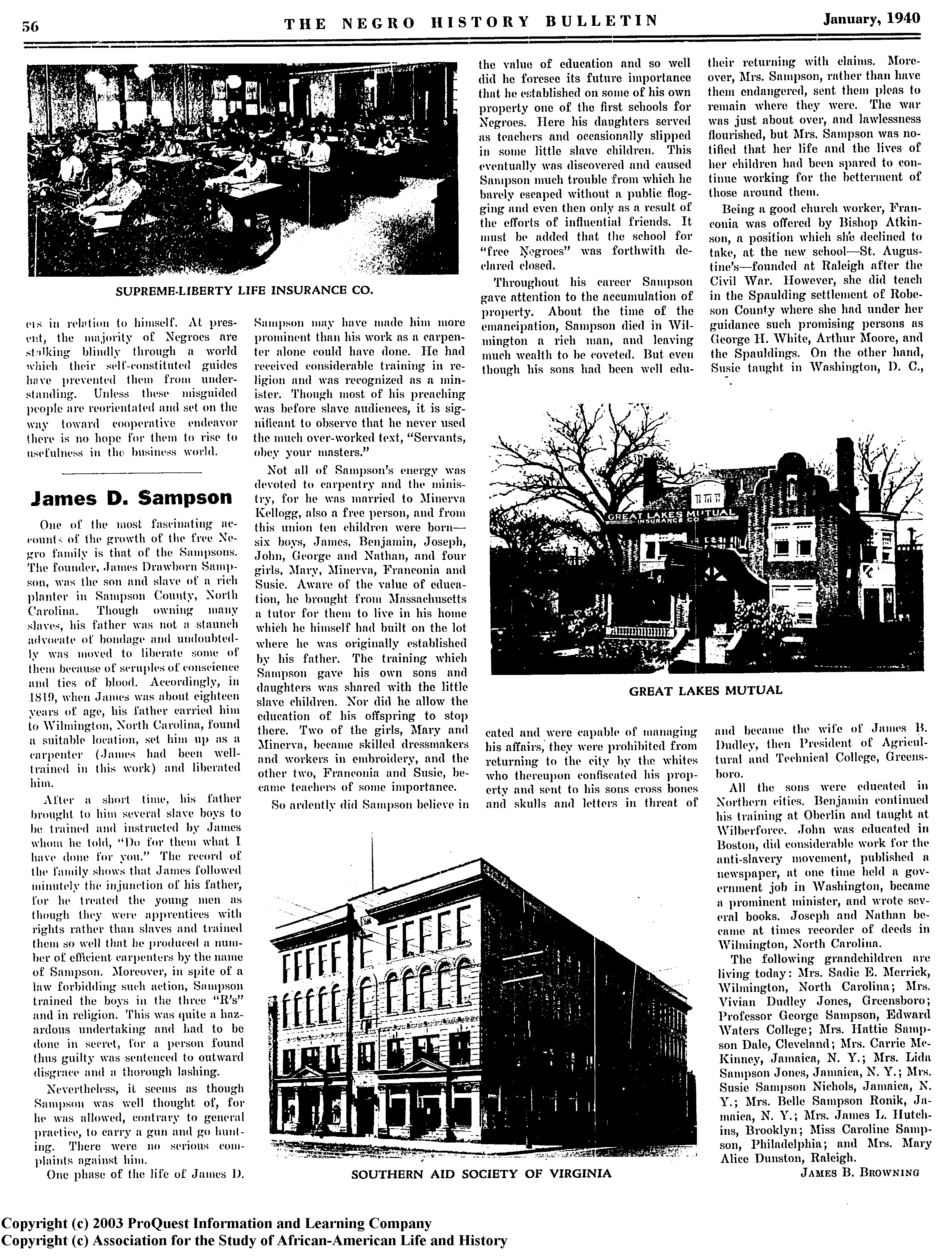
James Drawhorn Sampson.

ImageNegro History Bulletin, January 1940.

Shuffer Tonies was free issues and part Indian.

MEMORIES OF UNCLE JACKSON, John H. Jackson, 309 S. Sixth St., Wilmington, N.C.

My mother was the laund’ess for the white folks. In those days ladies wore clo’es, an’ plenty of ’em. My daddy was one of the part Indian folks. My mammy was brought here from Washin’ton City, an’ when her owner went back home he sold her to my folks. You know, round Washin’ton an’ up that way they was Ginny (Guinea) niggers, an’ that’s what my mammy was. We had a lot of these malatto negroes round here, they was called ‘Shuffer Tonies’, they was free issues and part Indian. The leader of ’em was James Sampson. We child’en was told to play in our own yard and not have nothin’ to do with free issue chil’en or the common chil’en ‘cross the street, white or colored, because they was’nt fitten to ‘sociate with us. You see our owners was rich folks. Our big house is the one where the ladies of Sokosis (Sorosis) has their Club House, an’ our yard spread all round there, an’ our house servants, an’ some of the bes’ artisans in Wilmin’ton lived in our yard.

I mus’ tell you’ bout Gov’ner Dudley’s election, an’ the free issue niggers. They say Mr. Dudley told ’em if they’d vote for him he’d do more for ’em than any man ever had. So they voted for him an’ he was elected. Then he ups an’ calls a const’utional convention in Raleigh an’ had all the voting taken away from ’em. An’ that the big thing he done for em.

From Slave Narratives: A Folk History of Slavery in the United States from Interviews with Former Slaves (1841).

In the 1860 census of Wilmington, New Hanover County: carpenter Jas. Sampson heads a household that includes his wife Francinia, 49; James, 30, shoemaker; Joseph, 28, carpenter; Eliza, 19; Jannie, 15; and Susan Sampson, 8; carpenters Ben Freeman, 19, and Wm. Campbell, 18; and “sv’t in house” Melinda Green, 72, Dave Miller, 30, Lucy Miller, 27, Virgil McRae, 60, and Maria McRae, 55, all mulatto. Sampson reported owning $26,000 real estate and $10,000 personal estate.

She mixed his blood with whiskey and drank it.

EX-SLAVE STORY AS TOLD BY MILLIE MARKHAM OF 615 ST. JOSEPH ST., DURHAM, N.C.

I was never a slave. Although I was born somewhere about 1855, I was not born in slavery, but my father was. I’m afraid this story will be more about my father and mother than it will be about myself.

My mother was a white woman. Her name was Tempie James. She lived on her father’s big plantation on the Roanoke River at Rich Square, North Carolina. Her father owned acres of land and many slaves. His stables were the best anywhere around; they were filled with horses, and the head coachman was named Squire James. Squire was a good looking, well behaved Negro who had a white father. He was tall and light colored. Tempie James fell in love with this Negro coachman. Nobody knows how long they had been in love before Tempie’s father found it out, but when he did he locked Tempie in her room. For days he and Miss Charlottie, his wife, raved, begged and pleaded, but Tempie just said she loved Squire. ‘Why will you act so?’ Miss Charlottie was crying. ‘Haven’t we done everything for you and given you everything you wanted?’

Tempie shook her head and said: ‘You haven’t given me Squire. He’s all I do want.’

Then it was that in the dark of the night Mr. James sent Squire away; he sent him to another state and sold him.

But Tempie found it out. She took what money she could find and ran away. She went to the owner of Squire and bought him, then she set him free and changed his name to Walden, Squire Walden. But then it was against the law for a white woman to marry a Negro unless they had a strain of Negro blood, so Tempie cut Squire’s finger and drained out some blood. She mixed this with some whiskey and drank it, then she got on the stand and swore she had Negro blood in her, so they were married. She never went back home and her people disowned her.

Tempie James Walden, my mother, was a beautiful woman. She was tall and fair with long light hair. She had fifteen children, seven boys and eight girls, and all of them lived to be old enough to see their great-grandchildren. I am the youngest and only one living now. Most of us came back to North Carolina. Two of my sisters married and came back to Rich Square to live. They lived not far from the James plantation on Roanoke River. Once when we were children my sister and I were visiting in Rich Square. One day we went out to pick huckleberries. A woman came riding down the road on a horse. She was a tall woman in a long grey riding habit. She had grey hair and grey eyes. She stopped and looked at us. ‘My,’ she said, ‘whose pretty little girls are you?’

‘We’re Squire Walden’s children,’ I said.

She looked at me so long and hard that I thought she was going to hit me with her whip, but she didn’t, she hit the horse. He jumped and ran so fast I thought she was going to fall off, but she went around the curve and I never saw her again. I never knew until later that she was Mis’ Charlottie James, my grandmother.

I don’t know anything about slavery times, for I was born free of free parents and raised on my father’s own plantation. I’ve been living in Durham over sixty-five years.

From Slave Narratives: A Folk History of Slavery in the United States from Interviews with Former Slaves (1841).

Squire Walden married Tempy James on 28 March 1832 in Halifax County. John Keemer was bondsman, and clerk of court J.H. Harwell witnessed. 

In the 1850 census of Northampton County: Squire Walden, 38, laborer, wife Temperance, 34, and children Samuel, 14, William, 13, Amanda, 12, Martha, 11, James, 9, Hester, 8, Peyton, 5, and Whitman, 1, plus William Walden, 78, farmer. All born in NC, except the elder William, who was born in Virginia. All were described as mulatto.


Opens at once both earth and heaven.

I went to my mistress and inquired what was her price for me. She said a thousand dollars. I then told her that I wanted to be free, and asked her if she would sell me to be made free. She said she would; and accordingly I arranged with her, and with the master of my wife, Mr. Smith, already spoken of, for the latter to take my money  and buy of her my freedom, as I could not legally purchase it, and as the laws forbid emancipation except, for “meritorious services.” This done, Mr. Smith endeavored to emancipate me formally, and to get my manumission recorded; I tried also; but the court judged that I had done nothing “meritorious,” and so I remained, nominally only, the slave of Mr. Smith for a year; when, feeling unsafe in that relation, I accompanied him to New York whither he was going to purchase goods, and was there regularly and formally made a freeman, and there my manumission was recorded. I returned to my family in Raleigh, and endeavored to do by them as a freeman should. I had known what it was to be a slave, and I knew what it was to be free.

But I am going too rapidly over my story. When the money was paid to my mistress and the conveyance fairly made to Mr. Smith, I felt that I was free. And a queer and a joyous feeling it is to one who has been a slave. I cannot describe it, only it seemed as though I was in heaven. I used to lie awake whole nights thinking of it. And oh, the strange thoughts that passed through my soul, like so many rivers of light; deep and rich were their waves as they rolled; — these were more to me than sleep, more than soft slumber after long months of watching over the decaying, fading frame of a friend, and the loved one laid to rest in the dust. But I cannot describe my feelings to those who have never been slaves; then why should I attempt it? He who has passed from spiritual death to life, and received the witness within his soul that his sins are forgiven, may possibly form some distant idea, like the ray of the setting sun from the far off mountain top, of the emotions of an emancipated slave. That opens heaven. To break the bonds of slavery, opens up at once both earth and heaven. Neither can be truly seen by us while we are slaves.

[Footnote omitted.] From THE NARRATIVE OF LUNSFORD LANE, FORMERLY OF RALEIGH, N. C., Embracing an account of his early life, the redemption by purchase of himself and family from slavery, And his banishment from the place of his birth for the crime of wearing a colored skin. PUBLISHED BY HIMSELF (1842).

Pure white and Indian.

Image

Enoch Manuel and wife live in Dismal Township, Sampson County. He is now 70 years old. His father was Michael Manuel and lived on South River and died in 1858. Michael’s father was Nicholas Manuel, a soldier in the Revolutionary War, in John Toomer’s Army. His father was Ephraim Manuel. The records of Sampson County show, book 5, page 222, that in the reign of George III Benjamin Williams conveyed to Ephraim Manuel 400 acres of land, lying on the east side of Great Coharie, charging annual quit rents to His Majesty. We find another deed from Solomon Hardin to Levi Manuel, dated October 10, 1778, for 125 acres on March Branch and Miry Bottom Branch in Sampson County, consideration 50 English pounds. There are numerous other old deeds to the Manuel family on record in Sampson County. The father of Ephraim Manuel was Nickey Manuel and came from Roanoke River and claimed to be half white and half Indian. There is no trace of negro blood known to exist in the Manuel family as far back as they have any record.

Enoch Manuel says that his ancestor, Nickey Manuel, raised Matthew Leary, father of Sheridan Leary, who was killed in John Brown’s insurrection at Harper’s Ferry. Sheridan Leary was a brother of John S. Leary, a lawyer of Charlotte, formerly of Fayetteville, N. C.  …  Sarah, wife of Enoch Manuel, whose picture appears above, was a daughter of Amos Hardin, a wheelright [sic] in Honeycutts Township, and was recognized as a Croatan Indian. This couple have seven children and numerous grandchildren. They have not intermarried with the negro race, and their children attend Shiloh Indian School in Dismal Township, of which school Enoch Manuel was the founder.

[“]My mother’s mother was one Lanie Jackson, a white woman. Therefore as you can plainly see, my father and mother were pure white and Indian. My wife was the daughter of Amos Harding and Cassie Lockamy, a white woman, of Irish descent.

We had in our home several sons and daughters. Jonah Emanuel, who married Luberta Bledsole, daughter of W. J. Bledsole. W.J. Bledsole was the son of Mary Bledsole, a white woman, his father unknown. He is evidently a white man, with some trace of Indian blood. Enoch Emanuel, Jr., also married a daughter of the above W. J. Bledsole. Macy Lee Emanuel married Hassie J. Jones of Robeson County, a person of white and Indian descent. All of the above are descendants of the late Nicholas Emanuel and Jonathan Harding.

Many of the members of the Emanuel family have moved to other sections. They are now living in as many as seven different States of the Union. Some have spelled our name Manuel; others Emanuel. I have followed the latter form for our name in this pamphlet. [“]

From George E. Butler, “The Croatan Indians of Sampson County, North Carolina. Their Origin and Racial Status. A Plea for Separate Schools,” (1916).

Charles Waddell Chesnutt.

Image

Charles Waddell Chesnutt was an author, essayist, political activist and lawyer, best known for his novels and short stories exploring complex issues of racial and social identity in the post-Civil War South. Chesnutt was born June 20, 1858, in Cleveland, Ohio, to A. Jackson Chesnutt and Ann Maria Sampson Chesnutt, free people of color from Fayetteville, North Carolina. His paternal grandfather was known to be a white slaveholder. Chesnutt said he was seven-eighths white, but identified as a colored man.

In 1867, the Chesnutts returned to Fayetteville. By age 13, Charles was a pupil-teacher at the Howard School, one of many founded for black students by the Freedmen’s Bureau during the Reconstruction era. He eventually was promoted to assistant principal of the normal school in Fayetteville (later Fayetteville State University), one of a number of historically black colleges established for the training of black teachers. In 1878, Chesnutt married Susan Perry. The couple moved briefly to New York City, then Cleveland, Ohio. Chesnutt passed the Ohio bar exam in 1887 and established a lucrative legal stenography business.  Chesnutt also began writing stories, and in August 1887 Atlantic Monthly published his first short story, “The Goophered Grapevine.” Chesnutt’s The Conjure Woman, a collection of short stories, appeared in 1899.  Chesnutt’s works grappled with complex issues of racial identity and social place, and he began to write novels that reflected his stronger sense of activism. His Marrow of Tradition was a political-historical novel based on the Wilmington Massacre of 1898, in which white Democratic insurrectionists overthrew city government, burned a black newspaper office, and randomly killed black citizens. Because his novels posed a more direct challenge to existing sociopolitical conditions, they were not as popular as his short stories, and poor sales doomed his hopes of a self-supporting literary career.

In the new century, Chesnutt increasingly turned his energies social and political activism. He served on the General Committee of the newly founded National Association for the Advancement of Colored People and became one of the early 20th century’s most prominent activists and commentators. Chesnutt died on November 15, 1932, at the age of 74. He was interred in Cleveland’s Lake View Cemetery.

Modified from Wikipedia.

In the 1850 census of Fayetteville, Cumberland County: Anna M. Chestnut, 37, and children Geo. W., 19, barber, Jackson, 17, laborer, Sophia, 13, Stephen, 9, Mary Ann, 7, and Dallas Chestnut, 3. All of Anna’s children claimed real property valued $100-250, possibly inherited from their father.  Also, Moses Harris, 45, carpenter; wife Chloe Harris, 40; Ann M. Sampson, 18; and John Jasper, 6.

Andrew Jackson Chestnut died 26 December 1920 in Fayetteville, Cumberland County. His death certificate described him as a married, colored male; aged 87; and a farmer. He was born in North Carolina to Waddell Cade and Annie Chestnut.  He was buried in Brookside Annex. Miss Annie Chestnut of Fayetteville was the informant.

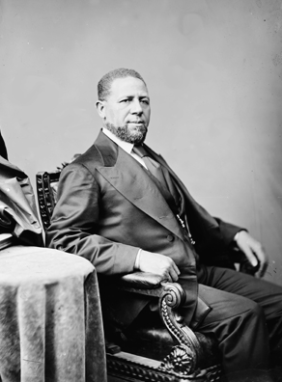
Hiram Rhodes Revels.

Image

Hiram Rhodes Revels was the first person of color to serve in the United States Congress.

Revels was born free in 1827 in Fayetteville, North Carolina. In 1838 he moved to Lincolnton, North Carolina to apprentice in his brother Elias B. Revels’ barber shop. After attending seminary in Indiana and Ohio, Revels was ordained as a minister in the African Methodist Episcopal Church in 1845 and served as a preacher and religious teacher throughout the Midwest.

Revels served as a chaplain in the United States Army during the Civil War and helped recruit and organize black Union regiments in Maryland and Missouri. He took part at the battle of Vicksburg in Mississippi. In 1865, Revels left the AME Church and joined the Methodist Episcopal Church. In 1866, he was given a permanent pastorship in Natchez, Mississippi, where he settled with his wife and five daughters, became an elder in the Mississippi District, continued his ministerial work, and founded schools for black children.

In 1869, Revels was elected to represent Adams County in the Mississippi State Senate. In 1870 he was elected to finish the term of one of the state’s two United States Senators, vacant since Mississippi seceded from the Union.

When Revels arrived in Washington, Southern Democrats opposed seating him in the Senate, basing their arguments on the Dred Scott decision, which ruled that people of African ancestry were not and could not be citizens. Because no black man was a citizen before the 14th Amendment was ratified in 1868, they argued, Revels could not satisfy the requirement for nine years’ prior citizenship.

Revels’ supporters of Revels made a number of arguments, including: (1)  that Revels was of mixed black and white ancestry (an “octoroon”) and the Dred Scott decision applied only to blacks who were of purely African ancestry; (2) that Revels had been  considered a citizen (and indeed had voted in Ohio) before Dred Scott; and (3) that the Civil War and the Reconstruction Amendments had voided Dred Scott. On February 25, 1870, Revels, on a strict party-line vote of 48 to 8, became the first black man to be seated in the United States Senate.

Revels resigned two months before his term expired to accept appointment as the first president of Alcorn Agricultural and Mechanical College (now Alcorn State University). In 1873, Revels took a leave of absence from Alcorn to serve as Mississippi’s secretary of state ad interim.  He died on January 16, 1901.

Adapted from Wikipedia. 

In the 1850 census of Cambridge City, Wayne County, Indiana: Robert Freeman, 34, laborer, born Virginia; Jane Freeman, 30, born Virginia; Malinda Freeman, 14, born Ohio; Hannah, 13, William H., 10, Robert, 4, and Margaret Freeman, 3, all born in Indiana; Charles Guinea, 18, born Virginia; and Hiram Revels, 25, and wife Phebe Revels, 17, both born in NC.

In the 1860 census of Ward 11, Baltimore, Baltimore County, Maryland: Hiram Revels, 35, Prest’n clergyman O.S., born North Carolina; wife Phoebe, 25, born Ohio; Elizabeth, 5, and Emma Revels, 3 months, born in Maryland; and Mary Brooks, 16, born in Maryland.

Dave Dickinson.

Dave Dickinson or Dickerson (ca. 1790-after 1850) was a black plasterer and bricklayer active in the Albemarle region in the early 19th century who spent much of his life as an enslaved artisan but was manumitted late in his life. He worked for a planter clientele wealthy enough to build houses with plastered walls. Because of the records kept by these clients and their use of Dickinson’s full name (rather than just a first name as was the case for many enslaved artisans), an unusual amount of his work is documented. There are numerous references to artisans named Dave and Davy, Dickinson and Dickerson, probably referring to the same man but possibly to two different men.

“The first references to Dave Dickinson appear in the memorandum books kept by planter James C. Johnston when he was building his Hayes Plantation House near Edenton. Johnston recorded many payments to workmen, usually by name and only rarely by task, and did not generally distinguish between enslaved and free workmen. Among Johnston’s payments to artisans are those to Dave Dickinson in 1816 and 1817, some as small sums, others as ‘wages’ of $30 and more. Johnston did not identify Dickinson’s trade, but he may have been involved in plastering. During the spring and summer of 1817, Dickinson was at work along with Benjamin French, a plasterer who had come from New York to execute the refined plasterwork at Hayes.

“A plasterer named Dave Dickerson — probably the same man — was mentioned by Chowan County planter Clement Blount in 1837. Blount and his cousin Ebenezer Pettigrew of Tyrrell County were both in need of plasterers. Blount wrote to Pettigrew on June 6, 1837, that he had obtained ‘the promise of Dave Dickerson to go on the 15th July if nothing turns up to prevent him. I think he is industrious and will do the work well.’ In the meantime, Blount was looking out for another plasterer. ‘The fellow Jack Moody [?] I was telling you of I did not know who had the control of him, I have since been informed the Brandy bottle controls him.’ Two months later, Blount had had no success. While waiting to see if Dickerson had finished ‘Mr. [James?] Johnston’s work,’ Blount visited Johnston’s house ‘to see if he was done, and he has not done one stroke of work there yet and has gone to Washington County to Plaster a House for Mr. Harrison at Lees Mills, which is treating you and myself very ill.’ (Blount decided to employ another plasterer, Benjamin Balfour.) In a time when skilled artisans were scarce, even such wealthy and influential men as Blount and Pettigrew were often at the mercy of workmen such as Dickinson, who served a far-flung planter clientele according to his own schedule.

“Dave Dickinson was evidently enslaved for most of his life, but operated almost as a free man. An intriguing entry in the United States census of 1840 listed in Edenton one David Dickinson who, according to the check marks on the census form, was head of a household that included no free people, white or of color, but four slaves — the total number of people cited for the household. Three members of the household were occupied in manufacturing or a trade. It is possible though unusual that the census taker might list a slave household in this way, perhaps thus identifying the household of a well known person living essentially as a free man. (There are also a few other heads of households listed in Edenton in the same census in which no free persons are included, and the total number of household members is the same as the number of enslaved people. Whether these listings were errors or actually represented households of enslaved persons is unknown.)

“In 1846, Joseph D. Bond of Chowan County petitioned for the emancipation of ‘a negro slave known by the name of Davy Dickinson,’ who was then aged 50 and had maintained a good character and given meritorious service. The court granted the petition in 1847. The United States Census of 1850 listed in Edenton a free black bricklayer named Davy Dickerson, aged 60, owner of $200 worth of real property, and with no family members listed as free people. (He may have been living alone or may have had a family who were still enslaved). How long he lived as a free man or who his family members were is not yet known.”

Author: Catherine W. Bishir.  Published 2009.

As published in North Carolina Architects and Builders: A Biographical Dictionary,  http://ncarchitects.lib.ncsu.edu  (All rights retained.) This web site is a growing reference work that contains brief biographical accounts, building lists, and bibliographical information about architects, builders, and other artisans who planned and built North Carolina’s architecture.