Fourth Generation Inclusive

Historical Documents of Genealogical Interest to Researchers of North Carolina's Free People of Color

Month: April, 2013

Killer escaped.

HALIFAX. MARCH 20.

Last night Harris Allen, who was committed for the murder of John James, a free mulatto, of Northampton county, made his escape from the gaol of this town. He is remarkable tall man, and had on a short round jacket. It is hoped the officers of justice and others, will be vigilant in their endeavours to apprehend and bring him to condign punishment.

North-Carolina Journal, Halifax, 20 March 1793.

I think they will aim for Washington or New Bern.

Ten Dollars Reward.

Ranaway form the Subscriber on Sunday, the 19th instant. A bright Mulatto Man named Mark. About 42 or 42 years of age, five feet 10 or 11 inches high; straight and stout built; a good countenance; a film coming on his left eye – had two or three pair of homespun Jackets and Trowsers, some of them filled with wool and dyed purple. He went off with a free mulatto woman by the name of Dill Moore, who has a free pass, and I expect she has procured one for him also. I think they will aim for Washington or Newbern, for the purpose of obtaining a passage on board some vessel bound for a Northern port. Should Dill Moore take a passage for herself only, she probably may have the man put on board privately. The above reward will be paid to any person who will deliver the said Mark to me, or secure him in any prison so that I can get him again.

Masters of vessels and all other persons, are hereby forbid to harbor, employ or carry off the said Mark, as I will prosecute with vigour the person so offending.  JAMES HANRAHAN. Washington’s Ferry, Pitt County. April 25, 1829.

North Carolina Sentinel, New Bern, 13 June 1829.

Says he bought them from a free colored person.

GREENSBORO’, N.C. APRIL 13.

Discovery. – The Jailer in this place, Col. John M. Logan, informed us yesterday, that he had found in possession of a negro slave from Anson county, four keys, two of which were found to belong to the United States’ Mail, and to open it as easily as the key employed for that purpose in the post office at this place.

The said negro was apprehended and confined to prison here about four months ago; and owing to his dexterity at concealment, the keys had never been found in his possession before. He says he bought them, together with two or three locks, from a free coloured person living with John Rushall on Round creek, in Anson county. This statement relative to the manner in which he obtained the keys, is thought not to be entitled to credit, as one of the other keys was a large one, with which he had probably opened some person’s storehouse, and purloined the mail keys, and three $5 bills on the Cheraw bank which were found in his possession at the time of his apprehension.

Miners’ and Farmers’ Journal, Charlotte, 21 April 1831.

To allow.

GENERAL ASSEMBLY OF NORTH CAROLINA.

From the Wilmington Herald’s correspondence we condense Tuesday’s proceedings, which we have not received from any other source: —

Mr. Humphrey introduced a bill to allow free persons of color to become slaves by choosing masters.

Carolina Observer, Fayetteville, 3 December 1860.

Minutes, New Hanover Court of P&Q.

At February term, 1807: Ordered that John Beauford, a mulatto fellow now in prison, for whom F. Fontaine and John McLellan became security for the procurement of a certificate for his freedom, and it appearing to the court that the said mulatto is a freeman, that he be released from prison upon F. Fontaine’s paying his jail fees and that the bond of the said Francis and John be cancelled and given up.

At May term, 1807: Upon the petition of Philip Bazadier ordered that a mulatto woman named Susan be emancipated and set free from slavery and that she hereafter bear the named Susan Bazadier.

At May term, 1807: Ordered that Anthony Williamson be appointed guardian of Major Armwood, an orphan, in room of Bartholomew Byrns, who surrenders said orphan to the court, giving bond with John Walker, and Joel Parrish as securities.

At August term, 1807: Upon the petition of J.D. Toomer and Lewis Toomer, ordered that Sam, a negro man slave of the said petitioners be emancipated and set free from slavery and that he hereafter bear the name of Sam Toomer, the petitioners giving bond with Wm. Campbell, secy.

Minutes, Court of Pleas & Quarter Sessions, New Hanover County Records, North Carolina State Archives. 

Thomas Day.

Image

Thomas Day, a cabinetmaker by trade, is the most celebrated of North Carolina’s antebellum craftsmen. He was born 1801 in Dinwiddie County, Virginia, to a family of free, landowning African-Americans. His father, John Day, was a skilled cabinetmaker who plied other trades as well, but always relied on woodworking to bring in money. Thomas and his brother John Day were well-educated. John’s education, during which he boarded with prominent whites and attending schools with them, is documented in his later correspondence, and it is assumed that Thomas did the same. Both of the Day sons initially followed in their father’s footsteps, learning the skills of a cabinetmaker. John eventually left the trade to study theology and later moved to Liberia, becoming one of its founders by signing its Declaration of Independence.

John Day moved to Warren County by 1820 and it is believed that Thomas was with him. The Days had established themselves in the furniture business in Milton by 1823. Thomas Day became a prominent and well-respected citizen of the community. In response to an act that prohibited free blacks from immigrating into the state, Milton’s white leaders petitioned the General Assembly in 1830 to allow Day’s bride, Aquilla Wilson, a free black from Virginia, to join him. They reared two sons and a daughter. In his almost forty years in Milton, Thomas Day built an extraordinary business, employing freedmen and slaves alike to craft stock lines of furniture and to fill custom orders for furniture and interior woodworking. By 1850, Day had the largest cabinetry shop in North Carolina. He is believed to have died in about 1861, after having suffered financial losses due to the national panic of 1857.

Adapted from ncmarkers.com.

In the 1850 census of Milton, Caswell County: Thomas Day, 49, cabinetmaker, born Virginia, property valued at $8000; wife Aquila, 44; son Devereux J., 17, cabinetmaker, born Milton; Mourning S. Day, 84, born VA; and Joshua Wood, 32, cabinetnaker; all mulatto except the last, who was white.

Charles & Frances Wynn.

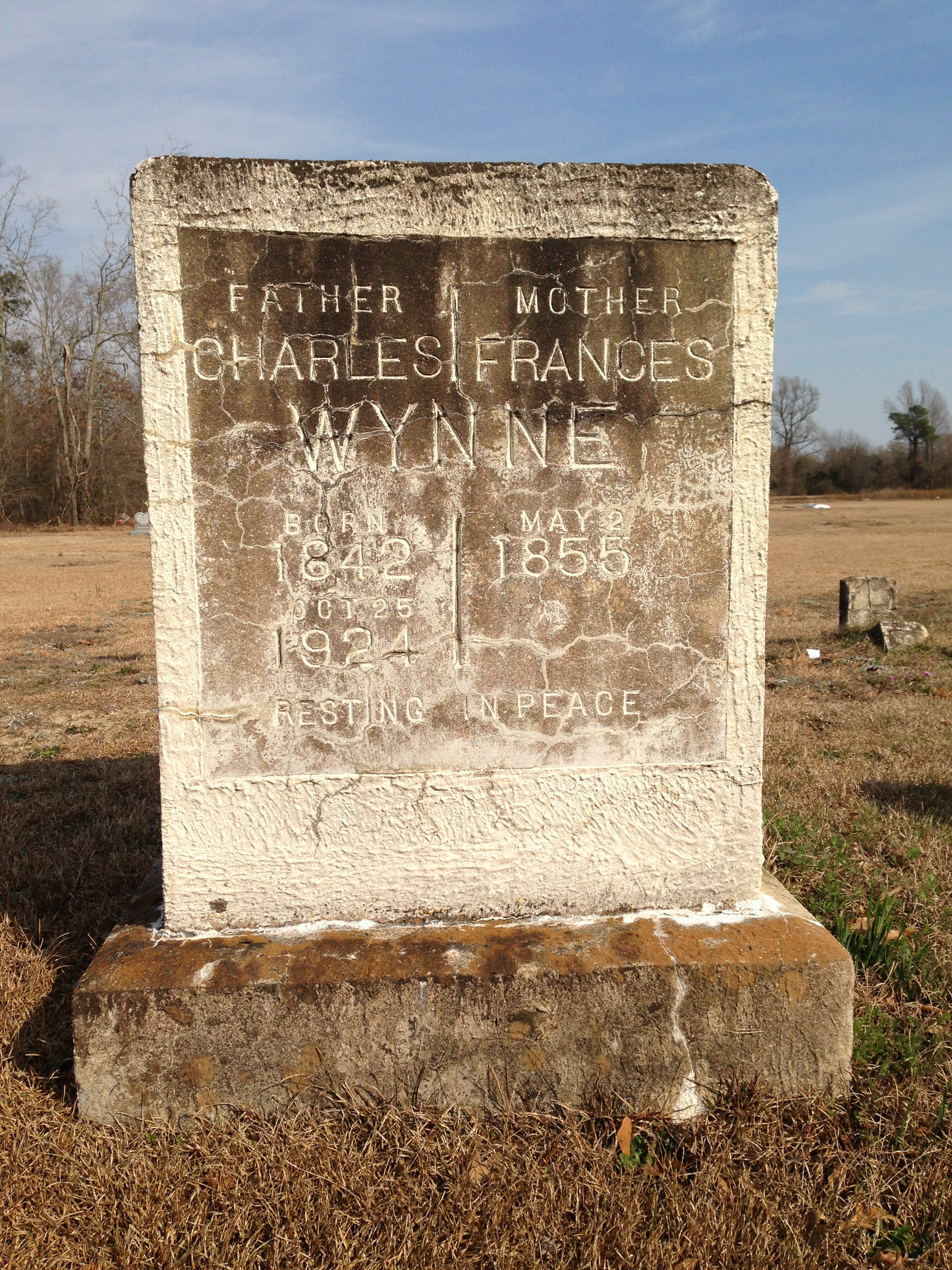
ImageCHARLES WYNN was born about 1842, probably in northern Duplin or southern Wayne County, to Levi Wynn and his wife, Bertha. FRANCES ALDRIDGE WYNN, probably born in southern Wayne County, was the daughter of John Matthew Aldridge and Catherine Boseman (or Simmons) Aldridge. They are buried in the cemetery of First Congregational Church, Dudley, Wayne County.

Photo taken by Lisa Y. Henderson, March 2013.

Police report.

Reported for the Sentinel.

Office of Police, August 7th, 8th & 9th.

A vigilant police is essential to the execution of laws. The execution of the laws is essential to our security. The wicked and disorderly must be opposed, and if not done by the police, it will have to be done with our muskets. It is not expected that the violent and disorderly are to be exterminated, but they can be kept in check; and with the assistance of the posse comitatus, we are determined to do it.

The third case was that of Bob Hazle, a free negro. Bob was met at 10 o’clock at night, in a public street, by one of the patrol, and on enquiring who he was, and where going, said he “was as free a man as any body – that he had a right to travel when and where he pleased,” and added some abusive language, as a sauce to his discourse. But Bob had made a wrong estimate of his franchise, as also of his consequence; for, without much ceremony, he was arrested, conducted to the police office, tried, and found guilty of disorderly conduct, and was compelled to enter into a recognizance to the state, with security for his good behavior for twelve months.

The fifth case was that of Nancy Brown, a free mulatto woman: She had taken up a notion that she ought to parade the streets and abuse the police officer, for arresting the fellow Ned [a slave], on Sunday. To alter her singular ideas, and to set her at ease on the subject, she was arrested and tried for disorderly conduct, was found guilty, and compelled to enter into a recognizance with security for her good behavior for twelve months.

… The seventh case was of Jordon S. Carrow, the police officer. A free mulatto, whose name is not remembered, was arrested by Mr. Carrow for riotous conduct in the street. The man resisted Mr. Carrow, who inflicted on him one or two slight blows with his cane – one, about his head, which cut the skin and caused the blood to flow. The court was of the opinion that as the officer was resisted, he had a right to subdue the prisoner.

We cannot close our report without saying that the public have in Mr. Carrow, a deserving and vigilant officer.

Newbern Sentinel, 18 August 1827.
He passed for a free man for fifteen months.

RAN-AWAY.

From the Subscriber on the 10th day of September, a bright mulatto fellow by the name of Ralph. He is about 35 years old – a number of his fore teeth are missing – several before, so as to disqualify him from chawing any thing hard. He has a very down look. He had on when he left me cotton clothes, except his coat, which was cotton cambrick, of a brown colour, made in the present fashion. The coat had a pocket on the inside of the left lappell. – He is about five feet, eight or ten inches high – thick built. I expect he will attempt to pass for a free man, and perhaps aim for Richmond, in Virginia, where he was raised.  He left his former master, whose name was Jeffery, (lived in South Carolina,) and passed for a free man about fifteen months in the counties of Duplin, Bladen, and Jones, where he was at length taken up and committed to Wilmington Jail, where his master got him. Any person who will confine said Negro in any Jail in this state so I get him again, shall receive a reward of ten dollars, and if delivered to me in Wadesborough, 25 dollars. JOHN JENNINGS. Wadesborough, Sept. 25, 1809.

Star, Raleigh, 19 October 1809.

44 acres on Calf Pasture branch.

Know all men by these presents that we Lovett Reaves & Milly Reaves of the State of Georgia & County of Hancock Know ye that we Lovett Reaves & Milly Reaves for & in consideration of the sum of One hundred and ten dollars to us in hand paid by Jane Winn of the State of North Carolina & County of Duplin before this executing and delivering of these presents, the receipt whereof we hereby acknowledge & confess that we are therewith fully satisfied contended and paid & for these same considerations have given granted sold & assigned & set [illegible] to the said Jane Wynn her heirs and assigns forever a certain tract or parcel of land [illegible] lying & being in the County of Duplin & State of North Carolina on or near the head of the Calf Pasture branch, it being part of a tract of land belonging to the late Reuben Johnston &c and it also being the part of land that fell to the said Milly Reaves in the division of the said land by heirship, beginning at a stake in the old line & runs north with the old line N 45 poles to a stake Felix Johnson’s corner, then with his line W 158 poles to a stake his corner over the road then S 45 poles along the old line to a stake then W 158 poles to the first station including the house & field on the Road containing Forty four acres more or less together with all do privileges rights [illegible] and appurtenances to the said parcel of land & premises of the same to the use benefit & behoof of the said Jane Wynn her heirs & assigns to have & to hold forever & the said Lovett & Milly Reaves doth for themselves their [illegible] said parcel of land forever & the said said Jane Wynn shall & will warrant & forever defend from themselves their heirs executors adm’r & assigns & all other persons whatsoever. In witness whereof we the said Lovell and said Reaves [sic] hereunto set our hands and seals this twenty second day of February in the year of Our Lord Eighteen hundred & eighteen.   Lovett Reaves    Molly X Reaves

Signed sealed & del’d in the presence of Asher Flowers, Thomas X Gray

State of No Carolina, Duplin County. October Term 1818. The within deed was proved [illegible] by the oath of Asher Flowers & order to be registered. Test Wm. Dickson C.C.

Grantor Book DTFU, page 415. Register of Deeds Office, Duplin County Courthouse.

[Sidenote: Jane (or Jinny) Winn was a sister or mother or cousin of the male Winns, farmers and mechanics, who amassed property in the thousands of acres in Duplin, Wayne and Cumberland Counties. Much of it was lost in the decade before the Civil War. More later…. — LYH]