Fourth Generation Inclusive

Historical Documents of Genealogical Interest to Researchers of North Carolina's Free People of Color

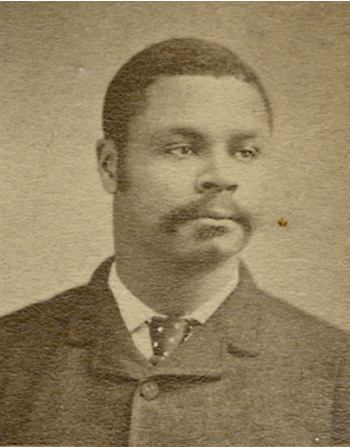
George Henry White.

Image

GEORGE HENRY WHITE (December 18, 1852 – December 28, 1918) was an attorney, the Republican U.S. Congressman from North Carolina between 1897 and 1901, and a banker. He is considered the last African-American Congressman of the Jim Crow era, one of twenty to be elected in the late nineteenth century from the South.

White was born in Rosindale, Bladen County, North Carolina, where his natural mother may have been a slave.  His father Wiley Franklin White was a free person of color of Scots-Irish and African ancestry, who was a laborer in a turpentine camp. George had an older brother, John, and their father may have purchased their freedom.  In 1857 Wiley White married Mary Anna Spaulding, a granddaughter of Benjamin Spaulding. Born into slavery as the son of a white plantation owner, Spaulding had been freed as a young man and worked to acquire more than 2300 acres of pine woods, which he apportioned to his own large family.

White studied at Howard University. He graduated in 1877 and was hired as a principal at a school in New Bern. He studied law in the city as an apprentice under former Superior Court Judge William J. Clarke and was admitted to the North Carolina bar in 1879.

In 1880 White ran as a Republican candidate from New Bern and was elected to a single term in the North Carolina House of Representatives. He returned to politics in 1884, winning election to the North Carolina Senate from Craven County. In 1886, he was elected solicitor and prosecuting attorney for the second judicial district of North Carolina, a post he held for eight years. Though he considered running for Congress, he deferred to his brother-in-law Henry Plummer Cheatham, who was elected to the US House in 1890.

White was a delegate to the 1896 and 1900 Republican National Conventions. In 1896 he was elected to the U.S. Congress representing the predominantly black Second District from his residence in Tarboro, defeating white Democratic incumbent Frederick A. Woodard of Wilson. In 1898 White was re-elected in a three-way race. In a period of increasing disfranchisement of blacks in the South, he was the last of five African Americans in Congress during the Jim Crow era.

On January 20, 1900, White introduced the first bill in Congress to make lynching a federal crime to be prosecuted by federal courts; it died in committee. A month later, as the House was debating issues of territorial expansion, White defended his bill by giving examples of crimes in the South. Arguing that conditions in the region had to “provoke questions about …national and international policy,” he said, “Should not a nation be just to all her citizens, protect them alike in all their rights, on every foot of her soil, in a word, show herself capable of governing all within her domain before she undertakes to exercise sovereign authority over those of a foreign land—with foreign notions and habits not at all in harmony with our American system of government? Or, to be more explicit, should not charity first begin at home?”

White delivered his final speech in the House on January 29, 1901: “This is perhaps the Negroes’ temporary farewell to the American Congress, but let me say, Phoenix-like he will rise up some day and come again. These parting words are in behalf of an outraged, heart-broken, bruised and bleeding, but God-fearing people; faithful, industrious, loyal, rising people – full of potential force.”

After White left office, no other black American would serve in Congress until Oscar De Priest was elected in 1928. No African-American was elected to Congress from North Carolina until 1992.

Adapted from Wikipedia. Photo courtesy of http://www.lib.unc.edu.

In the 1860 census of Columbus County: Willey F. White, 39, farmer, born Pitt County; wife M.A., 20, and children John W., 14, and W.F., 7, plus W.T. Freeman, 7.

[Sidenotes: (1) George H. White’s secretary during his Washington years was William S. Hagans, son of Napoleon Hagans and nephew of my great-great-grandmother Louvicey Artis Aldridge.  (2) My junior high school in Wilson NC was named after Frederick A. Woodard. — LYH]
“John Doctor,” minutely described.

Twenty-Five Dollars Reward.

Runaway from the Subscriber on the night of 24th ult. a Negro Man by the name of BEN, commonly called BEN THORN; he is about 5 feet 6 or 7 inches high, between 30 and 40 years old, perhaps might weigh between 145 and 160 pounds; is of a bright complexion, neither black nor mulatto; is well made, stands a little wide, and springs back in his knees; has a round head, middling long neck; long face, flat jaws, high nose, inclined to be Roman, and somewhat sharp; his eyes is rather large, white and glaring when thrown open, his mouth projects out, and is tolerable large, with a very good set of teeth; speaks broad and quick, and endeavors to speak proper language; his arms is rather long, and short fingers, he has thick, short hair, and inclined to be square across his forehead; fine grained skin, &c. He is a little ruptured, or what is called bursting, in consequence of which he commonly wears a truss. He had when he went away, a furred or knapped hat, considerably worn; a blue broad cloth coat, worn out at the elbows and cuffs; a homespun jacket, blue grounded, with small white streaks, the stripes went round; a pair of white homespun pantaloons; a pair of mixed do.; a black velvet cravat, and what is called a white comforter, with some colouring at the ends, and perhaps some other old cloathing. He can read and write, so as he can be understood, is very intelligent, being acquainted with a number of the States, sea-port towns, and other noted places. It is presumed that he has an instrument of writing, and will endeavor to pass as a free man; having made the attempt and was apprehended with a free pass in the town of Edenton, on the 16th of Feb. 1816, where he went by the name of John Doctor, and was imprisoned for about three months, and taken out of jail by me. His intentions were at that time, and I make no doubt are now, to get on board some vessel and escape to some of the Northern States, where slavery is not tolerated. It is presumed he will alter his name, and change his features (if possible.) All masters and owners of vessels are hereby forwarned from taking the said Negro on board. The above reward will be given to any person who will apprehend said Negro, and confine him in any jail, and give me information so that I get him again.  ALEXANDER SORSBY, Nash county, N.C.  March 16.

Norfolk & Portsmouth Herald, 6 April 1818.

Fugitive, with a bold look.

State of North Carolina.

$300 REWARD.

A PROCLAMATION,

By his Excellency JONATHAN WORTH, Governor of North Carolina:

Whereas, it has been represented to me that HENRY BERRY LOWRY, a free negro, late of the county of Robeson, in said State, stands charged with the murder of James P. Barnes, of said county, and other crimes, and that the said Lowry is a fugitive from justice:

Now, THEREFORE, in order that the said Henry Berry Lowry may be arrested and brought to trial for said alleged crimes, I, JONATHAN WORTH, Governor of said State, do issue this, my proclamation, offering the reward of

THREE HUNDRED DOLLARS

For his arrest and delivery to the Sheriff of the said county of Robeson.

In witness whereof, His Excellency, JONATHAN WORTH, Governor of said State, has hereunto set his hand and caused the Great Seal of the State to be affixed.

Done at the city of Raleigh, this the 11th day of December, A.D., 1866.

By the Governor:   JONATHAN WORTH.

Wm. H. Bagley, Private Secretary.

Description. – Henry Berry Lowry is five feet eight or nine inches high, heavy built, copper color, long, coarse, bushy hair, Indian like, black eyes, high nose, with a bold look; has a scar under one of his eyes.

Dec. 13.

The Daily Journal, Wilmington, 28 December 1866.

First patrolman of his race.

Wiley G. Overton.

The First Full Fledged Patrolman of His Race Appointed on Brooklyn’s Police Force.

Wiley Granda Overton is a successful undertaker, whom Commissioner Hayden has appointed as patrolman and assigned to the First Precinct, in the most popular and business part of Brooklyn, under Capt. Campbell. Mr. Overton is originally from North Carolina. He was born in Elizabeth City, Oct. 20, 1859, of free parentage. He spent his early days attending school, until his graduation from the normal school. While yet quite a young man he passed a good examination before the county commissioners and obtained a position as a teacher in the public schools. With his parents he came North fourteen years ago and settled in Brooklyn. Through his energy and push he was not long in obtaining a good situation [illegible] wholesale firm in New York City [illegible] Taylor & Co. Entering as a porter he rose to the important position of stock clerk, which he held for seven years. While in this position he spend all of his leisure moments in private study and improved his education. After leaving his New York situation he engaged with a well known undertaker, Moses Genung, and after sufficient training he started out in business for himself at 75 Lawrence street. His business has grown rapidly, and he will turn it over to his cousin, R.D. Overton.

Immediately after his business venture, it came to his mind that he would like to become one of the guardians of the city and he entered the civil service examinations …. He attained 76 ½ percentage, standing 58 on a list of 164 eligibles. It was thought that Mr. Overton’s color would be a barrier to his appointment …. Commissioner Hayden, however, … said: “He passed a good examination, and, as the law makes no distinction in regard to color, I do not see why there should be any question as to my duty in the matter.”

Mr. Overton is nearly six feet high, of fine athletic build and of dark complexion. He has been assigned to Post 5 of the First Precinct, bounded by Pierpont, Joralemon, and Clinton streets and Columbia Heights. … Mr. Overton is a devoted member of Bridge Street A.M.E Church and has been been a member of the Trustee Board for several years. He has a charming wife and two beautiful daughters to cheer him at his fireside.

In the 1860 census of Pasquotank County: Jeffry Overton, 62, farmer, Juley, 31, Jeffry, 29, Haywood, 18, Ruben, 10, Margaret, 9, Mary, 6, John, 4, George, 2, and Wiley, 8 months.

The New York Age, 21 March 1891.

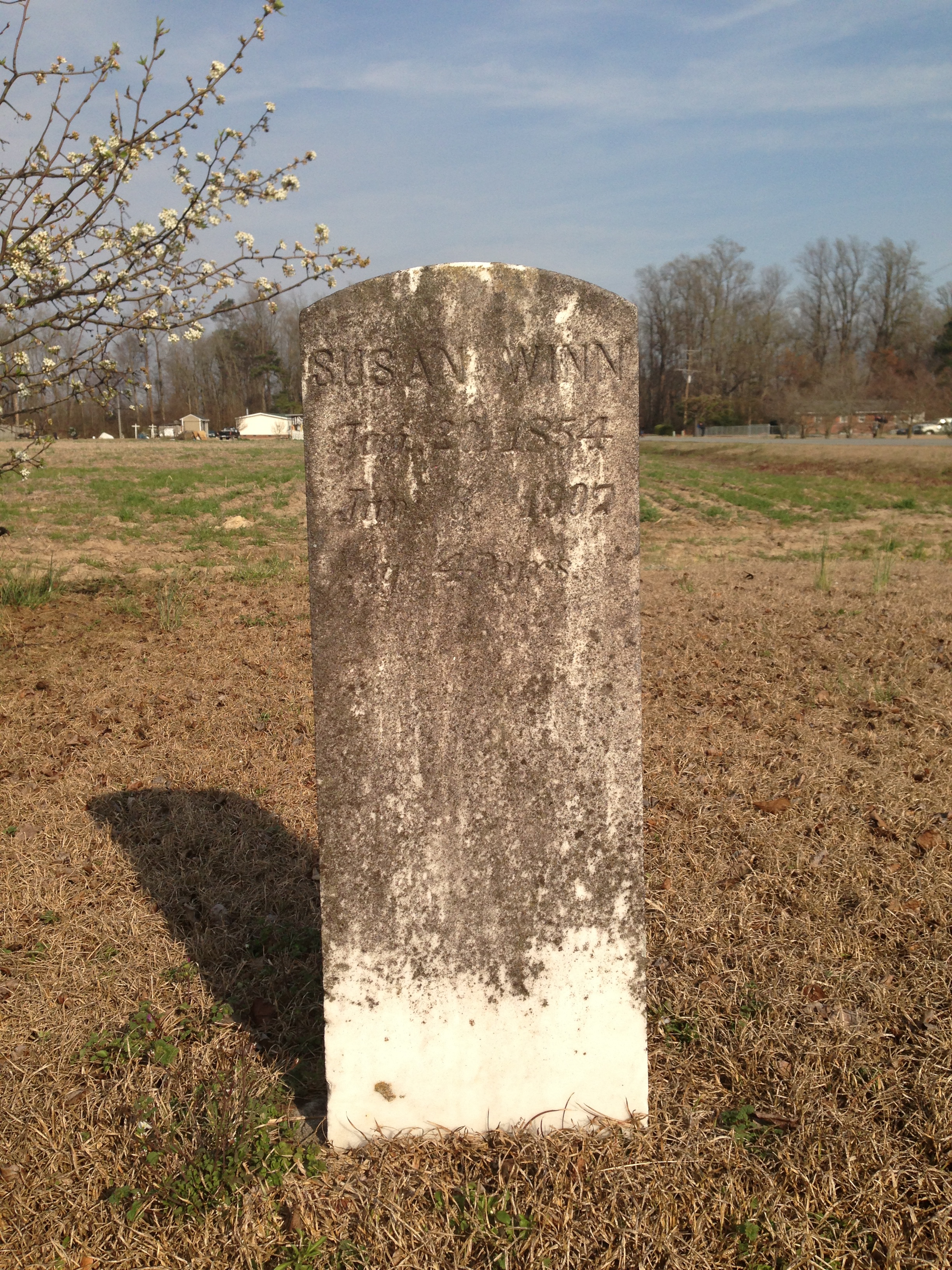
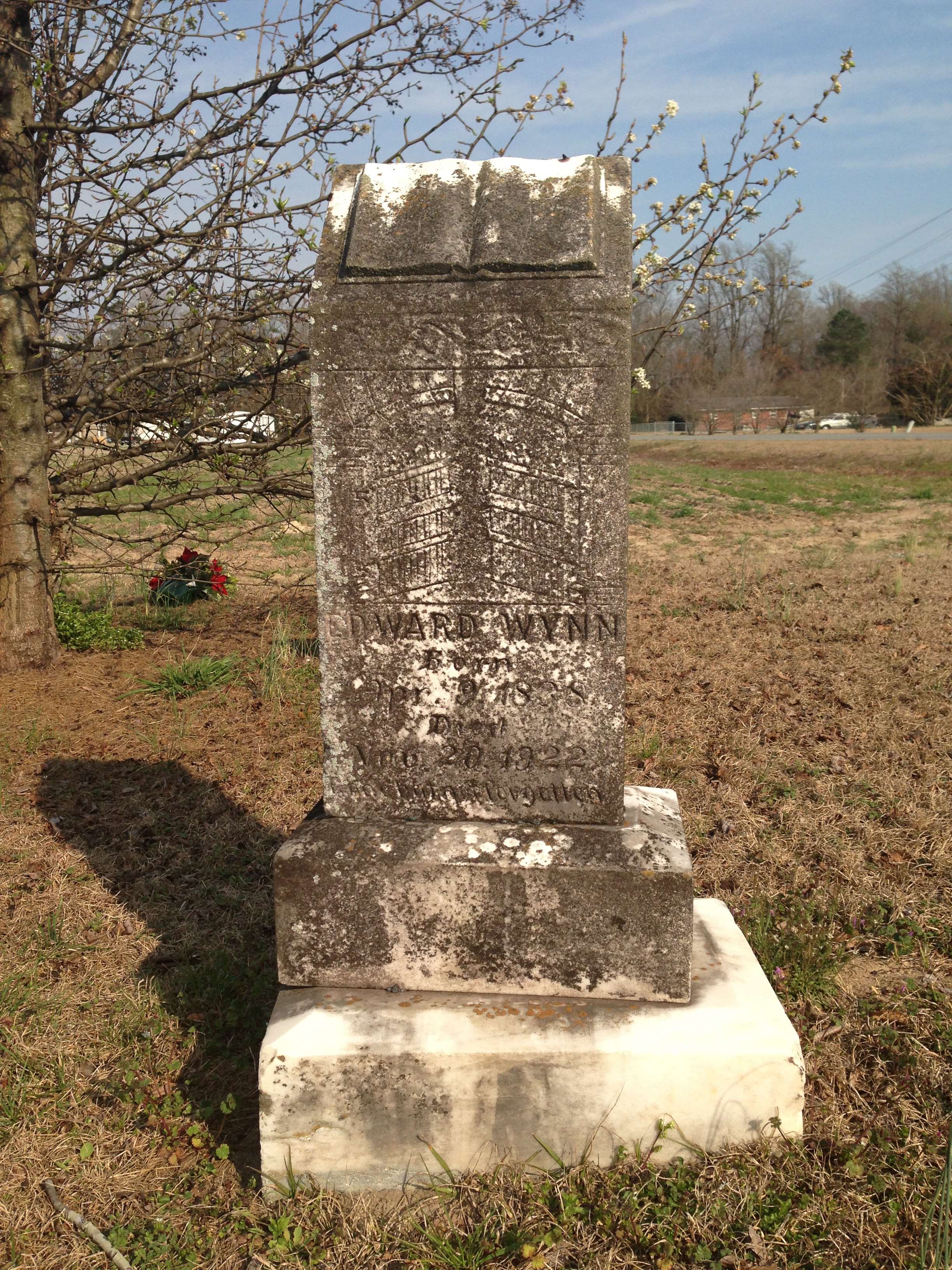
Edward J. & Susan Henderson Wynn.

Image

Image

EDWARD JAMES WINN (1838-1922) was the son of Gray Winn and Sarah “Sallie” Greenfield Winn.  His wife, SUSAN HENDERSON WYNN (1854-1907), was the daughter of James Henderson and Louisa Armwood Henderson. They are buried in a small family cemetery near Dudley in southern Wayne County.

Photograph by Lisa Y. Henderson, March 2013.

In the 1850 census of South Side of the Neuse, Wayne County: Sally Winn, 30, and children Betsey, 14, Edw’d J., 12, Eliza, 10, Penny, 6, Ally, 4, and Washington, 1.

In the 1860 census of Westbrooks, Sampson County: James Henderson, 52, wife Eliza, 25, and children Anna J., 8, Susan, 6, Hepsie, 4, and Alexander, 1.

[Sidenote: Edward Winn’s brother, Washington Francis “Frank,” married Susan Henderson’s sister Hepsie. — LYH]

Oldest North Carolinian ever.

Cross Woodis: Candidate for Oldest North Carolinian

By Dr. H.G. Jones, for the Associated Press

Chapel Hill (AP) — … Who was the oldest person ever to live in North Carolina? We may never know, but know candidate for the distinction was Cross Woodis, who complained before his death about 1880 that liquor had shortened his life.

He had done pretty well, though, for according to his biographer, Woodis was 130 years old when he died. If we base his age on the census of 1860 when he was listed as 100, he would have been only 120 at the time of his death. But what difference would 10 years make at that age?

We would perhaps know nothing of Cross Woodis except for a tiny sketch published in 1905 by Alfred Nixon ….

A mulatto born free but bound to a white man named Curtis until he was 21, Cross Woodis, according to census records, was born in Mecklenburg County long before the Revolution. He spent many years in Cabarrus County but lived in Lincoln County in his advanced years. He had a cabin on the farm of William King near Catawba Springs.

As a young man Woodis married a free black woman who, when the southern states began restricting the rights of free Negroes, insisted that the couple move to the free state of Ohio.

Woodis told his wife to go ahead with her relatives ad that he would follow. He never did, except for a visit. After years of separation from his first wife, he married another free black woman in North Carolina.

Apparently Cross Woodis was primarily a farmer, but he worked at various jobs – fisherman, hunter, horse racer, well digger, water witch. With a forked peach tree spout, he was almost unerring in locating water for his clients.

Woodis was remembered as shriveled and stooped but retaining a remarkable degree of his senses, particularly his memory and wit. He claimed to have killed a British soldier while guarding a cache of guns during the Revolution, a claim that Nixon accepted as true. …

Cross Woodis died at the home of a daughter in Mecklenburg County about 1880 and was buried at a Presbyterian church for blacks at Caldwell, a few miles from Cowan’s Ford.

The Robesonian, Lumberton, 11 February 1982.

In the 1850 census of Lincoln County: Cross Woodruss, 70, Delphy, 35, Henderson, 10, and Jane Woodruss, 8.  In the 1860 Lincoln County: Cross Woodis, 100, farm laborer (active), born Mecklenburg County.  In 1870 Catawba Springs, Lincoln County: Jordan Shuford, 25, wife Dovey, 26, and Cross Wordice, 110, “at home.”  In 1880, Catawba Springs, Lincoln County: farm worker George Johnston, 27, Lucy, 22, Lizzie Boyd, 55, mother, Sarah Johnston, 50, mother-in-law, and Cross Woodis, 128, grandfather.

Horrible outrage.

OUTRAGES IN NORTH CAROLINA.

Three Radicals Murder a Negro, His Wife and Four Children in Their Own Home.

The House Burned to Conceal the Crime – A Mother’s Devotion – The Woman Alarms Neighbors and Secures the Arrest of the Murderers.

RALEIGH, N.C., May 2, 1871.

The Sentinel of to-day has a correspondence from Rutherford Court House, which give the details of one of THE MOST HORRIBLE OUTRAGES that has ever shocked human ears. The perpetrators of the deed are radicals, though it partakes of the nature of Ku Klux Klan outrages. Six souls were, without a word of warning, ushered into eternity, and their slaughtered bodies afterwards consumed in the flames of their burning home. The outrage occurred in Morgan township, on the border of McDowell county, and is as follows:

Silas Weston, a free negro before the war, has for many years been living with Polly Steadman, a white woman of loose character. Polly has or had four children, white, the oldest about fourteen, the youngest nearly two years of age.

SILAS AND POLLY lived peaceably together, and were in better circumstances than most of their class. Some time ago three notorious characters – Govan and Columbus Adair and M. Bernard – were charged with the theft of a quantity of brandy and bound over at McDowell County Court. Silas had seen the thieves carrying off the booty, and was subpoenaed as the principal witness for the prosecution. The Adairs threatened his life if he peached but Silas expressed a determination to bring the rogues to justice. What we now proceed to tell is THE SWORN DEPOSITION of the woman Polly Steadman: — On Wednesday evening, April 26, shortly after nightfall, while the family were preparing to retire to peaceful repose, the dog began to bark violently. Polly, looking through chinks between the logs, received a pistol bullet in the eye. With a wild scream she sprang back, and at that instant the door was broken down and in rushed Govan Adair, Columbus Adair and Bernard FIRING AS THEY CAME. Silas fell dead, with two balls in the head. One of the assassins stood over the children as they lay upon the floor, shooting them through the head like so many pigs. Polly stopped to creep under the bed, but was flung back. Then she began to fight like a tigress. One of the butchers attacked her with a knife. Finally, with five deep cuts on the body, with her throat deeply gashed and a pistol shot through the eye, this poor creature sank to the floor and was kicked into a pile of broom straw preparatory to THE GRAND AUTO DA FE.  Meanwhile every voice in the family had been stilled. Six lifeless bodies lay on the bloody floor – the old man on the hearth, the mother haggled in pieces on the straw, and the children in their night clothes, lying where they fell – all had been jostled by rude feet. The fiends contemplated their work, to make sure it had been done thoroughly, and prepared to hide their tracks. Piling up clothing, straw and other combustible matter they applied the match, and then, with an ineffaceable stain on their souls, fled away into the darkness.

A MOTHER’S DEVOTION. And now occurred what may well sound marvelous. Polly Steadman, scorched by the flames, arouses herself, seizes her youngest child, who gives signs of life, and, crawling towards the door, tries to drag out another child, but nature fails, and the body lies just outside the threshold; then, with supernatural strength, Polly staggers the distance of half a mile to the residence of Mrs. Williams, and gives THE ALARM. It is too late. Three bleached skeletons grin from the ashes,, and a blistered corpse lay without the door.  As soon as possible messengers were dispatched for Sheriff Walker and for medical assistance; but before either arrived, Polly, supposing herself in the last agony of death, solemnly testified against the murderers. She knew them well; they were her near neighbors, and were not disguised. Her testimony was so clear and positive it carried conviction to all who heard it. Accordingly Squire Hanes promptly issued a warrant for THE ARREST of the suspected parties. They were found at home, one of them in bed, though late in the day. Sheriff Walker arrived shortly afterward and conveyed the prisoners to this place, where they are closely confined. Commenting on this horrible affair, it is proper to state with emphasis that all the parties are of the lowest order of society, and that all of them, the slain and the slayers, are radicals of the deepest dye. The Adairs for years have attended the polls for no other purpose than to insult and intimidate conservative voters. So “trooly loil” were they that even with murder in their hearts they sought to make the deed redound for the benefit of the party.

Reading Eagle, Reading, Pennsylvania, 4 May 1871.

In the 1860 census of Catheys Creek, Rutherford County: Cinthia Weston, 41, (described as “idiotic”), Elizabeth, 32, Stephen, 21, and Silas Weston, 20. In the 1870 census of Morgan, Rutherford County: Silus Western 50, farmer, wife Mary, 25, and children Harberd, 10, Docia, 6, David, 4, and Mary, 7 months. Silus, Harberd and baby Mary were described as mulatto; Mary, Docia, and David as white. Nearby, the large household of James H. and Arminta Adair, which included sons Columbus, 26, and Govan, 24.

More tales of slave-owning Negroes.

… Mr. George W. Brooks, of Atlanta, recalls [free negroes who owned slaves] when he was a youth in the county of Person, which lay immediately on the Virginia line. There was there quite a colony of free negroes, many of them named Epps, and supposed to be descendants of the slaves set free by Mr. Epps, the brother-in-law of Thomas Jefferson. In Person County there was a free negro named Billy Mitchell, an honest man of genial disposition, who being without means, often hired himself to work for Mr. Brooks’ father on his tobacco farm.  Mr. Brooks remembers hearing Mitchell telling his father of his trip to Mecklenburg, about thirty miles away, when and where he went courting, and told of the lands and slaves which were owned by his girl’s father. He told with much humor of an incident which occurred while he was there. He went out one morning with the girl’s brother to the pig pen to look at the fattening swine. He said that one of the slave boys came and got upon the pen with them; that soon he heard the girl calling her mother to “look at Jim perched up on the hog pen with the white folks.” Billy said that he looked at them all and he could not see but Jim was about as white as any of them. Billy went back and married the girl, took up his abode with them, became interested in the estate and became a slave owner himself.

From Calvin D. Wilson, “Negroes Who Owned Slaves,” Popular Science Monthly, vol. LXXXI (1912).

A deserving case.

Wants Pension for James Saunders.

Citizens of Onslow County have sent up a petition, asking that James Saunders, colored, be put upon the Confederate pension roll, for service rendered at Fort Fisher in the works and as a soldier. Mr. Koonce says that Saunders is the old free negro type and a deserving case; and that he is the first one of the race to ask for a pension. The Legislature has done worse things.

The Courier, Asheboro, 4 February 1909.

In the 1860 census of Richlands, Onslow County: James Sanders, 28, farm laborer, Amos Dove, 14, and Zachariah Dove, 10. 

Free-Issue Death Certificates: BOWSER.

William Hardy Bowser.  Died 19 April 1928, Alligator, Tyrrell County. Colored. Married. Farmer. Born 9 September 1859 in Tyrrell County to Zion Bowser and Nansy Hill. Buried home cemetery. Informant, Linton Bowser, South Shores.

William Franklin Bowser. Died 28 June 1917, Alligator, Tyrrell County. Colored. Married. Farmer. Born 14 July 1862, Tyrrell County to Zion Bowser and Nancy Hill, both of Tyrrell Hill. Buried South Shore. Informant, Ardel Liverman, South Shore.

Ellin E. Sykes. Died 10 Dec 1930, Alligator, Tyrrell County. Colored. Widowed. Age 65. Born Tyrrell County to Zion Bowser and Nancy O. Buried at Twiddy graveyard. Informant, John W. Sykes.

In the 1860 census of Tyrrell County: Zion Bowser, 24, mariner, wife Nancy, 20, and son Hardy, 9 months.

Polly Bowser. Died 19 November 1932, Gum Neck, Tyrrell County. Negro. Widow of Randell Bowser. Midwife. Age 89. Born in Gum Neck to Abner Hill and Litha Hill, both of Gum Neck. Informant, Tom Barrow.

In the 1860 census of Tyrrell County: Abner Hill, 67, farmer, wife Elitha, 54, and Edmund, 23, William, 19, Elizabeth, 17, Mary, 12, Asa, 10, Agga, 8, and Eliza, 4.

John Bryant.  Died 28 November 1923, Alligator, Tyrrell County. Resided Fort Landing. Colored. Married to Burney Bryant. Farmer. Age about 70. Born Alligator to Martin Bryant of Gum Neck and Nancy Bowser of Alligator. Buried South Shore cemetery. Informant, Bunch Bryant.

In the 1860 census of Tyrrell County: Martin Bryan, 50, farm laborer, wife Nancy, 25, and children Victoria, 12, Mary, 10, Sarepta, 7, Martha, 6, John, 4, Affa, 1, and Nelson Bryan, 11.