Fourth Generation Inclusive

Historical Documents of Genealogical Interest to Researchers of North Carolina's Free People of Color

They had to leave home more than 100 times.

THE EFFECTS OF SLAVERY ON THE FREE COLORED PEOPLE OF THE SOUTH. – Mary Morgan, of No. 59 King-Street, New-York, widow of James Morgan, who died in the spring of 1834, with the small pox, says that she and her husband owned a farm of 250 acres of land in Pasquotank County, about five or six miles from Elizabeth City, North Carolina; that they had hogs, cattle, and horses, and were well to live; that they were both born free, as were both their parents; that as many as six or seven years ago [before they had been provoked to it by northern abolition] a number of the lower class of the whites went about the country to disturb the free colored people; that they frequently came to their dwelling, broke their table, and cups, and saucers, and beat James Morgan a number of times, sometimes with a club, at other times with a cowhide, and at one time so severely that his life was despaired of.

Some of the better class of whites called at the house, and said they thought he was so badly hurt he could not live. For a fortnight after, he was not able to cut a stick of wood. Seven places on his head were shaved to put on plasters, and his back and legs were also much bruised. So frequently were they attacked, that they had to leave their dwelling more than one hundred times, often in showers of rain. At one time, Mary was put on horseback, behind one of the ruffians, who rode off violently for about a mile, took her off, and placed her in a mud puddle up to her waist, in a dark night, and there left her to get as she could. These things happened so frequently that the Friends, commonly called Quakers, (who were really friends to them,) advised them to sell their property and come to the North. Those who caused them to suffer, gave no other reason for their conduct than that they were free negroes, and ought to go to the North, and that there was no law for free negroes in Carolina. Joseph Elliott, Thomas Elliott, and Aaron Elliott, of the society of Friends, were their near neighbors, and were often very kind to them, and did their best to prevent the abuse. Miles White, a merchant of Elizabeth city, knows this statement to be true; other free colored people of that neighborhood suffered pretty much in the same way. They came to New-York, where her husband was taken sick and died; Mary and the children were taken to the Almshouse, where they staid about seven weeks, and were then turned out, penniless, and had it not been for the charity of some humane persons, they might have perished from want.

The farm in Carolina was sold for the small sum of $350, which was soon eaten up by the expense of coming to New-York, and the maintenance of the family while here.

Mary Morgan has to support, by day’s work, five small children. The friends of the oppressed, who have any sympathy to spare, will do well to render her some assistance – at least, by furnishing her with work.  No. 59 King street is her residence.

The First Annual Report of the New York Committee of Vigilance (1837).
No. 1 negro woman takes up with free negro man.

$100 Reward

Ranaway from Mr. N. Carpenter, on the Charlotte Rail Road, near Brown Marsh, in November last, my negro Girl BELL.  The said girl is a No. 1 negro, about 5 feet 6 or 8 inches high, very well put up, and with a smooth black skin.

She is supposed to have taken up with a free negro man in the Brown Marsh neighborhood. I will give the above reward for her delivery to me in Fayetteville, or $50 for her confinement in any jail so that I can get her.   James P. Robertson. Jan. 23.

Fayetteville Observer, 26 January 1863.

He built a house in this gap.

Footnote 41. Ambrose Gap is a few miles southwest [of Cut Laurel gap], and is so called because a free negro of that name built a house across the State line in this gap, and when he died his grave was dug half in Tennessee and half in North Carolina, according to local tradition. 

From John Preston Arthur, Western North Carolina: A History, 1730-1913 (1914).

To prevent him being sold into slavery.

Chap. 486.

AN ACT to remunerate James Bennett for expenses incurred and services rendered in procuring the release of Anthony Adams, a colored citizen of this State, from imprisonment in the jail of Edenton, North Carolina, to prevent him being sold into slavery.

Passed April 15, 1857, three-fifths being present.

The People of the State of New-York, represented in Senate and Assembly, do enact as follows:

SECTION 1. The treasurer shall pay on the warrant of the comptroller, out of any moneys in the treasury not otherwise appropriated, to James Bennett, the sum of two hundred and sixty-eight dollars, being four dollars per diem for eighteen days service, and for moneys expended in procuring the release of Anthony Adams, a free colored citizen of the town of Deerpark, county of Orange, state of New-York, from the jail of Edenton, state of North Carolina, where he was confined.

Sec.2. This act shall take effect immediately.

Laws of the State of New-York Passed at the Eightieth Session of the Legislature, Vol. II (1857).

The child was murdered.

Infanticide. – We learn that an inquest was held on the body of an infant child found in a branch in Robeson county on the 6th inst. The result was a verdict that the child was willfully murdered by its mother, a free woman of color named Arrah Carter.

Fayetteville Observer, 10 October 1853.

She is of free parents.

North Carolina, Edgcombe County  }  To the Sheriff of Edgcombe County Greeting; You are hereby commanded that, you Summon Thomas Hodges of your said County if to be found in your Bailiwic personally to appear before the Justices of the County Court of Pleas & Quarter Sessions to be held for the same on the fourth monday in November next then & there to shew Cause by what Right title or claim he holdeth in Slavery, a young Woman of mixed Blood named Bet (Elizabeth) who by Thomas Hall her Attorney Suggests that she is of free Parents & entitled to freedom — And have then & there this Writ; Witness Edward Hall Clerk of sd. Court, the [blank] Day of [blank] ann Dom’o 1780, in the 5th year of Independency     Edw’d Hall C.C.

Edgecombe County Records, North Carolina State Archives.

Levi & Betsy Winn.

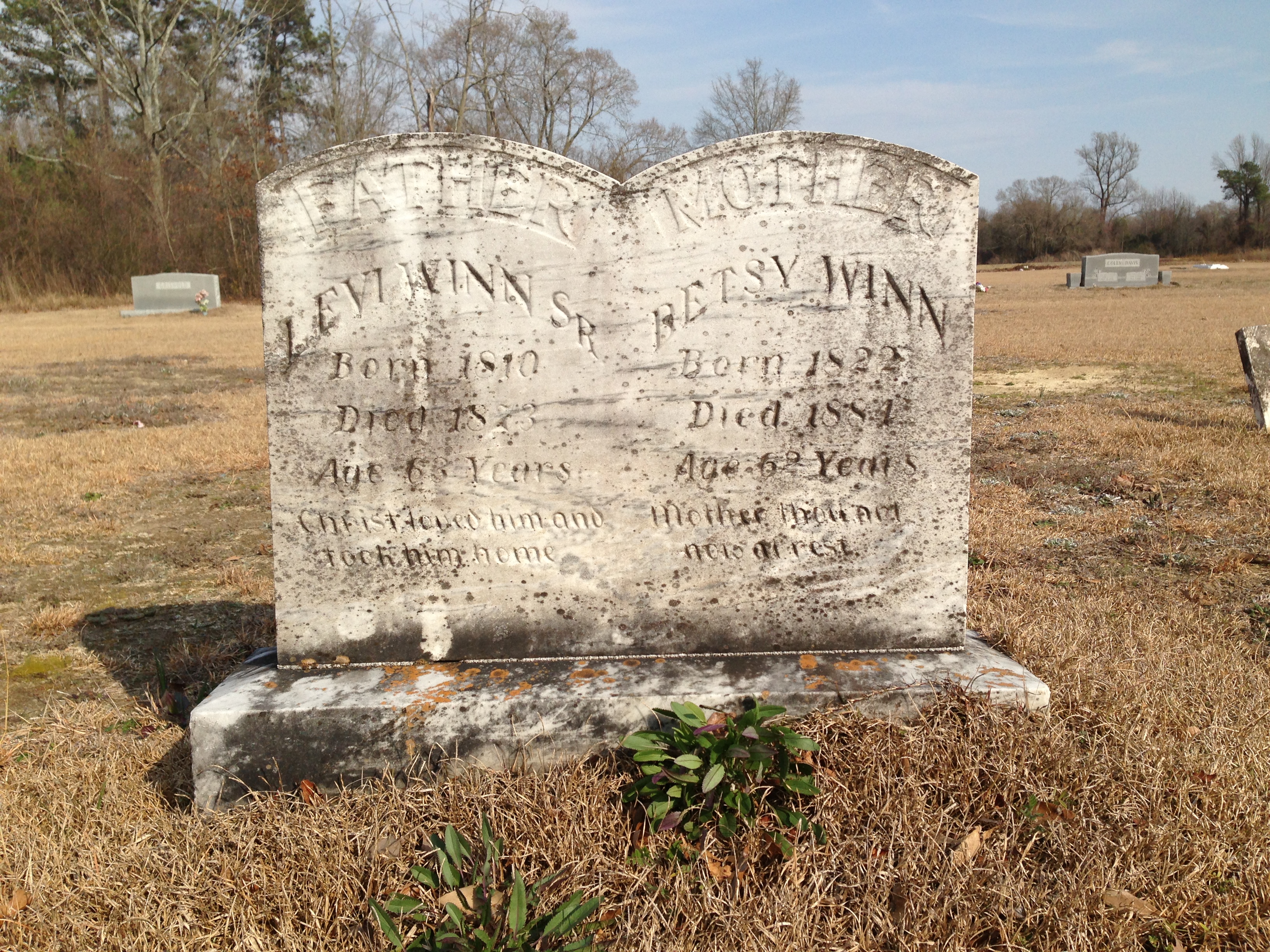
Image LEVI WINN was probably born in northern Duplin County. Elizabeth, called “Betsy,” last name unknown, was his second wife. They are buried at First Congregational Church in Dudley, Wayne County.

Photo by Lisa Y. Henderson, March 2013.

In the 1860 census of Buck Swamp, Wayne County: Levi Winn, 47, blacksmith, wife Elizabeth, 39, and children Henry, 21, David, 20, Pinkney, 19, George, 17, Charles, 15, Mary, 13, Martha, 11, John, 9, Elizabeth, 7, Susan, 5, and Levi, 3.

He was elected county commissioner.

“I remember the first election held here after the negroes were given the right to vote. The negroes were corralled in Little Washington by J. E. O’Hara, a West India negro, and formed in two lines and marched to the Court House. I was standing on the piaza [sic] of the old Griswold Hotel, when they turned down Walnut Street, and as the last of the line passed where I was standing, the head of the column was turning into the court house square near where Col. I. F. Dortch’s office stands. The election lasted for three days and the votes were sent to Gen. Canby’s headquarters at Charleston, S.C. to be counted. At the first election held after the adoption of the Canby Constitution, one negro, Green Simmons, was elected on the Board of County Commissioners. Negroes were appointed on the police force of the town.  A Yankee, J. H. Place, who came here with the army, was elected mayor. The finances of the town and county both got into bad shape, county orders getting down as low as forty cents on the dollar.”

From J.M. Hollowell, “War-Time Reminiscences and Other Selections,” Goldsboro Herald, June 1939.

In the 1850 census of South Side of the Neuse, Wayne County: Green Simmons, 33, cooper, wife Betsy J., 26, and children Needham, 5, Cicero, 3, and Mary, 1. All were born in Wayne County, except Betsy, born in Sampson.

Born in 1844 in New York of West Indian and Irish parentage, James E. O’Hara migrated to North Carolina after the Civil War with African Methodist Episcopal Zion missionaries.  He served as clerk for the 1868 state constitutional convention and was elected to the North Carolina State House of Representatives in 1868 and the United States House of Representatives in 1882. O’Hara died in New Ben in 1905.

He has a mulatto indenture.

One Hundred Dollars Reward.  Ranaway from the subscriber in April, 1800, a negro man named ZIBE, about 25 years of age, 5 feet 7 or 8 inches high, well made, handsome features, and dark complexion – I do suppose he is in or about Norfolk, as his mother and some of his other connexions live in that place. I have lately understood he has a mulattoe indenture and certificate, and goes by the name of the mulattoe, which is James Turtle, which if he has the indentures was executed in Bertie county North Carolina, to Mr. Jesse Brown, of county and state aforesaid, and the certificate was granted to said Turtle, by said Jesse Brown. The above reward will be given to any person apprehending said negro and confining him to that I get him again, or delivering him to me in Hertford county North Carolina, and all reasonable expences paid.  Eli Moor.

N.B. He is a tolerable shoemaker.

Norfolk Herald, 1 July 1802.

Fayetteville State founders.

Image

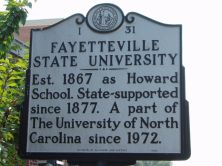
Fayetteville State University, now part of the University of North Carolina system, was the first normal school for African Americans in North Carolina. The university’s founding dates to 1867, when David A. Bryant, Nelson Carter, Andrew J. Chestnutt, George Grainger, Matthew Leary, Thomas Lomax and Robert Simmons paid $140 for a lot on Fayetteville’s Gillespie Street and named themselves into a board of trustees to maintain the property as a permanent site for the education of black children. General O. O. Howard, an early supporter of black education, erected a building on the site, and the school was named the Howard School in his honor.

The education center was chartered by the legislature as the State Colored Normal School in 1877. In 1880 Charles W. Chesnutt was appointed principal of the school after the death of principal Robert Harris. Chesnutt served the institution for three years before resigning and moving to Cleveland, Ohio.

Ezekiel Ezra Smith was appointed as Chestnutt’s replacement in 1883. E. E. Smith had a long and distinguished career at the school. During his span as principal (and eventually president) at the institution, he served in a host of other positions. Smith was appointed Minister Resident and Consul General of the U. S. to Liberia by President Grover Cleveland in 1888. George H. Williams assumed the duties of principal in Smith’s absence. After serving in Liberia for two years, Smith returned to North Carolina to organize the state’s first newspaper for African-Americans, The Carolina Enterprise, in Goldsboro. During Smith’s tenure, he saw the school the school move to its permanent location on Murchison Road in 1907. The high school curriculum was discontinued by the state in 1929 and Smith’s title change to president. He retired in 1933.

Adapted from http://www.ncmarkers.com.

In the 1850 census of Fayetteville, Cumberland County: Angus Carter, 45, boatman, wife Dezda, 38, and children Nelson, 16, Angus, 15, John, 13, Margaret A., 12, Betsy, 10, Jane, 8, Alonzo, 5, Mellissa, 2, and Ann, 2 months.

In the 1850 census of Fayetteville, Cumberland County: John Terry, 13, Ellen Terry, 16, Sally Lucus, 12, and Thos. Lomack, 18, in the household of Jesse W. Powers, merchant.

In the 1850 census of Eastern Division, Cumberland County: Griscilla Simmons, 35, Robert, 12, Samuel, 8, and Mary A., 2.