Fourth Generation Inclusive

Historical Documents of Genealogical Interest to Researchers of North Carolina's Free People of Color

She shall have a comfortable maintenance.

I, Nathan Lamb of the County of Randolph & State of North Carolina being of sound mind & memory but considering the uncertainty of my earthly existence do make & declare these my last Will & Testament in manner and form following. That is to say first that my executor shall provide for my body a decent burial suitable to the wishes of my relations & friends & pay all funeral expenses together with my just debts howsoever & to whomsoever owing out of the money that may first come into his hands as part or parcel of my estate.

Item, I give & devise to my beloved wife Mary Lamb all the tract of land & plantation whereon I now live including my mansion house & all outhouses & other improvements whatsoever to her the said Mary Lamb to have & to hold for & during her natural life or widowhood in lieu of her dower & thirds of my real estate.

Item, I give and devise to my grandson Nathan Wall all this tract of land whereon I now live except the life estate of my wife derived in a former item on this my will & except the maintenance of my old Servant mentioned in another item to have & to hold to him & his heirs in fee simple forever.

Item, I give & devise to my daughter Mary Morgan, wife of William Morgan, all that tract of land whereon Elizabeth Stanton now lives known by the name of the Morgan Place to have & to hold to her & her heirs in fee Simple forever.

Item, I give & bequeath to my Said beloved wife Mary Lamb all the household & kitchen furniture all the horses & cattle & hogs & all the farming tools & all my other property on this plantation, all the crops of every discription that may be on the plantation whereon I now live & all the provisions on hand at my death for & during her natural life or widowhood except what may be necessary to pay all funeral expenses together with my just debts to be Selected & Sold by my executor for that purpose provided there Should not be money Sufficient on hand.

Item, My will & desire is that all the Crop Stock & provisions on hand at the death of my wife all the improvements of husbandry & all other personal property belonging to the estate Should be Sold & the money arriving from such Sale Should be equally divided among my children, except Mary Morgan, Share & Share alike to them & their personal representatives forever.

Item, My will is also that Luce, a free woman of Colour formerly in my Service Shall have a comfortable maintenance from my home plantation during her natural life or whenever She may chose to live thereon.

And lastly, I do hereby constitute & appoint my Son in Law William Chamness my lawful executor to all intents & purposes to execute the my last will & testament according to the true intent and meaning thereof, hereby revoking & declaring utterly void all other wills & testaments by me hereuntofore made. In witness whereof the Said Nathan Lamb do hereunto set my hand & seal this 4th day of May AD 1839.  Nathan X Lamb. Witnesses Daniel Swain, Anna Swain.     

Probated February term, 1845.  Randolph County Courthouse.
Not guilty.

The Superior Court for this county, his honour Judge DONNELL, presiding, commenced its session on Monday last.

On Wednesday, Nancy Quinn, a free woman of colour, upon whose case the jury, at the last term, were unable to render a verdict, was tried for the murder of her infant child. She was found “Not Guilty.”

Newbern Sentinel, 28 October 1826.

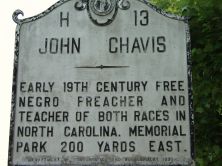
John Chavis.

Image

This marker, originally approved and erected in 1938, was the first one in the North Carolina Highway Historical Marker Program dedicated to African American history. The original sign (depicted in the photograph) was replaced in 2009 by one with a revised inscription.

John Chavis, born around 1763 in Virginia, was a prominent free black preacher and educator in and around Raleigh area from 1810 on. Chavis had an extensive education for the time, likely the best education of any African American of his day. He is best known for his classical teaching in Raleigh, educating children of all races. In 1832 free blacks lost many of their rights in North Carolina, and Chavis lost his freedom to preach and teach. He died in 1838, having lived and worked as a respected member of society.

Little is known about John Chavis’s early life, but it is thought, based on estate records from 1773, that he may have been an indentured servant for Halifax, Virginia, attorney James Milner. It is also speculated that Chavis received early education from Milner’s classical library under the tutelage of Reverend William Willie. In 1778, Chavis enlisted in the 5th Regiment of Virginia, serving for three years for the Patriots. Honorably discharged, Chavis studied at Washington Academy, present-day Washington & Lee University, and possibly studied privately at Princeton with Dr. John Witherspoon, the president of what was then College of New Jersey. In 1800 he returned to Virginia and was licensed as a Presbyterian minister.

Between 1801 and 1807, John Chavis did mission work among slaves for the Presbyterian Church throughout the southeastern United States. In 1809 he moved to Raleigh, where he began preaching as a part of the Orange County Presbytery. It was around this time that Chavis began his school.

Chavis’ school accepted both black and white students, widely expanding the options available for the education of free blacks in Raleigh at the time. Chavis taught white students during the day and black students during the evening. Many were from notable families in North Carolina, including future Governor Charles Manly and the sons of Chief Justice Leonard Henderson. Chavis may also have  instructed future United States Senator Willie P. Mangum.

Following Nat Turner’s Rebellion, free blacks across the south lost their standing as citizens. Chavis could no longer legally preach or educate, and was forced to close his school and retire. In 1833 he published his only written work, a sermon entitled An Essay on Atonement. The work was successful and widely read, and helped to supplement his income during the final years of his life. Chavis died on June 15, 1838. His burial location is unknown, although there is speculation that the grave is on Willie P. Mangum’s former plantation in present-day Durham County.

Adapted from ncmarkers.com.

Ever an anomaly.

INTRODUCTION

The most pathetic figure in North Carolina prior to the Civil War was the free negro. Hedged about with social and legal restrictions, he ever remained an anomaly in the social and political life of the State. The origin of this class of people may be attributed to many sources, the most common of which are (1) cohabitation of white women and negro men, (2) intermarriage of blacks and whites, (3) manumission, (4) military service in the Revolution, and (5) immigration from adjoining States. As early as 1723 many free negroes, mulattoes and persons of mixed blood had moved into the Province and had intermarried with the white inhabitants “in contempt of the acts and laws in those cases provided.” In the year 1715 in order to discourage intermarriage between white women and negro men, a penalty of £50 was imposed upon the contracting parties, while clergymen and justices of peace were forbidden to celebrate such marriage under a like penalty.

However regrettable it may be, it is certain that there were a few disreputable white women who had illegitimate children by negro men, and such children inherited the legal status of the mother. The laws of 1715 take cognizance of this fact by imposing a penalty on any white woman “whether bond or free,” who shall have a bastard child by any negro, mulatto or Indian.

Probably the most fruitful origin of the free negro class was manumission. While it is doubtful whether many slaves were set free prior to 1740, it is certain that the Quakers in their Yearly Meeting began to agitate the question of emancipating slaves in that year, and they never ceased to advocate emancipation both by precept and example.

The free negro class was slightly augmented by the addition of certain negroes who had served in the continental line of the State during the Revolutionary War, many of whom had been promised their freedom before they enlisted. It was easy in such cases to allege meritorious service as a ground for emancipation. To the before-mentioned causes for the existence of the free negro in North Carolina should be added one other; namely, immigration, particularly from Virginia. Despite the law to the contrary, many free negroes drifted across the State line from Virginia into North Carolina and quietly settled on the unproductive land adjacent thereto.

In every instance except one (service in the Revolution) the free negro came into being against the will of the State either expressed or implied; but once given a place in the social order of the commonwealth, his tribe increased in spite of adverse laws and customs prescribed by the dominant race.

From R.H. Taylor, The Free Negro in North Carolina (1920).

They are called Ephram Mitchell.

NOTICE.

Ranaway from the subscriber on Sunday night the 29th instant, two negro slaves, (mulattoes,) by the names  of DUNCAN and JIM the former about twenty four years of age, and the latter twenty one – the said negroes belong to the estate of John Whitted, dec’d, and are hired to the subscribers and probably at this time are lurking in the neighborhood of Haywood (Chatham county, in this State) for the purpose of taking off along with them their Brother, who is also a mullatto, (by the name of Stephen) these boys having calculated on their freedom from their late masters will, and feeling disappointed in their expectation, it is therefore believed that they will make for some part of the country, where freedom is tolerated, and in the mean time pass as free persons of colour, as they are determined to effect their freedom if possible. – Duncan is likely not very stout about five feet ten inches high and has a scar on his neck occasioned by rising, any person or persons who will apprehend the same negroes and deliver them to the subscribers in Hillsborough shall be reasonably rewarded – or if taken up out of the state and secured in any Jail thereof, so that the subscribers get them shall receive a reward of five dollars each.

N.B. It is said these negroes have procured some kind of instrument of writing from a free man of colour by the name of Ephram Mitchell which was given by the Clerk of county some time past, which they will probably make use of to answer their purpose, therefore they will try to pass in his name, Ephram Mitchell.  H. Thompson, John Young. August 29th 1819.

Star, Raleigh, 10 September 1819.

He is called William Wall.

Four Hundred Dollars Reward.

The store of the subscribers was robbed on the night of 24th February last, of three thousand, three or four hundred dollars, by a mulatto fellow named JIM, the property of William L. Thomas, esquire, of Chesterfield District, South-Carolina. Jim is about five feet eight inches high, a little round shouldered, has a large scar on his left arm near the shoulder, and wore a pair of whiskers. His dress cannot with accuracy be described, but had on when last seen a green bombazette coatee – He was seen and pursued on the 2d instant, by a party of men in Moore county, North Carolina, where he had purchased a horse, but was forced to abandon his horse and baggage when pursued. Jim has obtained a free pass or rather certificate of his freedom in which he is called William Wall; but it is not improbable he will again change his name, and procure another pass to prevent detection by the old one, as he is a very artful fellow. It is his avowed intention to go to the state of Pennsylvania or Ohio, but he may be at this time in Chatham county, North Carolina, from whence he was brought some time in the  month of May last year by a Mr. Ramsay. Any person or persons who will apprehend said fellow and confine him in any jail so that the subscribers may get him, shall receive $100 reward m or $120 if deleivered to them at their residence, and ten per centum for all the money restore. The money is in notes on different banks in Georgia, South Carolina, North Carolina and Virginia, & one $50 note on the Hudson Bank of New York, which is a counterfeit, and on the back is written “Atwaters,” the man’s name from whom it was received.  GILLESPIE & SANDERS. Chatham, Chesterfield District, South-Carolina, 19th March, 1816.

Star, Raleigh, 31 May 1816.

Surnames: Cleveland County, 1850.

The following surnames are found among free people of color in Cleveland County in 1850:

BLACK, BROOKS, CLARKE, CROW, DAVIS, FORNEY, HUSKIN, JOHNSON, McLEAN, MORGAN, PRIOR, PROCTOR, REVELS, and ROBISON.

I am determined to pay no debts.

NOTICE.

Whereas my wife SARAH BREWINGTON has left my bed and board without any cause – this is therefore to caution all and every person not to credit her on my account, as I am determined to pay no debts of her contracting.   WM. R. BREWINGTON. Fayetteville, June 15, 1860.

Carolina Observer, Fayetteville, 18 June 1860.

He stabbed her child.

MURDER. A man who called himself JOHN REID, a Scotchman, came to Newbern with a number of low priced watches for sale, and while here, was frequently drunk. In a state of intoxication, on the 4th inst., he entered the house of Nancy Sawyer, a free woman of color, and stabbed her child, Celia Maria Sawyer, a girl 8 years old, with a dirk, and also wounded a young coloured woman. The child died on the 11th inst. and an inquest taken before me has found that the child died of that wound.

Reid has left the County, and probably returned to Norfolk, of which place he said he was a resident. This notice is given, to the end that if met with in this State he may be delivered to the subscriber, of to the Sheriff of Craven, that he may be brought to justice. Thomas C. Masters, Coroner Craven County. Newbern, 15th April, 1819.

Newbern Sentinel, 24 April 1819.

Wayne County Apprentices, 1836-37.

Calvin Artis, 15, was bound to Erastus Ham in 1836.

Rufus Lane, 9, was bound to Joel Lane in 1836.

Bryan and Lucy [no last names or ages] were bound to John Barfield in 1836.

Sip Read was bound to Sherard Barden in 1837.

Washington Read, 18, was bound to Burket Barnes in 1837.

Rufus Lane, 7, was bound to John Exum in 1837.

Sint Hagans, 16, Hilory Hagans, 20, and Betsey Hagans, 18, were bound to Exum Pike in 1837.

John Hays, 16, was bound to Ephraim Grant in 1837.

Dorcas Hall, 18, was bound to Martin Sauls in 1837.

Churchill Herring, 13, and Charles Herring, 9, were bound to William Wilkins in 1837. Churchill was to learn to be a “gig or wagon maker;” Charles, a mechanic.

Benja Ann Hall, 2, Winnie Hall, 4, Sam Hall, 5, and Mozana Hall, 6, were bound to Starling Daniel in 1837.

Edy Burnett, 10, and Barna Burnett, 5, were bound to Everett Joyner in 1837.

Ephraim Hagans, 10, was bound to Zachariah Davis in 1837.

Susan Artis was bound to Edwin Bryan in 1837.

Harriet Seaberry was bound to Henry Best in 1837.

Minerva Artis, 4, Rufus Artis, Benajah Artis, and Julia Artis were bound to Edwin Bryan in 1837.