Fourth Generation Inclusive

Historical Documents of Genealogical Interest to Researchers of North Carolina's Free People of Color

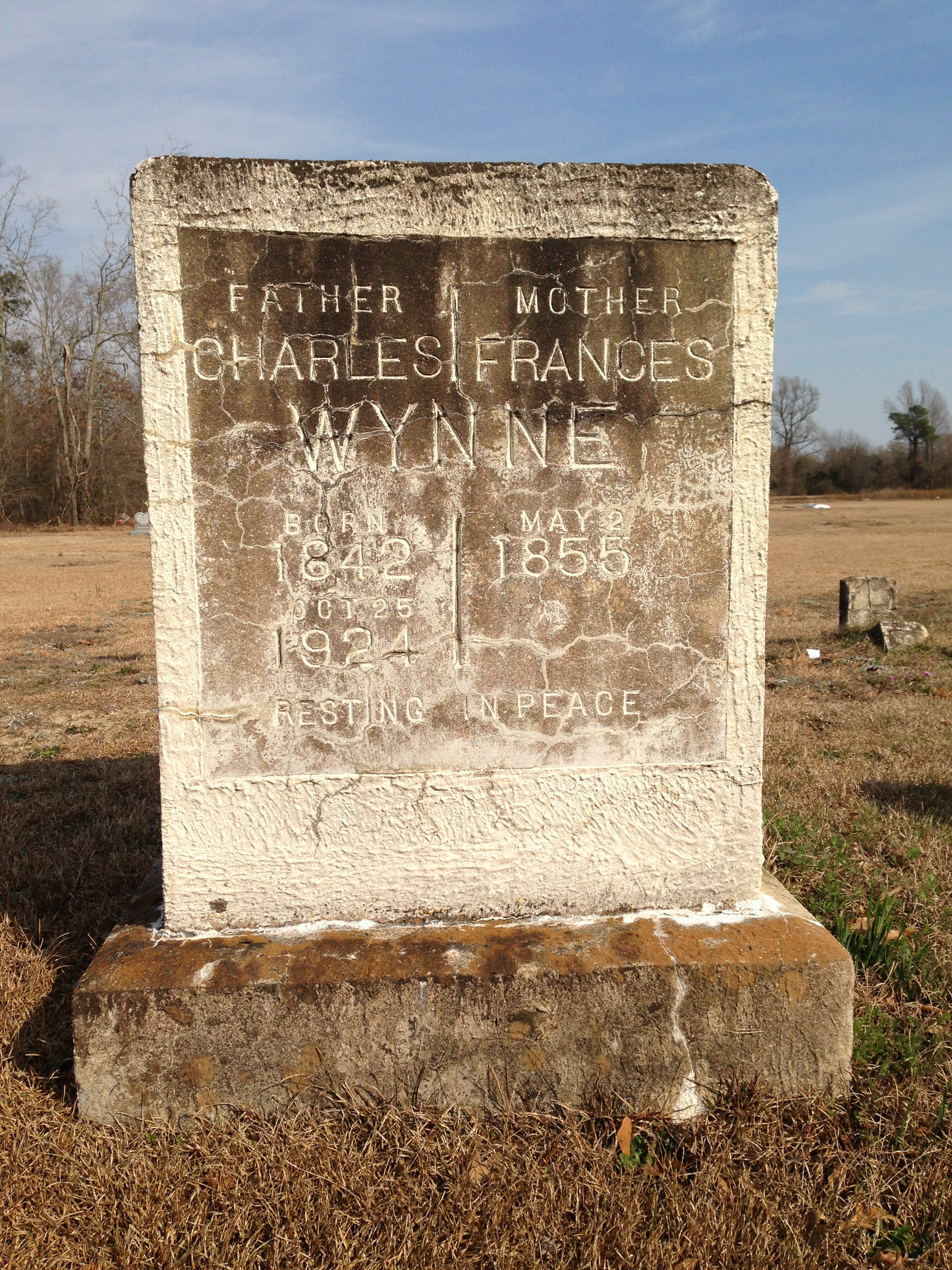
Charles & Frances Wynn.

ImageCHARLES WYNN was born about 1842, probably in northern Duplin or southern Wayne County, to Levi Wynn and his wife, Bertha. FRANCES ALDRIDGE WYNN, probably born in southern Wayne County, was the daughter of John Matthew Aldridge and Catherine Boseman (or Simmons) Aldridge. They are buried in the cemetery of First Congregational Church, Dudley, Wayne County.

Photo taken by Lisa Y. Henderson, March 2013.

Police report.

Reported for the Sentinel.

Office of Police, August 7th, 8th & 9th.

A vigilant police is essential to the execution of laws. The execution of the laws is essential to our security. The wicked and disorderly must be opposed, and if not done by the police, it will have to be done with our muskets. It is not expected that the violent and disorderly are to be exterminated, but they can be kept in check; and with the assistance of the posse comitatus, we are determined to do it.

The third case was that of Bob Hazle, a free negro. Bob was met at 10 o’clock at night, in a public street, by one of the patrol, and on enquiring who he was, and where going, said he “was as free a man as any body – that he had a right to travel when and where he pleased,” and added some abusive language, as a sauce to his discourse. But Bob had made a wrong estimate of his franchise, as also of his consequence; for, without much ceremony, he was arrested, conducted to the police office, tried, and found guilty of disorderly conduct, and was compelled to enter into a recognizance to the state, with security for his good behavior for twelve months.

The fifth case was that of Nancy Brown, a free mulatto woman: She had taken up a notion that she ought to parade the streets and abuse the police officer, for arresting the fellow Ned [a slave], on Sunday. To alter her singular ideas, and to set her at ease on the subject, she was arrested and tried for disorderly conduct, was found guilty, and compelled to enter into a recognizance with security for her good behavior for twelve months.

… The seventh case was of Jordon S. Carrow, the police officer. A free mulatto, whose name is not remembered, was arrested by Mr. Carrow for riotous conduct in the street. The man resisted Mr. Carrow, who inflicted on him one or two slight blows with his cane – one, about his head, which cut the skin and caused the blood to flow. The court was of the opinion that as the officer was resisted, he had a right to subdue the prisoner.

We cannot close our report without saying that the public have in Mr. Carrow, a deserving and vigilant officer.

Newbern Sentinel, 18 August 1827.
He passed for a free man for fifteen months.

RAN-AWAY.

From the Subscriber on the 10th day of September, a bright mulatto fellow by the name of Ralph. He is about 35 years old – a number of his fore teeth are missing – several before, so as to disqualify him from chawing any thing hard. He has a very down look. He had on when he left me cotton clothes, except his coat, which was cotton cambrick, of a brown colour, made in the present fashion. The coat had a pocket on the inside of the left lappell. – He is about five feet, eight or ten inches high – thick built. I expect he will attempt to pass for a free man, and perhaps aim for Richmond, in Virginia, where he was raised.  He left his former master, whose name was Jeffery, (lived in South Carolina,) and passed for a free man about fifteen months in the counties of Duplin, Bladen, and Jones, where he was at length taken up and committed to Wilmington Jail, where his master got him. Any person who will confine said Negro in any Jail in this state so I get him again, shall receive a reward of ten dollars, and if delivered to me in Wadesborough, 25 dollars. JOHN JENNINGS. Wadesborough, Sept. 25, 1809.

Star, Raleigh, 19 October 1809.

44 acres on Calf Pasture branch.

Know all men by these presents that we Lovett Reaves & Milly Reaves of the State of Georgia & County of Hancock Know ye that we Lovett Reaves & Milly Reaves for & in consideration of the sum of One hundred and ten dollars to us in hand paid by Jane Winn of the State of North Carolina & County of Duplin before this executing and delivering of these presents, the receipt whereof we hereby acknowledge & confess that we are therewith fully satisfied contended and paid & for these same considerations have given granted sold & assigned & set [illegible] to the said Jane Wynn her heirs and assigns forever a certain tract or parcel of land [illegible] lying & being in the County of Duplin & State of North Carolina on or near the head of the Calf Pasture branch, it being part of a tract of land belonging to the late Reuben Johnston &c and it also being the part of land that fell to the said Milly Reaves in the division of the said land by heirship, beginning at a stake in the old line & runs north with the old line N 45 poles to a stake Felix Johnson’s corner, then with his line W 158 poles to a stake his corner over the road then S 45 poles along the old line to a stake then W 158 poles to the first station including the house & field on the Road containing Forty four acres more or less together with all do privileges rights [illegible] and appurtenances to the said parcel of land & premises of the same to the use benefit & behoof of the said Jane Wynn her heirs & assigns to have & to hold forever & the said Lovett & Milly Reaves doth for themselves their [illegible] said parcel of land forever & the said said Jane Wynn shall & will warrant & forever defend from themselves their heirs executors adm’r & assigns & all other persons whatsoever. In witness whereof we the said Lovell and said Reaves [sic] hereunto set our hands and seals this twenty second day of February in the year of Our Lord Eighteen hundred & eighteen.   Lovett Reaves    Molly X Reaves

Signed sealed & del’d in the presence of Asher Flowers, Thomas X Gray

State of No Carolina, Duplin County. October Term 1818. The within deed was proved [illegible] by the oath of Asher Flowers & order to be registered. Test Wm. Dickson C.C.

Grantor Book DTFU, page 415. Register of Deeds Office, Duplin County Courthouse.

[Sidenote: Jane (or Jinny) Winn was a sister or mother or cousin of the male Winns, farmers and mechanics, who amassed property in the thousands of acres in Duplin, Wayne and Cumberland Counties. Much of it was lost in the decade before the Civil War. More later…. — LYH]

Beaten, bruised and mangled.

Disgraceful Outrage. – An occurrence took place in this City, on Friday night last, which has excited a great deal of feeling, and will do much towards destroying the deservedly high reputation, which our City has always enjoyed, until recently, as a law loving and law-abiding community. A free man of colour, named Allen Jones, a Blacksmith by trade, who has rendered himself somewhat obnoxious, was forcibly taken from his own house, in the dead of night by a mob, and so beaten, bruised and mangled, that doubts are entertained of his recovery.  – Ral. Reg.

Tarboro’ Press, 22 October 1842.

Marshall A. Carter.

ImageMARSHALL ARCHIE CARTER (or, perhaps, Archie or Archibald Marshall Carter, though his initials are shown as “M.C.” above) was born in 1860 to William Carter (1833-ca1875) and Mary Cox Carter (ca1830-??) of Sampson County. His father William was the son of Michael Carter (1805-ca1875) and his wife Patience.  Marshall Carter married Margaret Frances Jacobs.  They are buried in the First Congregational Church, Dudley, Wayne County.

Photo taken by Lisa Y. Henderson, March 2013.

In the 1860 census of Clinton, Sampson County: Wm. Carter, 26, farmer; wife Mary, 34; and children Cornelia, 12, Francenia, 6, Thos. G., 5, Sarah J., 2, and Archibald, 7 months.  Next door: Michael Carter, 57, and wife Patience, 47. All mulatto. [A duplicate listing in Piney Grove, Sampson County: William Carter, 27, turpentine laborer; wife Mary, 27; and children Cornelia, 12, Francenia, 6, Isaaih T., 4, Sarah J., 2, and Archy M., 6 months.]

This death certificate was filed in Wayne County: Marshall Carter. Died 11 July 1922, Dudley, Brogden, Wayne County. Colored. Farmer. Married to Frances Carter. Born 7 July 1860, Duplin County, to William Carter and Mary [last name unknown.] Buried in Dudley. Informant, Milford Carter, Mount Olive NC.

An act to emancipate Louis.

An Act to emancipate Louis, a slave, the property of James Dunn

Be it enacted by the General Assembly of the State of North Carolina, and it is hereby enacted by the authority of the same, That Louis, a slave, the property of James Dunn, of Cumberland county, be and he is hereby, with the consent and at the request of the said owner, emancipated and set fee, and by the name of Louis Dunn shall hereafter possess and excercise all the rights and privileges which are enjoyed by other free persons of color in this State: Provided, nevertheless, That before said slave shall be emancipated, his said owner shall give bond with good sureties in the sum of five hundred dollars, payable to the Governor of the State and his successors in office, that the said slave shall honestly and correctly demean himself while he remains in this State, and not become a county charge; which bond shall be filed in the office of the clerk of the court of pleas and quarter sessions of Cumberland county, and may be sued upon in the name of the governor for the time being, to the use of the county or persons injured by a breach thereof. [Ratified 16th day of February, 1855]

Chapter 113, Public and Private Laws of North Carolina Passed by the General Assembly 1854-55, North Carolina State Archives.

Tenant or servant?

Joseph Hare v. Barney Pearson, 26 NC 76 (1843).

This matter was appealed from Fall Term, 1843, Superior Court of Law of Nash County. The case involved an action of trover (wrongful possession of private property) for a quantity of corn.  At trial, the Hare showed that Pearson rented a small tract of land in 1841 to Elijah Powell, a free man of color, for the year 1841. Powell agreed to pay one-half his corn crop as rent. On 13 March, 1841, an unnamed person obtained a judgment against Powell and an execution was levied on his growing crop the following June. When the corn was gathered, Powell and Pearson divided it equally and stored it in one barn.  Before the sheriff’s sale on 8 February, 1842, more than half the corn had been removed from the barn. Pearson objected to the sale, claiming the remaining corn as his. The sale proceeded, and Hare bought was left. Pearson exclaimed that he would break every bone in Hare’s body before he would let Hare take the corn. Pearson offered evidence that he had not rented the land to Powell, and Powell was only a laborer with no ownership interest in the crop.

The Court left it to the jury to decide whether Powell was Pearson’s tenant in 1841 (in which case, the sheriff had a right to levy on the crop and Hare was entitled to its value after Pearson refused to give it over), or whether he was merely his servant (in which case Hare could not recover.) The jury returned a verdict for the plaintiff, and the defendant appealed.

The Supreme Court found that, even if Powell had been Pearson’s servant, the evidence showed that they had split the crop, giving Powell title to half. Powell was present at the sale, and it was he, rather than Pearson, who had standing to object to any irregularity.  Pearson claimed Powell’s corn without title, and his threat to beat Hare rather than let him take his purchase amounted to conversion. This was a matter of law, not fact, and should not have been sent to the jury. Judgment affirmed.

He was the same person who had been kidnapped from his mother.

Wilmington, Oct. 2. – About eleven years ago, a white man came to the house of a free coloured woman, named Fanny Larrington, living on the sound, in the neighbourhood of this town, and requested her to lend him some assistance in bringing up some things he had landed close by. She readily sent her eldest child Dick with him. His long stay alarmed her; she went to look for him, and then she called, received no answer. She had not gone far when she heard the cry of her two younger children whom she left in the house. In returning to their relief she suddenly came upon a Negro man who had under each arm one of her children, who, he instantly dropped and made his escape into the woods. The mother knew at once the fate of her son, and while she embraced her little daughters thus fortunately rescued, she cried bitterly for the loss of her eldest child, who had been so cruelly and treacherously stolen from her. Of this son she had not heard any tidings, until a few days ago he arrived in Wilmington, and made her, as he was himself, happy by the recovery of his long lost freedom. He went before a very respectable Magistrate of this town and proved by two credible witnesses, that he was the same person who had been kidnapped from his mother as above recited, and that he was born free. He states that he went along with the white man to the landing, but saw nothing to bring away; he was obliged to go into a canoe over to the opposite side of the Creek, and when, on hearing his mother call for him he attempted to answer her, his mouth was gagged and he forced to accompany him through the woods, until, as by concert, they met on the road a wagon and team going into the back country. The apparent owner of it, who called himself “Dukes” claimed him as his property, carried him away and sold him. His last master was Mr. Wm. Walker, of Stokes county, with whom he went by the name of Prince. A subscription had been raised for the purpose of sending on a person who could identify this boy and by regular process of law, release him from his slavery. But Dick had availed himself of a favourable opportunity. He escaped, and by the exercise of considerable ingenuity, made good his way to Wilmington, where his claims to freedom have been substantiated beyond the possibility of a doubt.

Observing in the Raleigh Star an advertisement of Mr. Walker for a runway Negro, it would be well for the Editor of that paper to notice the circumstances here stated. It is hoped that by means of his last master, the perpetrators of this atrocious crime may be found out and brought to that punishment which they richly deserve.  – Gazette.

Star, Raleigh, 11 October 1810.

Both drowned.

Mr. Alpheus Whitehurst and a free coloured man, in attempting to cross Ocracoke Bar, a few days since, were capsized in their boat, and both drowned. – ib.

Tarboro’ Press, 15 June 1839.