Fourth Generation Inclusive

Historical Documents of Genealogical Interest to Researchers of North Carolina's Free People of Color

He had no marks of violence on his body.

State of North Carolina, Nash County }

An Iquisition indented taken near Mr. Rickes in the said county of Nash on the 29 day of Dec’r A.D. 1838 before A.B. Baines coroner of and in the said county upon the mein of the body of Jams Locust then and there lying dead upon the oaths of Marmaduke Ricks Gideon Stricklen William Cone Saml Wester Griffin Bird Ruben Stricklen George R. Bell Isaac Stricklen Jos. Barnes Richrd H. Dorzier Jerry Perry Merida Whitley good and Lawful men of the county aforesaid who being sworn and charged to engain on the part of the State aforesaid, when, where, how, and often what manner the Said James Locust came to his death do say upon there oath that the said Jas. Locust on the 29 day of Dec’r A.D. 1838 in the county aforesaid to wit in the publick road leading from Raleigh to Tarborough near one Marmaduke Ricks was found dead that he had no marks of violence on his body and died by being intoxicated with spirituous liquors and being unable to escape from the rain and snow [illegible] and by reason of the same died witness where of as well the afore said coroner as the Jury afore said have to this Inquesition put their seals, on the day and date first above written at the place aforesaid

[Signatures of coroner and committee omitted.]

From the file of James Locust, Nash County, North Carolina Estate Files 1663-1979, https://familysearch.org. Original, North Carolina State Archives.
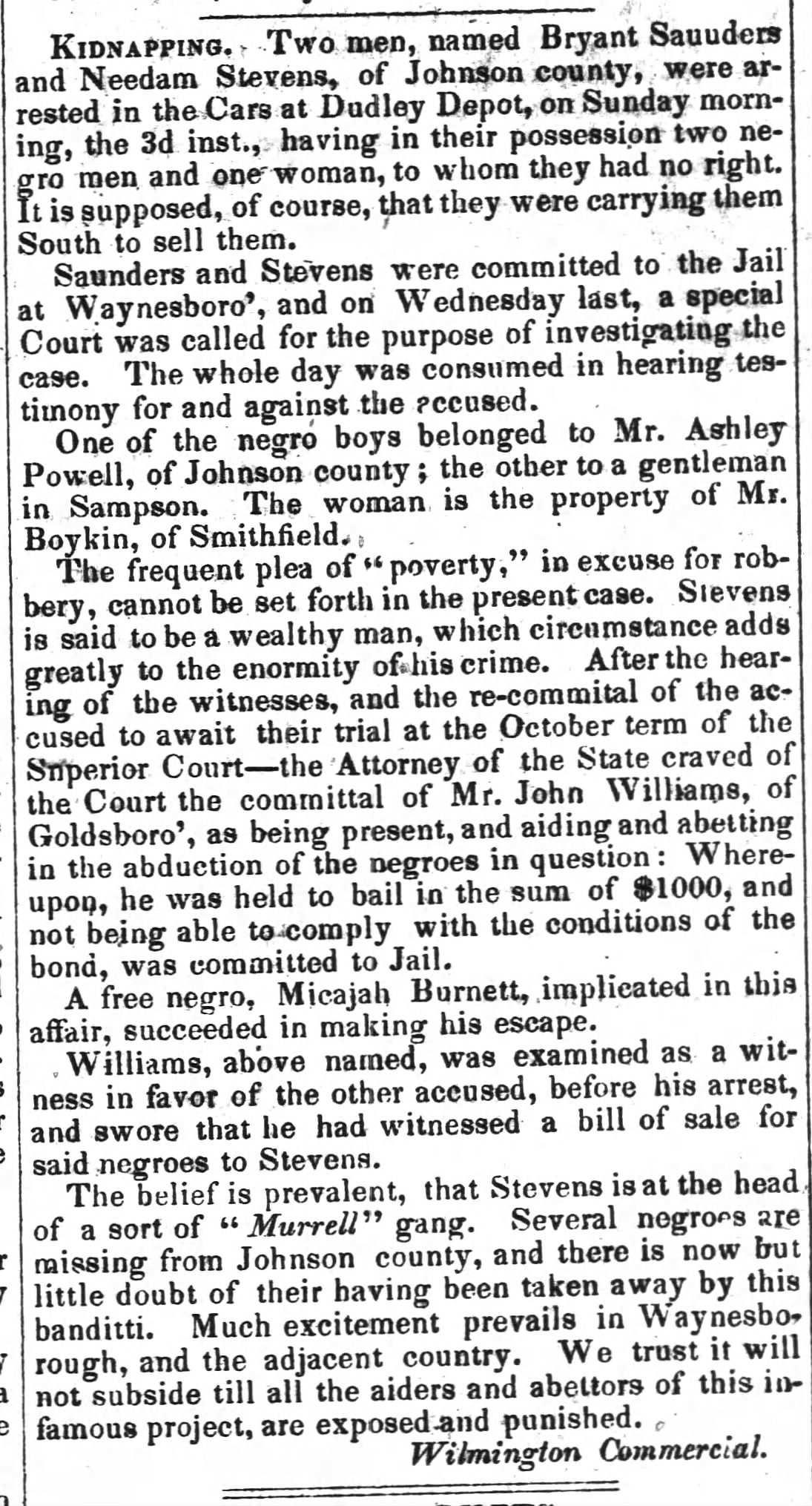
A free negro succeeded in making his escape.

More re the alleged Negro-stealing free Negro, Micajah Burnett:

Image

 Weekly Standard (Raleigh NC), 20 September 1848.

Freeman.

Freeman, community in ne Columbus County. Believed to have been named for free Negroes living in the area before the Civil War.” — William S. Powell, The North Carolina Gazetteer: A Dictionary of Tar Heel Places (1968).

He was in for the right thing.

Charles Wynn filed claim #9340 with the Southern Claims Commission. On 1 July 1872, he testified: “I am fifty-five years of age, reside in Wayne County, North Carolina …. I resided during the war in Wayne County, North Carolina, on my own land. It contained about 230 acres, 100 of which was under cultivation.” Tony Roberts, age 40, colored, testified that he lived about a quarter of a mile from Wynn during the war and saw him often. Roberts said Wynn “believed the Union army would succeed, that he thought its cause wasa right, and he was in for the right thing. He said that secession would ruin the country, and he thought its cause was right, and he was in for the right thing.” William H. Thompson, age 28, colored, swore that he had known Wynn for 24 years and saw him every four months or so during the war. He said Wynn “hoped that the Union army would be successful, put down the rebellion and do away with slavery” and revealed that the Confederate government occasionally pressed Wynn’s wagons and drivers into service to haul its goods. (Confederate archives revealed two vouchers for hauling arms from Fayetteville to Raleigh, dated in 1862, and signed by others on behalf of Wynn.)

In December 1898, a special attorney rejected the claims of Wynn’s estate: “We do not care to review the testimony in the case. If the testimony were offered in behalf of a white man under the same circumstances, it would scarcely be sufficient to prove loyalty. But in view of the fact that the claimant was a colored man, his loyalty must be largely presumed from his natural sympathies with those of his own color and those who were fighting, as the colored man believed, in his behalf.”

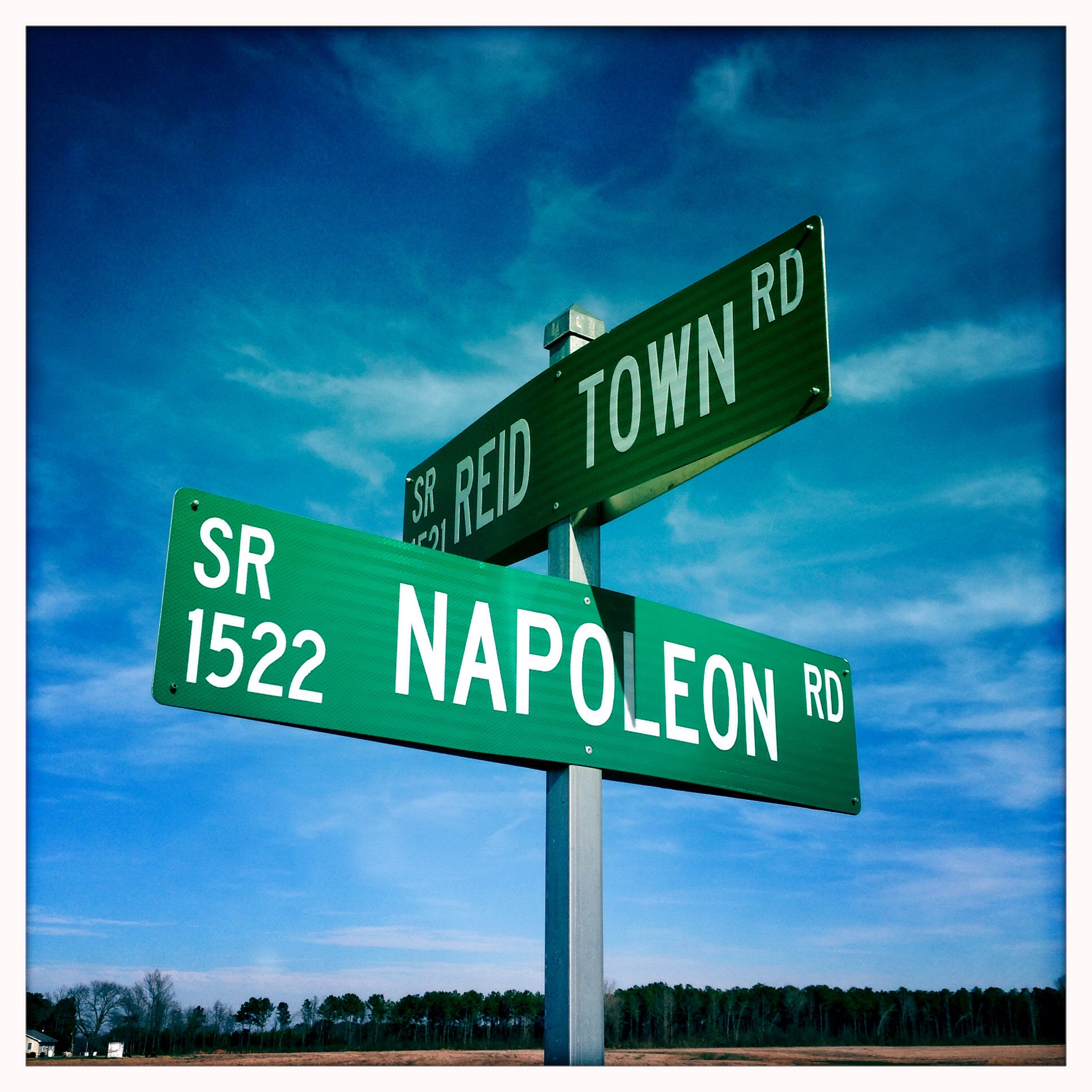
Intersection.

Image

Napoleon Road is a bent elbow of a dirt lane running north west of Eureka in Wayne County. At its southern end, it debouches into Reidtown Road, so named for the free colored Reid family who lived in the area as early as the 1830s.  Napoleon Road is no longer than a mile or so, and there is one house on it. Napoleon Hagans built that house.

Rural roads did not have formal names until the county implemented its 911 system perhaps 20 years ago.  It is a testament to Napoleon Hagans’ stature that, nearly one hundred years after his death and three-quarters of a century after his descendants left the state, the majority landowner along what had been his road chose to memorialize him permanently.

The murder of one Dick Jones.

To His Excellency John M. Morehead, Governor of the State of North Carolina

The Petition of the undersigned respectfully shew unto your Excellency that at the Fall Term 1842 of the Superior Court of Law for the County of Green an Indictment was tried against Joseph Suggs, Bright Cannady and Edith Brown for the murder of one Dick Jones, alias – Jeffrey Mares, a free Negro – that upon the trial of said Indictment the said Bright Cannady and Edith Brown were acquitted and the said Joseph Suggs was convicted of the murder of the said Dick Jones, that the undersigned are some of them acquainted with the said Joseph Suggs and beleive that he is a very ignorant illiterate man and has not the ordinary sense belonging to person of his age and station, that they beleive a violent assault had been commited on the said Joseph Suggs by Dick Jones and his brother Jim Jones who were both free Negroes, and that the shooting took place very soon – not more then a half hour after the assault was committed upon him by the said free Negros, but the Jury under the charge of the Court considered that rather prolong a time had elapsed before the wound was inflicted of which Jones died and therefore felt bound under the said charge to find him guilty of murder

They therefore most respectfully pray your Excellency to grant a pardon to the said Joseph Suggs

Signed this 14th day of October 1842

Jurors names who Tried the crimnal

John Beeman
John Sutton
John F. Jones
Thos Wooten
Parrott M. Hardy
Edward Carmon
Henry H. Gibbons
B.F. Hazelton
James E. Exum
John T. Pridgen
Chas. Edwards

[Names of 151 petitioners omitted.]

Governors Papers, Gov. John M. Morehead, G.P. 102, Correspondence, Petitions, etc., Sept., 1842; Correspondence, Petitions, etc., Oct. 1842; North Carolina State Archives.

Made good.

“Colter’s entire life has consisted of challenges accepted and made good on. He was born on January 8, 1910, in Noblesville, Indiana, a small farming town about forty miles east of Indianapolis. On both side of the family his ancestors were free blacks who had settled in Indiana several years before the Civil War. Colter possesses a ledger tracing his mother’s family back to Britton Bassett, the son of a black man and a white woman in North Carolina, who was granted his freedom in 1797 when he was twenty-one and given a horse, bridle and saddle, and one hundred dollars. In the 1830s Bassett moved his wife and children to Indiana, traveling by night and hiding by day in order to elude slave hunters.”

— from the introduction to Cyrus Colter‘s The Rivers of Eros (1991).

[Sidenote: Britton Bassett, as the son of a white woman, was born free, not set free. Perhaps 1797 marked the end of his involuntary apprenticeship. He had a son Britton, who also had a son Britton and another named Daniel. Britton and Daniel married daughters of Montreville and Anna J. Henderson Simmons, who were born free in North Carolina and migrated to Indiana by way of Ontario, Canada.]

Richard Artis.

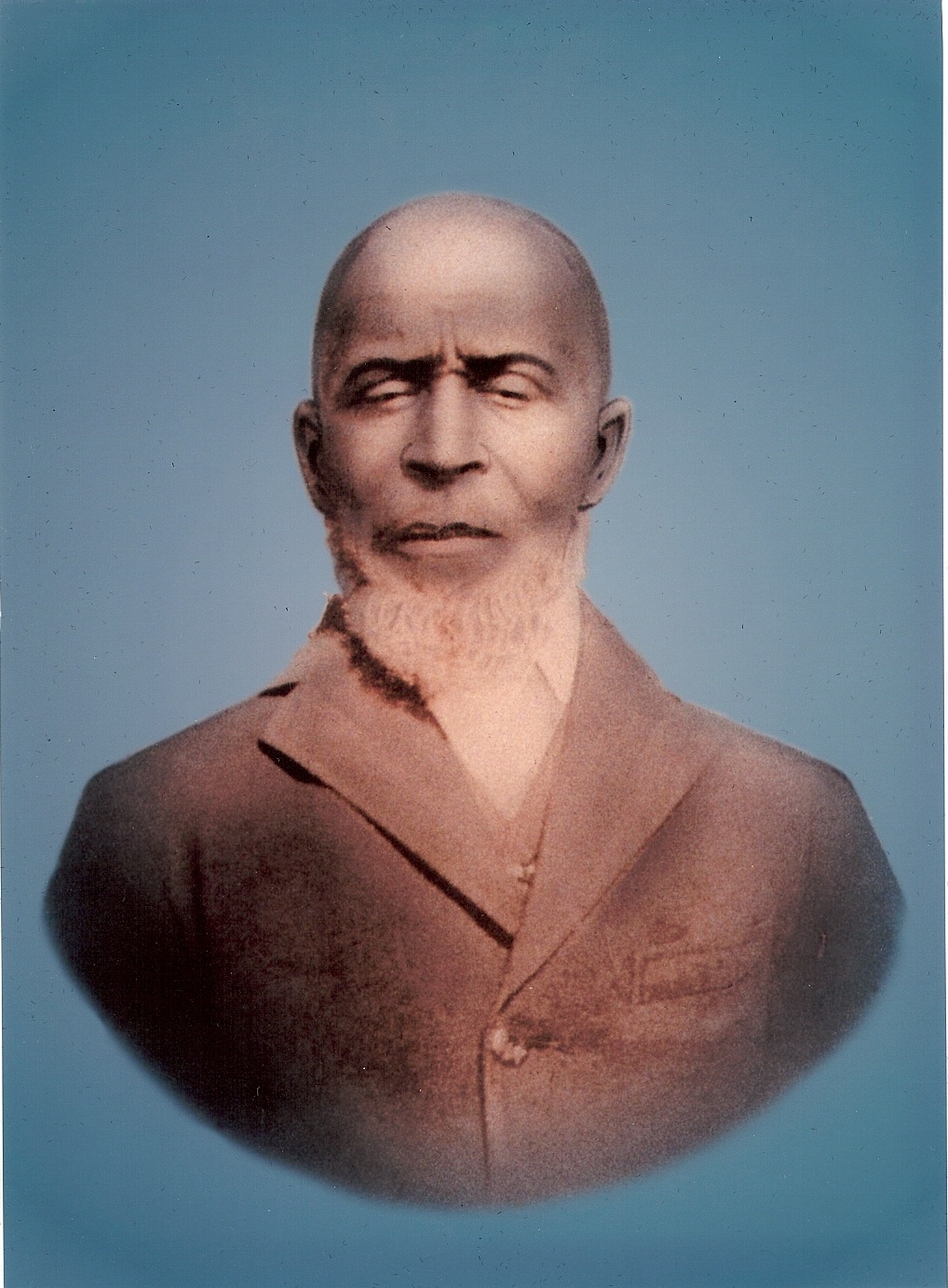
There had been a photograph of Adam Artis, cousin Daisy told me, but it had been stored with other things in a barn, and rain had ruined it. She recalled an image of a  brown-skinned man, or the suggestion of one anyway in the soft sepia and charcoal portraits of the day.

If no photograph of Adam exists, however, there is one of his youngest brother. His image, in fact, is the only one known of any of Vicey Artis and Solomon Williams’ children.

Image

Richard Artis was born in 1850 in Greene County, very near Wayne. He spent his youth out of sight of censustakers, but in 1873, he married Susanna Yelverton (also known as Susanna Hall, the daughter of free woman of color Nicey [or Caroline] Hall and a white Yelverton.) Their children included: Lucinda Artis Shearod, Emma Artis Reid, Ivory L. Artis, Loumiza Artis Grantham, Richard Artis Jr., Susan Artis Cooper, Jonah Artis, Charity Artis Coley, Frances Artis Newsome, John Henry Artis and Walter Clinton Artis.

Richard Artis farmed in northern Wayne County all his life. He died 12 February 1923 in Great Swamp township of apoplexy and was buried the next day by the son of his sister, Zilpha Artis Wilson.

——

Photo courtesy of Teresa C. Artis.

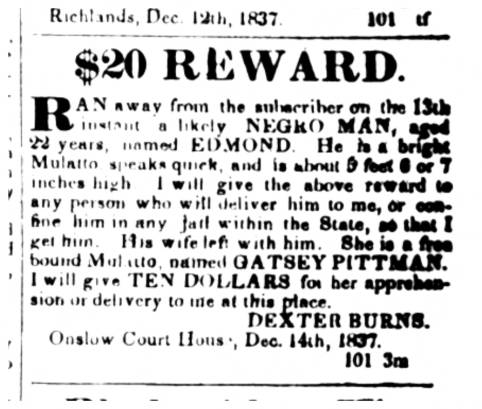
His wife left with him.

Image

See Gatsey Pittman here.

Wilmington Advertiser, 22 December 1837.

She has been delivered of a colored child.

To the Honorable the General Assembly of North Carolina Now in Session,

The Humble Petition of Jacob Johnson Sheweth, That my wife Hannah has violated the marriage Vow, distinguished herself as an abandoned woman in point of Morals and Chastity, by having been delivered of a coloured child on the 4th day of January 1822, Since which time our conjugal embraces have entirely ceased. The which base action causes me your humble petitioner to Solicit your kind interference in giving me a final discharge from said Hannah.

Your Humble Petitioner further Sheweth that misfortunes in life has rendered me Unable to Apply for a divorcement in the way heretofore prescribed by an act of the General Assembly – That Honorable body who now alone is able to give Me redress. And your Humble Petitioner will ever Pray &c 27th Nov’r 1823. /s/ Jacob Johnson

We the under signed believe the above Stated grievances to be Undisputed facts and from long acquaintance know your Petitioner to have Supported a good Moral character.  /s/ Oscar Alston, Elisha Siler, Joshua Adcock, R. Freeman, Jesse, Bray, Henry Dorsett, Duty Dorsett

[Granted.]

General Assembly Session Records, November 1823-January 1824, Box 1, North Carolina State Archives.