Most Horrible Murder.
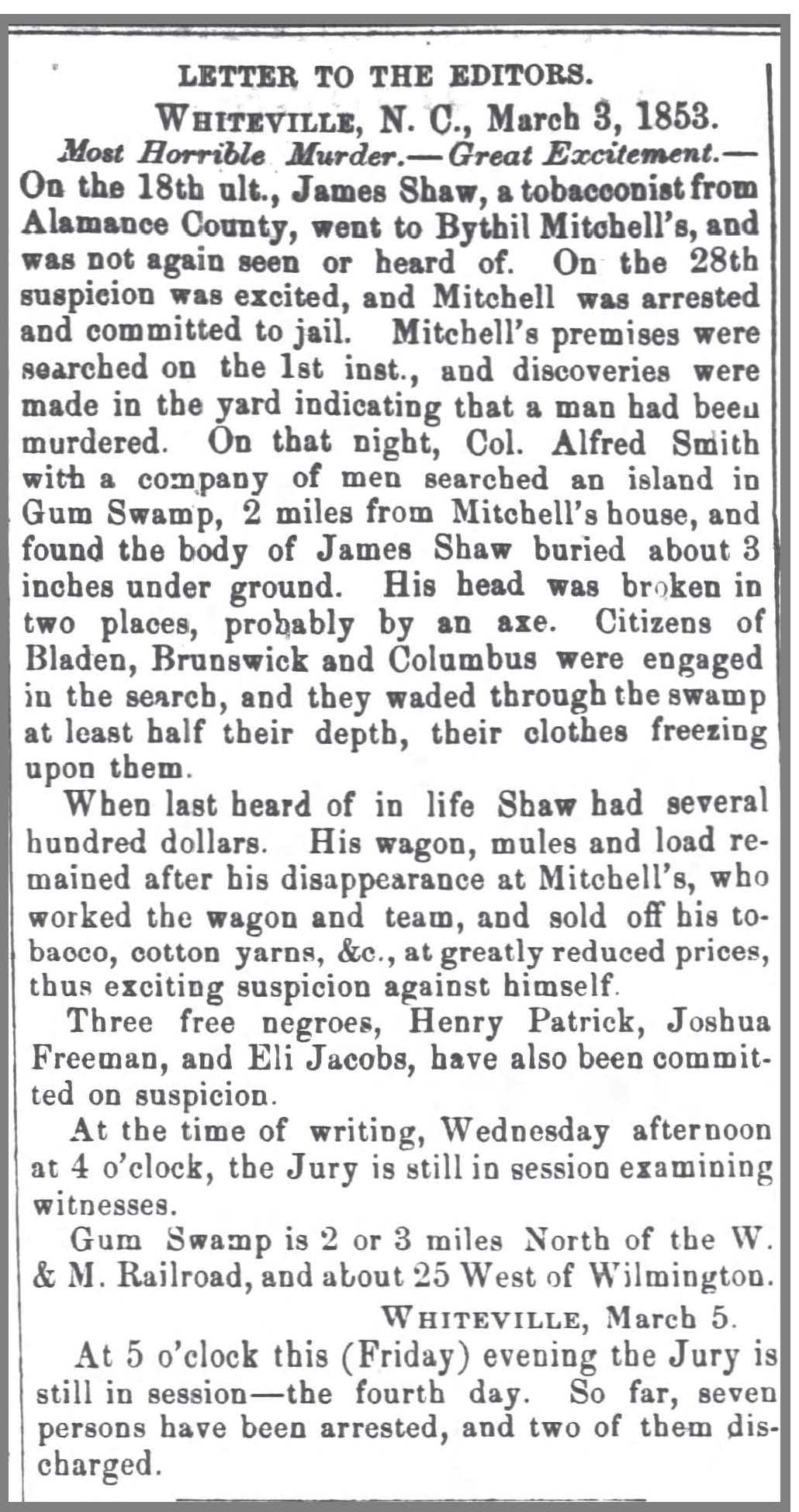
Fayetteville Weekly Observer, 8 May 1858.
Fayetteville Weekly Observer, 8 May 1858.
A pardoned villain. A fellow named Carroll, a free negro, has been arrested and imprisoned for horse-stealing in Wake county, N.C. This is the third offence. According to law he should have been hung for the second offence, but escaped, in consequence of some technical discrepancy in the proceedings. – He runs a slim chance of escape in the present instance; and surely if the penalty is strictly agreeable to the turpitude of his crime, he deserves it, especially for the third offence; but for ourselves we never could perceive the reason, the justice or righteousness of the law in such cases. Horse-stealing we regard as a high misdemeanor, but one which can only deserve incarceration in a penitentiary. – What! Deprive a human being of life for a stealing a horse? Horrible.
The Newbernian and North Carolina Advocate, 26 August 1843.
…
On Tuesday, therefore, the criminal docket was taken up, when Lewis Chavers, a free man of color, was put upon his trial for an assault and battery on Mr. Drury Kemp, a white man. Chavers was found guilty of the assault, which was of an aggravated nature, and fined one hundred dollars, and ordered to be sold for the payment of the fine. …
…
On Thursday, Harriet Durham, (a free woman of color,) charged with the murder of Grace, a negro woman, the property of Mr. John Pennington, of this county, was put upon her trial, and pleaded not guilty. The evidence in this case was entirely circumstantial. It seemed, from the proofs, that the prisoner and the deceased slept together in the same log-cabin; that on the night the murder was committed several of the witnesses were in the cabin with the prisoner and the deceased, and that they observed the signs of ill will between them; that the witnesses left the cabin about midnight; that next morning, about sun-up, one of the witnesses discovered the deceased lying in the jam of the chimney outside the cabin, with her skull broken; that the prisoner was interrogated by the witness before the body was found, as to where the deceased was, and that the prisoner said she did not know, but that somebody had called upon the deceased that night in a low voice, and asked her to come out of the cabin and go to a certain place; that another witness, after the body was found, told the prisoner she might as well confess herself the murderer, for she would have it to do; that the prisoner was afterwards asked why she had killed Grace, and that she answered because Grace had threatened to kill her; that the prisoner admitted she had struck the deceased two blows with a very heavy iron pestle, which caused her death. It was further in evidence that there was no way of getting into the cabin but through the door, which was fastened inside every night with a strong pin; that the iron pestle, which had been rusty and out of use before, was found that morning bearing the marks of having been scoured in the ashes; that blood was sprinkled upon the bed-clothing, on the floor, and upon the walls and loft of the cabin; that there was blood upon the door-sill, and evidence upon the ground outside the door of some one’s having been dragged upon it; that part of the bed-clothing had been washed, and that the blood had dried upon them in circles; that they were scortched in some places, and a portion of an old rug, the property of the deceased, cut out and hid or destroyed. This was the substance of the evidence on the part of the State. The prisoner offered no evidence. The case was opened by Hugh McQueen, Esq., for the prisoner; he was replied to by the Attorney General, and as the prisoner offered no testimony, was entitled to the concluding argument. This argument was more upon the facts than his opening speech, and was consequently extended to greater length; and we believe the opinion of all who heard it was that it eminently sustained his reputation for ability and ingenuity. The verdict of the Jury was, Guilty.
…
The North-Carolina Star (Raleigh), 12 April 1843.
… Grandison, a free boy of color, was out upon trial charged with larceny for entering in the night-time and robbing a store of Mr. S.J. Rickert, of this place, of money and merchandise a few months ago. The proof was point-blank, and Grandison was sentenced to receive thirty-nine lashes on his bare-back at this time, be imprisoned ‘till May term, and then receive thirty-nine lashes and be discharged.
Iredell Express (Statesville), 15 April 1859.
In the 1860 census of Iredell County, South of the River, 20 year-old Grandison, no last name, is listed in the household of white farmer James A. Kennedy, working as a servant. He is also noted as a convict.

Goldsboro Messenger, 4 February 1886.
[Sidenote: South Creek flows into the Pamlico River several miles before the river empties Pamlico Sound. Located northeast of New Bern, it is not hard to imagine that this area of Beaufort County was isolated and difficult to reach in the 19th century. — LYH]
TERRIBLE ACCIDENT.
On Wednesday evening last, the scaffolding of a new brick building, in progress of erection on Front Street near Market, gave way, precipitating the workmen from the 3d story to the earth. – None of them were actually killed, but we learn that Solomon Nash, a colored man, is so badly injured as to be despaired of. The others, Nicholas Logan, George Barr, Joseph Deas, and Benjamin Berry, colored, and Ephram Bettencourt, do., were all more or less injured. How they escaped with whole bones, is, to us, a most miraculous.
Wilmington Journal, 26 June 1846.
[In fact, Nash died of his injuries.]
Five Cents Reward.
ABSCONDED from the Subscriber, on the 19th ult.. a bound boy named Absalom Revels. – He is a very bright mulatto, about 14 years of age. All persons are cautioned against harboring him. The above reward, and no thanks, will be given for his delivery to me. DAVID SHAW. Fayetteville, August 4.
Fayetteville Weekly Observer, 11 August 1836.
FIVE CENTS REWARD.
RANAWAY from the subscriber, on the 1st of July last, a free black boy by the name of FRANK MITCHELL, an indented apprentice to the Blacksmith business. Frank is about 19 or 20 years old; of small size; and of light complexion. I hereby forewarn all persons from harboring or employing said boy under the penalty of law. The above reward, but no expenses will be paid for his delivery to me in Newbern. JAMES ARMSTRONG. NEWBERN, Feb. 24th, 1848.
The Newbernian and North Carolina Advocate, 29 February 1848.
DEATH BY FIRE – A Coroner’s Jury was called, Saturday at noon, to view the body of SALLY POTTS, a colored woman, who was burnt to death on Friday night, by her clothes taking fire, either from her own act or of some other person. The Jury had not been able to decide upon the case when our paper went to press. Her clothes had been impregnated with Spirits of Turpentine, and she was so dreadfully burnt that she died on Saturday. – Wil. Commercial
Raleigh Register, 5 December 1849.
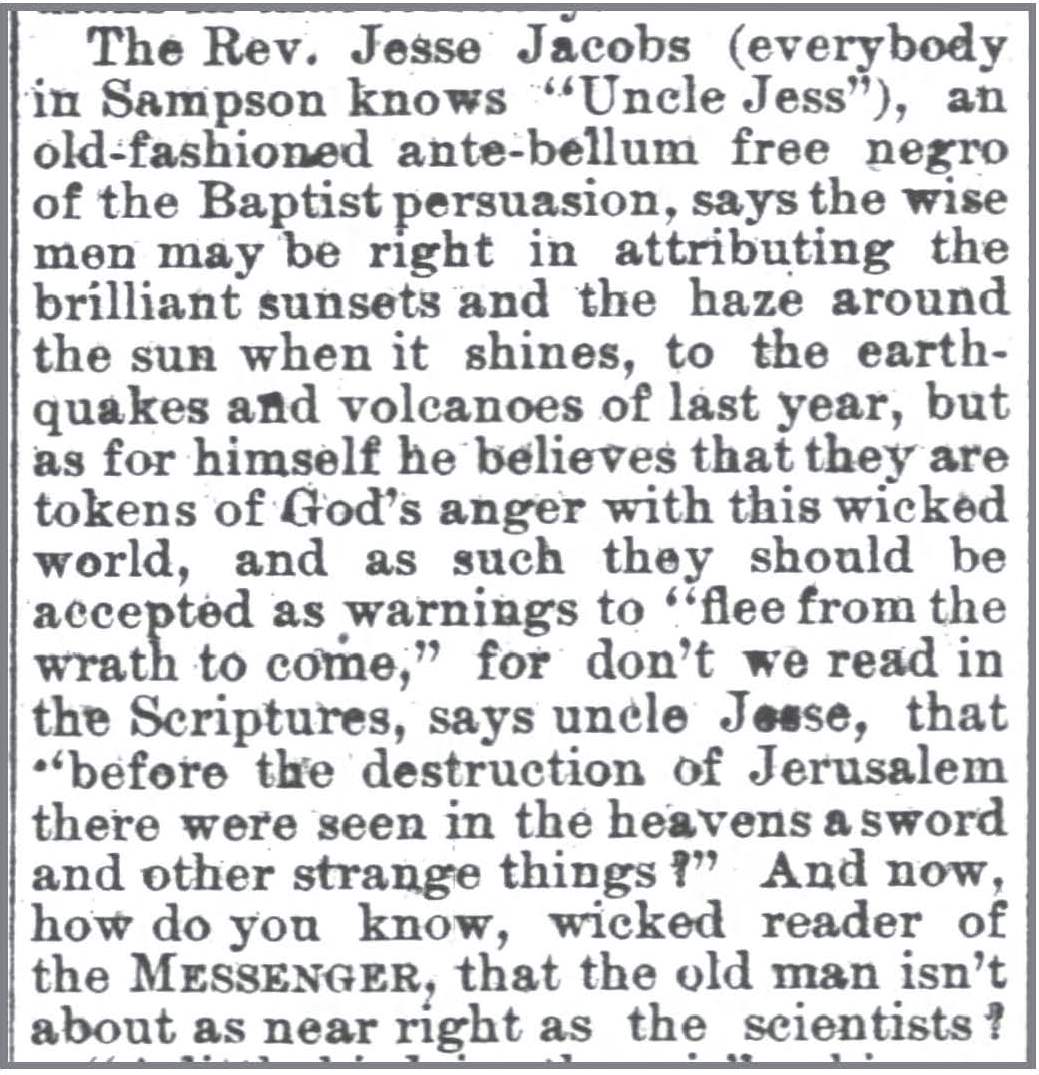
Goldsboro Messenger, 3 April 1884.
Jesse A. Jacobs was born about 1817 in Sampson County and died in Wayne County in 1902.
 Fourth Generation Inclusive