Fourth Generation Inclusive

Historical Documents of Genealogical Interest to Researchers of North Carolina's Free People of Color

Category: Migration

Jeffreys, woodworkers.

Thomas Day—who was born in 1801 in Greensville County, Virginia, to mixed-race parents, John and Mourning Day—moved with his family to Warren County, North Carolina, in 1817. When he moved to Hillsborough in the early 1820s, it appears that he became friends with members of the Jeffreys family who, although listed as “mulattos” in official records, were actually of Indian origin. The Jeffreys were part of a larger group of Occaneechi people from Virginia who had settled in the northwest section of Orange County, which became Alamance County in 1849. As with the Day family, the Jeffreys family had originated in Greensville County, Virginia. In 1830 Uriah Jeffreys served as a bondsman for Thomas Day when he married Aquilla Wilson. A bondsman was usually a close family member (such as a father, brother, or uncle) who assured the court that the couple should be married, and that the groom would not change his mind and leave the bride at the altar. Uriah Jeffreys must have been a close friend of Thomas to agree to be his bondsman. Historic records make it clear that both men were cabinetmakers, and it is possible that Uriah and his brother Nathan worked with Day for a short time. In 1828 Uriah decided to move. He advertised in the Hillsborough Recorder that he had a variety of furniture from his cabinetmaking business for sale, including “Bureaus, Bedsteads, Tables.”

Uriah moved to Ohio with two of his brothers, Parker and Augustus. Unfortunately, they experienced the same type of prejudice in the North that they had tried to leave behind. The law required free blacks entering Ohio to pay a bond of $500 to county officials. Whites thought this would guarantee that only free blacks of “good character” would settle and be able to support themselves. Parker Jeffreys refused to pay, insisting that his blood was a mixture of Indian and white, and not black. The case went to the county court, where he lost. Jeffreys persevered, and the Ohio Supreme Court heard his case in 1842. In Parker Jeffreys v. Ankeny et al., the supreme court justices ruled that he was an Indian with no African ancestry and did not have to pay the bond. Members of the Jeffreys family continued to make furniture near Xenia, Ohio, well into the twentieth century.

Nathan Jeffreys lived the rest of his life in North Carolina. It seems that he continued to work as a journeyman cabinetmaker, because in 1834 he is listed as such in a court document. However, in the 1850 and 1860 censuses, he is listed as a farmer owning $500 in property. Many cabinetmakers supplemented their incomes by farming. Day clearly considered Nathan a close family friend, because in 1851 in a letter to his own daughter, Mary Ann, he mentions the death of Nathan’s daughter, Safroney.

Fine furniture made by Nathan Jeffreys between 1845 and 1855 is known to exist in a private collection. The construction techniques that he used are similar to those found on the bureaus made in Day’s Milton shop, indicating that the two men probably worked together at one time. Jeffreys and other members of the Indian community passed on their woodworking skills. His great-great-grandson, William Bill Jeffries, learned woodworking from his father. He built houses as well as chairs during most of the twentieth century.

Adapted from Dr. Patricia Phillips Marshall, “Indian Cabinetmakers in Piedmont North Carolina,” www.ncpedia.org
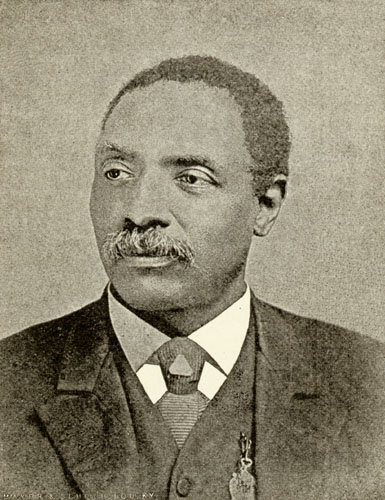
I do not find many colored men engaged as chiropodists.

ImageDr. Jared Carey, Chiropodist and Manicure, is a very interesting character. My attention was called to him while lecturing in Cincinnati. He is a native of North Carolina, but left his native State before the war, coming to Ohio with some Quakers and free colored people. In his early life he worked on a farm and engaged in all kinds of hard work, and many a month got as pay only $6.00, which in those days was considered large wages for a farm hand.

Dr. Carey had a great desire to travel and took up the profession of Chiropody in order that he might better his own condition and in his profession visit some of the larger cities, which he did in both the United States and Canada. I do not find many colored men engaged as Chiropodists, and none that I have met are as well prepared to do the work as Dr. Carey. He has several rooms handsomely fitted up for his work at 43 Arcade, up-stairs, Cincinnati, Ohio. Dr. Carey gives employment to at least six people all the time. His patrons are among the best people in Cincinnati. In addition to his regular work he has written a book on Chiropody and Manicure. For quite a number of years he has, in connection with his profession, conducted a school of Chiropody, and quite a number of his pupils are engaged in their profession in other large cities. Dr. Carey is assisted in his work by his wife, who is quite an expert at both Chiropody and Manicure. She is a very refined and pleasant lady, who is much thought of by their patrons. Dr. Carey has by good management been able to purchase some valuable property. He has been an active and useful member of the M. E. Church. Any young person, either lady or gentleman, desiring to learn Chiropody or Manicure would do well to write Dr. J. Carey at 43 Arcade, Cincinnati, for full particulars as to terms. I am confident that in most any large town a good Chiropodist could do well, and I should like to see more of the colored people thus engaged.

From G.F. Richings, Evidence of Progress Among Colored People (1902).

The fellow went towards Wadesborough.

Ten Dollars Reward.

Ranaway from Darlington Court-House, South Carolina, on Saturday 3rd, December 1814, a man of Colour who calls himself ROBERT BYRD, a black man, aged 20 or 25 years old, who has with him a pass from William Tunstall, Clerk, Pittsylvania County, Virginia – Said Negroe stole, and carried away a chestnut sorrel MARE, about 14 1-2 hands high, with a large star in her forehead and snip on her nose, a natural trotter, rather low in order. I will give the above reward for any person who will apprehend, and confine said fellow in any Joal [sic] so that he may brought to Justice, or deliver him to me, and all reasonable expences to any one who will deliver the said Mare to me – The fellow went towards Wadesborough, N. Carolina. JEREMIAH BROWN. December 6, 1814.

Star, Raleigh, 13 January 1815

Unlawfully did migrate, no. 4.

State of North Carolina, Wilson County   } Court of Pleas & Quarter Sessions October Term 1850

The Jurors for the State aforesaid upon their oath present that Gray Powel a free negro late of the county of Wilson on the 1st day of June AD 1859 at & in the said county unlawfully did migrate into the State of North Carolina contrary to the provisions of the act of the general assembly in such cases made & provided & that the said Gray Powel afterwards to wit up to this time doth yet remain in said State & in the county aforesaid contrary to the form of the Statute in each case made & provided & against the peace & dignity of the State    /s/ B.B. Barnes Solicitor

Slave Records, Wilson County Records, North Carolina State Archives.

In the 1850 census of Stephen Powell, 47, wife Synthia, 36, and children Gray, 9, Queen Anne, 8, Dolly, 7, Crockett, 3, and Noab, 1. [Sidenote: If this is the right Gray Powell, it suggests that he left the state prior to 1859 and tried to return. — LYH]

Adam & Angy Norphlet Artis.

Image Marriage license of Adam Artis and Angy Norphlet, Northampton County, 1835.

On 7 November 1848, Adam Artis of PIke County purchased “The North East quarter of the North West quarter of Section Fifteen, in Township Six, of Range Twenty; in the District of Lands subject to sale at Chillicothe Ohio; Containing Forty Acres,” certificate no. 16,235. US General Land Office Records 1796-1907, www.ancestry.com

In the 1850 census of District 17, Beaver township, Pike County, Ohio: Adam Artis, 36, laborer, wife Angelina, 30, and children Susan, 16, James, 13, and Aaron, 10, all born in Virginia.  In the 1860 census of Jackson, Pike Co. Ohio: Adam Artes, 40, farmer, wife Angeline, 40, and children Aaron, 20, and James, 23. Adam reportedly owns real estate valued at $400 and personal estate valued at $225.

[Sidenote: This Adam is not known to be related to Adam T. Artis — except in the sense that almost all Artises ultimately descend from a common ancestor. — LYH]

Some have resolved to move to Africa.

AUGUSTA, (GEORGIA) May 21st, 1837

To the Board of Managers of the American Colonization Society;

GENTLEMEN, I have the honor to submit a brief report of my proceedings since I left Washington early in March, with such suggestions and reflections as may occur during the relation of the incidents and observations of my tour up to this date.

North Carolina will stand forth a powerful and decided friend of the scheme of Colonization. … The Society of Friends in this State, early turned their thoughts to the plan of African Colonization, encouraged the free people of colour under their protection to emigrate to Liberia, and supplied a generous fund to defray the expenses of such as consented to remove thither. Several hundreds, once under the guardian care of this Society, are now enjoying the freedom and privileges of that Colony. There are still in North Carolina numerous free coloured persons of respectable intelligence and moral character. Those in Fayetteville, Elizabethtown, and Wilmington, have probably no superiors, among their own class, in the United States. After careful reflection, some have resolved to remove to Africa, and others are anxiously directing their thoughts to the subject. Louis Sheridan, with whose reputation and views the Board are partially acquainted, is a man of education, uncommon talents for business, a handsome property, and the master of nineteen slaves. His determination to emigrate to Liberia with a company of from forty to sixty of his relations and friends has already been announced. The public meetings held in Raleigh, during my visit, were well attended and of much interest, and addressed with spirit and effect by several of the citizens of that place. Collections were made for the benefit of the Society. The Resolutions adopted by the citizens of Raleigh are before the public.

I have the honor to be, With great respect, Gentlemen, your obedient Servant,

R. R. [Ralph Randolph] GURLEY

Excerpt from Secretary’s Report, The African Repository and Colonial Journal 13, No. 7 (July 1837), pages 201-206.

Only his aunt remains alive.

Charlotte County Virginia. This day Mary Belcher came before me Hillery Moseley a Justice for said County at the request of Lucy Chavers who has been married to Robert Cole both black persons and the said Lucy had a Sister by the name of Betty Chavers who had a Son which was crissind in my house by the name of John Jackson Chavers, and made Oath that the said two women were Sisters and She don’t believe there is any of the aforesaid Family a Live at this time except the said Lucy Cole, Given from under my hand this 27th day of April 1808  /s/ Hillery Moseley

———-

Mecklenburg County, Virginia. This day Haywood Rudd came before me a Justice for said county and made oath that he was acquainted with a black boy by the name of John Jackson Chaves that the said boy was bound and apprentice to William Steward a blacksmith and that when he the said Steward went from the County to Wake County N Carolina the aforesaid John Jackson Chaves went with him and that he knows of no relations of said John Jackson Chaves except Lucy Cole rais’d said J. Jackson Chaves from his infancy until he was bound apprentice to the said William Steward. Given under my hand this 9th day May 1808.  /s/ James Hester

———-

Mecklenburg County, Virginia. This day came Mathew Carter before me a Justice for the said County, and made oath that Lucy Cole Lived several years on his plantation in this County & that she rais’d a boy there by the name of John Jackson Chaves, Who was then said to be her sisters son that the said John Jackson Chaves was afterwards bound apprentice to William Steward blacksmith who carry’d him the sd. John Jackson Chaves with him when he moved from this county and that he knows of no relations in these parts to said Chaves or any where else except Lucy Cole, given under my hand this 9th day of May 1808  /s/ James Hester

Miscellaneous Records & Apprentice Bonds and Records, Wake County Records, North Carolina State Archives.

He is making for the Western Country.

One Hundred Dollars Reward.

RANAWAY from the subscriber on the 6th day of March last, a mulatto man by the name of JACK, well built, about five feet five or six inches high, 28 years of age, a tolerable shoe maker, and has been much in the habit of driving a wagon – He has a scar on his forehead, and a part of one of his upper foreteeth is broken off, one of his wrists broke and crooked, and his right leg pretty much shot with small shot which will shew very plainly. He has been seen on his way making for the Western Country, and passes as a free man but the name of John Revill, having obtained a pass from a black free man of that name which was written and signed by John Taylor Clerk of the County Court of Orange, (State of North-Carolina) – Any person who will deliver the aforesaid mulatto man to the Subscriber at Hillsborough in the state aforesaid, shall receive the above reward, and all reasonable charges paid from time of his being taken until delivered.  LEVI WHITTED.

Hillsborough Record, April 8, 1812.

P.S. The Subscriber was somewhat mistaken before in a part of the description given of this fellow, that is with respect to his height.

The Editor of the paper at Knoxville, is hereby requested to give this advertisement an insertion in his paper and continue the same about 6 weeks, for which he will be good enough to forward his account to the subscriber living at Hillsborough, and the money shall be duly forwarded.   L. WHITTED.

John P. Green.

Image

Hon. John P. Green was born in 1845 at New Berne, N.C., of free parents. As a boy of twelve years of age, he went with his widowed mother to Cleveland, Ohio. He was educated in the Cleveland public schools, graduating from the Central High School in 1869.

He was admitted to the bar of South Carolina in 1870. Returning to Cleveland, he for nine years served as justice of the peace. In 1881 he was elected member of the Ohio Legislature, serving three terms.

In 1897 he was appointed to a position in the postoffice department by President McKinley.He was also delegate to the National Republican Convention in 1872, in 1884 and 1896.

From D.W. Culp, ed., Twentieth century Negro literature, or, A cyclopedia of thought on the vital topics relating to the American Negro.

Courtesy of New Bern-Craven County Public Library. 

The roots of Arkansas’ largest free colored community.

DAVID HALL (1782?-1859?), described as a “colored” and “exceedingly stout man,” settled along the White River bottoms some seven miles below the mouth of the Little North Fork in 1819, the year that Congress created Arkansas Territory. The North Carolina-born Hall and his light-skinned wife Sarah, a Tennessean, built a cabin, raised corn, horses and cows, made whiskey in one of the first stills to be seen on the upper White River, and, not least of all, tended to their growing family. An 1840 surveyor’s map shows the Hall farm, which was located twenty miles west of today’s city of Mountain Home, with forty acres under cultivation, a larger operation that any other in his township. Hall paid county and state taxes for thirty years, and these records document his relative prosperity. … [His] sons Willoghby, Joe, and James, and his daughters Margaret Hall Turner and Eliza Hall Caulder established families that expanded the free black population in Marion County. These pioneer families lived in semi-isolation and in harmony with whites, a situation that attracted other free mulattoes who settled in the vicinity, forming antebellum Arkansas’s largest free black community.

Hall and his son-in-law Peter Caulder, despite state laws to the contrary, kept hounds and firearms essential to their frontier life. … Travelign about by any conveyance was legal in the territory and after statehood, but risky for free blacks since they were under the jurisdiction of any white man who cared to exercise that authority. Despite the risk, the Halls and their neighbor John Turner occasionally traveled outside the county by horse and by boat to attend tot heir business affairs.

Land ownership was one of the few legally recognized rights of Negros in slave states such as Arkansas. During the winter of 1849, David Hall and John Hall (possibly a brother) traveled one hundrted miles to the United States government land office at Batesville to pay cash for and later receive patents on their White River valley acreage. …

The settlement lasted until the Arkansas General Assembly passed a law in February 859 entitled, “An Act to Remove the Free Negroes and Mulattos from the State.” Penalties included seizure and sale into slavery, emancipation having already been made illegal in Arkansas. The enormity of the threat was enough to overcome the tenaciousness of folks in the free Negro community. More than one hundred of them abandoned good farms and departed Marion County and the state of Arkansas, a gut-wrenching turn of events, without doubt.

Today the land patented by David Hall lies beneath Bull Shoals Lake. With the exception of weathered and nameless wooden markers placed atop a stone wall alongside the Promised Land Cemetery by the Corps of Engineers before the valley was flooded, no physical trace remains of the free black community that thrived along the banks of the White River near the Missouri border. Hall disappeared from the tax and census records in 1859 when he would have been seventy-six years old. … [by] Billy D. Higgins

Adapted from Nancy A. Williams and Jeannie M. Whayne, eds., Arkansas Biography: A Collection of Notable Lives (2000).

In the 1850 census of Marion County, Arkansas: David Hall, 67, born NC, wife Sarah, 55, born Tennessee, and Mary, 18, Joseph, 12, and Henry Hall, 20, all born in Arkansas. Sons James and Jospeh are listed with theri families nearby.