Fourth Generation Inclusive

Historical Documents of Genealogical Interest to Researchers of North Carolina's Free People of Color

Category: Free Women of Color

Free colored farmers, no. 2.

These members of the Winn family were listed in the 1850 agricultural schedule of Duplin County:

Charles Winn. 125 improved acres, 199 unimproved acres, value $300. Farm implements valued at $50. 3 horses. 4 milch cows.  2 other cattle. 35 swine. Livestock valued at $230.  250 bushels, Indian corn.  8 bushels, oats.  100 lbs., wool. 500 bushels, peas and beans. 50 bushels, Irish potatoes.  400 bushels, sweet potatoes.  365 lbs., butter. Homemade manufactures valued at $75.

Adam Winn. 400 improved acres, 1500 unimproved acres, value $3800. Farm implements valued at $100. 6 horses. 6 milch cows.  30 other cattle. 6 asses and mules.  2 oxen.  20 sheep.  60 swine. Livestock valued at $715.  350 bushels, Indian corn. 10 bushels, oats.  70 lbs., wool.  100 bushels, peas and beans.  3 bushels, Irish potatoes.  1000 bushels, sweet potatoes. 450 lbs., butter.  Homemade manufactures valued at $42.

Levi Winn. 150 improved acres, 236 unimproved acres, value $1500. Farm implements valued at $60. 3 horses. 4 milch cows. 1 oxen. 12 other cattle. 11 sheep. 15 swine. Livestock valued at $300.  200 bushels, Indian corn. 75 bushels, oats. 3 bales, cotton. 45 lbs., wool.  200 bushels, peas and beans. 25 bushels, sweet potatoes. 50 lbs., butter. 5 tons, hay. Homemade manufactures valued at $10.

Washington Winn. 50 improved acres, 58 unimproved acres, value $400. Farm implements valued at $25. 1 horse. 2 milch cows. 1 other cattle.  8 swine. Livestock valued at $155.  250 bushels, Indian corn.15 bushels, oats. 15 lbs., wool. 40 lbs., rice.  40 bushels, peas and beans. 40 bushels, Irish potatoes. 50 bushels, sweet potatoes.  100 lbs., butter. 40 lbs., cheese.  3 tons, hay. Homemade manufactures valued at $30.

Sally Winn [widow of Gray Winn].  60 improved acres, 163 unimproved acres, value $500. Farm implements valued at $15.  3 horses. 2 milch cows. 3 other cattle. 10 swine. Livestock valued at $115. 220 bushels, Indian corn.  1 bushel, oats. 25 lbs., wool.  100 bushels, peas and beans. 50 bushels, Irish potatoes. 50 bushels, sweet potatoes. 6 tons, hay. Homemade manufactures valued at $5.
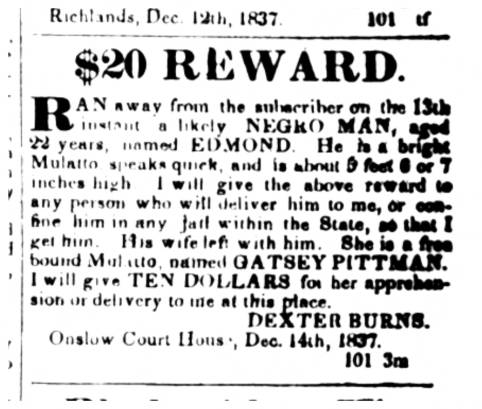
His wife left with him.

Image

See Gatsey Pittman here.

Wilmington Advertiser, 22 December 1837.

He ill-treated, whipped and abused her, then took up with a slave.

North Carolina, Guilford County    }   Superior Court of Law, To Fall Term, A.D. 1866.

To the Honorable, the Judges of the said Court:

Mary Hubbard, of said County, by her petitioner, respectfully showeth unto your Honor, that she was born free and was intermarried, about twelve years ago, with a free man of color of the name of John Hubbard; that they obtained a license from the Clerk of the County Court of Alamance County and the rites of matrimony were solemnized between them by a Justice of the peace in said county; that your petitioner and her said husband, John Hubbard, lived together agreeably, and as man and wife should, for about three years; that during this time she was treated affectionately and kindly; that for some cause, to your petitioner then unknown, the said John Hubbard, her husband aforesaid, began to ill-treat, beat, whip and abuse your petitioner in such wise as to make her life oppressive and burthensome; that this abuse of your petitioner continued from that time, with short intervals when he was less cruel and unkind to her, now and then, up to about the first of September, A.D. 1865; that prior to that time and to your petitioner’s quitting her said husband’s house, her said husband, the aforesaid John Hubbard, became intimate with one Emily, a slave then and in property of one Tobias May, of Alamance, and, as your petitioner is advised and believes, her said husband had habitually illicit and adulterous intercourse with the said Emily; that for these reasons and for the further reasons that her life with him became intolerable and unendurable, she left him and hath not cohabited with him since that time; that she is advised and believes, that the said John Hubbard, her husband aforesaid, hath since kept up his illicit, adulterous and criminal intercourse aforesaid, with the said Emily May, who is now free, and he is illegally and improperly cohabiting with the said Emily at this time, contrary to law and in despite of his vows of chastity and fidelity to your petitioner, made and entered into at the time of their marriage; that your petitioner hath resided in this county for the last twelve years and ever since she was married, and now resideth here; that the course of action hath existed ever since last September, which is about ten and a half months; that your petitioner hath kept her vows of chastity and fidelity to her said husband, both before and since this parting; that she is now leading a correct and chaste life:

Your petitioner, for the reasons aforesaid, most respectfully prays your Honor, that the bonds of matrimony, now existing between her and the said John Hubbard, her husband aforesaid, may be dissolved, and that your petitioner may have such other and further relief as the nature of her case may require and to your Honor may see merit.  She further prayeth, that the said John Hubbard be served with a copy of this libel, and a subpoena, commanding the said John Hubbard to appear at the next term of this honorable Court, to be held for the County aforesaid, at the courthouse in Greensboro; on the Fourth Monday after the Fourth Monday of September next; then and there, to plead, or answer, to this libel, and to stand to, abide by and perform the order, claims and Judgments of this Court. And an in duty-bound she will ever pray.    Scott & Scott, Attos. for Petitioner.

Divorce Records, Guilford County Records, North Carolina State Archives.

The peculiar circumstances: the husband might become a slave of his children.

To the Honorable the General Assembly of the State of North Carolina now in Session – The Petition of Lovedy Henderson a free woman of color, respectfully represents that your Petitioner intermarried some years since with a certain man of color by the name of Horace, then a slave, but with the consent of his owner. That since their marriage by care and industry, she has been enabled to purchase her said husband at the price of Eight Hundred & Seventy dollars of Hugh and John G. McLaurin Executors of Duncan McLaurin deceased.  That she has paid the purchase money & has a Bill of Sale duly executed by the said Executors. That your Petitioner now has two children by her said Husband & as by possibility her husband might become the slave of her children, your petitioner is induced to ask the interference of your honorable body, as the only tribunal authorized to grant the relief prayed for. Your Petitioner would not presume to ask this indulgence in her favour, in contravention to the policy of the Laws of the Land, but from the peculiar circumstances of her case & the belief that she will be enabled to establish for her Husband such a Character as to entitle him to the favourable notice of your honorable body. For this, she relied on the certificates of highly respectable gentlemen both in Fayetteville & the City of Raleigh, where they have lived since their intermarriage. Your Petitioner therefore prays the passage of an Act, emancipating her said husband Horace Henderson, and she in duty bound will ever pray &c. /s/ Lovdy Ann Henderson

We Hugh McLaurin & John C. McLaurin Executors of Duncan McLaurin dec’d unite in soliciting the passage of an Act for the emancipation of Horace Henderson as prayed for by his wife and we are free to say that we have long known said Horace who is a Barber and a boy of unexceptionable good character and of industrious & moral habits.   /s/ H. MacLaurin for himself and John C. MacLaurin

We the undersigned citizens of Fayetteville freely unite in soliciting the General Assembly to pass an Act emancipating the negro man Horace, that we have known said Horace as a Barber & a Boy of good character, industrious habits and as we believe of the strictest integrity.  /s/ J.H. Hooper, John MacRae, John Kelly, Thos. L. Hybart, [illegible] Cochran, John Lippitt, D.A. Saltmarsh, Chas. B. Jones, [illegible] Hawley, William S. Latta, Jas. Huske, Duncan Smith, Henry W. Ayer

We the undersigned citizens of Raleigh freely unite in soliciting the General Assembly to pas an Act emancipating the negro man Horace, that he has lived in the place for the last three or four years as a Barber, and has conducted himself with the utmost propriety, that in his deportment he is humble & polite, free as we believe from any improper intercourse with slaves, industrious & honest.  /s/ M. Stokes, R.M. Saunders, Jo. Gales, B.W. Daniel, Geo. Simpson, J. Brown, John Primrose, Hazlett Wyle, Richard Smith, S. Birdsall, Jno. G. Marshall, A. Williams, Fabius J. Haywood, Robert Staniroy

General Assembly Session Records, November 1832-January 1833, Box 5, North Carolina State Archives.

In the 1850 census of Greensboro, Guilford County: Horace H. Henderson, 40, barber, and wife Love, 39, both born in Fayetteville; children James, 18, farmer, Mary Ann, 17, and Timothy, 14, born in Raleigh; and Albert, 10, Sarah, 8, Thomas, 4, and Alexander, 3, born in Greensboro; all mulatto.

[Sidenote: Ninety years after this petition, a Horace Henderson was born into my extended family, but I know no connection between my Hendersons, originally of Onslow County, and Lovedy Ann Henderson. — LYH]

Some evil-disposed person sold him.

State of North Carolina, Pasquotank County   } Decem’r Term 1793

To the Worshipful the County Court of Pleas & Quarter Sessions for the County of Pasquotank aforesaid.

The petition of Jeremiah Alias Jeremiah Burges Sheweth

That he was Born of the Body of Nancy Alias Nancy Burges a Free Woman of Colour late of the said County of Pasquotank that some evil disposed person during the Infancy of your Petitioner sold him as he hath been informed to Edward Everigain late of the said County of Pasquotank Esquire deceased as a Slave in who Service he has since remained and that David George administrator of the said Edward Everigain since his death continues to hold your Petitioner in Slavery all which Actings & doings are contrary to the Law of Land & of Equity & good conscience In tender consideration whereof may it please your worships to grant to your Pet’r a Writ or Writs or Subp. Commanding the said David George adm. as aforesaid to appear & answer & to grant to your Pet’r such other & further relief as under the Act of Assembly in such case made & provided & in Equity he is entitled to receive & your Pet’t as in duty bound shall ever pray &c    /s/ Will Blair Atty

Records of Slaves and Free People of Color, Pasquotank County Records, North Carolina State Archives.

In payment of Confederate taxes, no. 2.

Form of the estimate and assessment of agricultural products agreed upon by the assessor and tax-payer, and the value of the portion thereof to which the government is entitled, which is taxed in kind, in accordance with the provisions of Section 11 of “an Act to lay taxes for the common defence and carry on the government of the Confederate States,” said estimate and assessment to be made as soon as the crops are ready for market.

Celia Artis by son

Cured Fodder     Quantity of gross crop. — 2500   Tithe or one-tenth. — 250    Value of one-tenth. — $7.50

I, Celia Artis of the County of Wayne and State of North Carolina do swear that the above is a true statement and estimate of all the agricultural products produced by me during the year 1863, which are taxable by the provisions of the 11th section of the above stated act, including what may have been sold of consumed by me, and of the value of that portion of said crops to which the government is entitled.   /s/ Calvin X Artis

Sworn to and subscribed to before me the 29 day of December 1863, and I further certify that the above estimate and assessment has been agreed upon by said Celia Artis and myself as a correct and true statement of the amount of his crops and the value of the portion to which the government is entitled.  /s/ J.A. Lane, Assessor.

Confederate Papers Relating to Citizens or Business Firms, 1861-1865, National Archives and Record Administration.

I’ve got her children.

Ten Dollars Reward.

RUNAWAY from Nixenton, Pasquotank County, some time in January last, a negro woman by the name of BECK, formerly the property of Mr. Morris of said county, who emancipated her and two children. She was apprehended and sold, agreeable to an act of Assembly of North Carolina. I expect she had a free pass, and will endeavor to pass for a free wench. I suppose she will go to Norfolk, as she has a free husband that is acquainted there. She is very large, rather light complexioned, about 22 years old. Any person apprehending and securing her in any jail, to that I get her again, or delivering her to me in Halifax county, North-Carolina, shall receive the above reward.   JOHN PONS.

N.B. I have got the two children from Mr. Morris, since the wench went away.

April 8, 1794

Virginia Chronicle, Norfolk, 12 May 1794.

The 1,000th post!

The liberty which free persons in a free country are entitled to.

To the worshipfull the Justices of Craven County Court  March Term 1785

The humble petition of Dorcas Brinson Sheweth That she is illegally held in Servitude by William Clark when she conceives she is entitled to her Freedom & the Liberty which Free persons in a Free Country are entitled to, and as her Complaint is returned to your Worships, she humbly hopes you will take her case into Consideration and Discharge her from Servitude.

And as in duty Bound she will ever pray &c   Dorcas Brinson

Records of Slaves and Free People of Color, Craven County Records, North Carolina State Archives.

In payment of Confederate taxes, no. 1.

Form of the estimate and assessment of agricultural products agreed upon by the assessor and tax-payer, and the value of the portion thereof to which the government is entitled, which is taxed in kind, in accordance with the provisions of Section 11 of “an Act to lay taxes for the common defence and carry on the government of the Confederate States,” said estimate and assessment to be made as soon as the crops are ready for market.

Adam Artis by wife

Cured Fodder     Quantity of gross crop. — 1500     Tithe or one-tenth. — 150     Value of one-tenth. — $4.50

I, Adam Artis of the County of Wayne and State of North Carolina do swear that the above is a true statement and estimate of all the agricultural products produced by me during the year 1863, which are taxable by the provisions of the 11th section of the above stated act, including what may have been sold of consumed by me, and of the value of that portion of said crops to which the government is entitled.   /s/ Adam X Artis

Sworn to and subscribed to before me the 3 day of December 1863, and I further certify that the above estimate and assessment has been agreed upon by said Adam Artis and myself as a correct and true statement of the amount of his crops and the value of the portion to which the government is entitled.  /s/ J.A. Lane, Assessor.

The Confederate Papers Relating to Citizens or Business Firms, 1861-1865 (NARA M346), often called the “Confederate Citizens File,” is a collection of 650,000 vouchers and other documents relating to goods furnished or services rendered to the Confederate government by private individuals and businesses.

The “Citizens File” was created by the Confederate Archives Division of the Adjutant General’s Office from records created or received by the Confederate War and Treasury Departments that were in the custody of the U.S. War Department. The Citizens File was created to aid in determining the legitimacy of compensation claims submitted for property losses allegedly inflicted by Union forces. The records were used by the Treasury and Justice Departments, Southern Claims Commission, Court of Claims, and congressional claims committees to determine whether the claimant had been loyal to the Union or had aided the Confederate government and thus not eligible for compensation.

[Sidenote: In 1863, Adam Artis was married to Frances Seaberry. They are my great-great-great-grandparents. — LYH]

Rather than trust his client’s color before the jury …

Wm. W. Johnson v. Peter G. Basquere, Justice, and others, Freeholders, and Thomas Miller v. Boon, Tax Collector of St. Paul’s, and Rice, Sheriff, 28 S.C.L. 329 (1843).

The South Carolina Court of Appeals heard these cases on the issue of whether, where a “narrator” has argued that he is “entitled to occupy in society the status of a free white man,” he can discontinue proceedings by motion for non-suit or leave of court before publication of the verdict.

In Johnson v. Basquere, the narrator, who was about to be tried as a free person of color, filed a declaration in prohibition alleging that he “had a right to occupy in society the status of a free white man of South Carolina.”  The defendants denied that he was a free white man, and the issue was put to a jury. “Much evidence was offered on both sides. Many witnesses on the part of the narrator, said that he was received in society, and regarded as a free white man, whilst witnesses on the part of defendants, testified that his great grand-mother, by the mother’s side, was a mulatto. The case was submitted to the jury, after full argument and a fair trial. When the jury returned to the court room, the foreman stepped to the clerk’s desk to write his verdict, and when he was about to deliver the record to the clerk, a motion was made to poll the jury, which the presiding Judge refused.” The narrator’s counsel –suspecting an unfavorable verdict –  then moved to discontinue the proceeding without publishing the verdict. This motion was granted.

Johnson was in court, “and had the appearance of a white man. He had been a member of a volunteer company, and had voted at the general election for members of the Legislature. There was no question but what his lineage on his father’s side, was that of white, and rather respectable people. His mother, Mary, was the daughter of one Nancy Patrick, formerly Nancy Miller. [Mr.] Patrick, who had married Nancy, was regarded a colored man, and Mary was born in wedlock; but several witnesses said Patrick never claimed her, and that her mother said she was the child of an Irish schoolmaster, Ellis, living in the neighborhood at the time she was begotten and born, and she was so generally regarded. Nancy Miller’s father was a white man, who married Elizabeth Tan,” Johnson’s great-grandmother. “Elizabeth Tan was a colored woman, with thick skin and long hair; and from what came out in another case, she was originally from North Carolina, and claimed to be an Egyptian.”

In Miller v. Boon, the question was whether the narrator “was subject to a poll tax imposed on free persons of color, of African origin and taint; or whether he was entitled to occupy the position of a free white man.” In an earlier matter, a judge had held that the narrator, Isaac Winningham, and his wife Rachel,“were not subject to be taxed as free persons of African origin, but that they were exempt from such a tax, as the descendants of Egyptians.” Winningham’s counsel argued that this decision ruled and rested his case. The solicitor then called Winningham into court – “and his appearance was that of a mulatto. At this stage of the proceedings, and perhaps when the Solicitor was about calling witnesses to shew that narrator was a mulatto, the counsel for narrator moved to discontinue his proceeding, preferring to rely on the [earlier] judgment …, rather than to trust to his client’s color, before the jury. The presiding Judge granted the motion.”

The court of appeals determined that both parties to the action are voluntary and entitled to stop proceedings to take a more prudent course. Decisions upheld.