Fourth Generation Inclusive

Historical Documents of Genealogical Interest to Researchers of North Carolina's Free People of Color

Month: April, 2013

Beaten, bruised and mangled.

Disgraceful Outrage. – An occurrence took place in this City, on Friday night last, which has excited a great deal of feeling, and will do much towards destroying the deservedly high reputation, which our City has always enjoyed, until recently, as a law loving and law-abiding community. A free man of colour, named Allen Jones, a Blacksmith by trade, who has rendered himself somewhat obnoxious, was forcibly taken from his own house, in the dead of night by a mob, and so beaten, bruised and mangled, that doubts are entertained of his recovery.  – Ral. Reg.

Tarboro’ Press, 22 October 1842.

Marshall A. Carter.

ImageMARSHALL ARCHIE CARTER (or, perhaps, Archie or Archibald Marshall Carter, though his initials are shown as “M.C.” above) was born in 1860 to William Carter (1833-ca1875) and Mary Cox Carter (ca1830-??) of Sampson County. His father William was the son of Michael Carter (1805-ca1875) and his wife Patience.  Marshall Carter married Margaret Frances Jacobs.  They are buried in the First Congregational Church, Dudley, Wayne County.

Photo taken by Lisa Y. Henderson, March 2013.

In the 1860 census of Clinton, Sampson County: Wm. Carter, 26, farmer; wife Mary, 34; and children Cornelia, 12, Francenia, 6, Thos. G., 5, Sarah J., 2, and Archibald, 7 months.  Next door: Michael Carter, 57, and wife Patience, 47. All mulatto. [A duplicate listing in Piney Grove, Sampson County: William Carter, 27, turpentine laborer; wife Mary, 27; and children Cornelia, 12, Francenia, 6, Isaaih T., 4, Sarah J., 2, and Archy M., 6 months.]

This death certificate was filed in Wayne County: Marshall Carter. Died 11 July 1922, Dudley, Brogden, Wayne County. Colored. Farmer. Married to Frances Carter. Born 7 July 1860, Duplin County, to William Carter and Mary [last name unknown.] Buried in Dudley. Informant, Milford Carter, Mount Olive NC.

An act to emancipate Louis.

An Act to emancipate Louis, a slave, the property of James Dunn

Be it enacted by the General Assembly of the State of North Carolina, and it is hereby enacted by the authority of the same, That Louis, a slave, the property of James Dunn, of Cumberland county, be and he is hereby, with the consent and at the request of the said owner, emancipated and set fee, and by the name of Louis Dunn shall hereafter possess and excercise all the rights and privileges which are enjoyed by other free persons of color in this State: Provided, nevertheless, That before said slave shall be emancipated, his said owner shall give bond with good sureties in the sum of five hundred dollars, payable to the Governor of the State and his successors in office, that the said slave shall honestly and correctly demean himself while he remains in this State, and not become a county charge; which bond shall be filed in the office of the clerk of the court of pleas and quarter sessions of Cumberland county, and may be sued upon in the name of the governor for the time being, to the use of the county or persons injured by a breach thereof. [Ratified 16th day of February, 1855]

Chapter 113, Public and Private Laws of North Carolina Passed by the General Assembly 1854-55, North Carolina State Archives.

Tenant or servant?

Joseph Hare v. Barney Pearson, 26 NC 76 (1843).

This matter was appealed from Fall Term, 1843, Superior Court of Law of Nash County. The case involved an action of trover (wrongful possession of private property) for a quantity of corn.  At trial, the Hare showed that Pearson rented a small tract of land in 1841 to Elijah Powell, a free man of color, for the year 1841. Powell agreed to pay one-half his corn crop as rent. On 13 March, 1841, an unnamed person obtained a judgment against Powell and an execution was levied on his growing crop the following June. When the corn was gathered, Powell and Pearson divided it equally and stored it in one barn.  Before the sheriff’s sale on 8 February, 1842, more than half the corn had been removed from the barn. Pearson objected to the sale, claiming the remaining corn as his. The sale proceeded, and Hare bought was left. Pearson exclaimed that he would break every bone in Hare’s body before he would let Hare take the corn. Pearson offered evidence that he had not rented the land to Powell, and Powell was only a laborer with no ownership interest in the crop.

The Court left it to the jury to decide whether Powell was Pearson’s tenant in 1841 (in which case, the sheriff had a right to levy on the crop and Hare was entitled to its value after Pearson refused to give it over), or whether he was merely his servant (in which case Hare could not recover.) The jury returned a verdict for the plaintiff, and the defendant appealed.

The Supreme Court found that, even if Powell had been Pearson’s servant, the evidence showed that they had split the crop, giving Powell title to half. Powell was present at the sale, and it was he, rather than Pearson, who had standing to object to any irregularity.  Pearson claimed Powell’s corn without title, and his threat to beat Hare rather than let him take his purchase amounted to conversion. This was a matter of law, not fact, and should not have been sent to the jury. Judgment affirmed.

He was the same person who had been kidnapped from his mother.

Wilmington, Oct. 2. – About eleven years ago, a white man came to the house of a free coloured woman, named Fanny Larrington, living on the sound, in the neighbourhood of this town, and requested her to lend him some assistance in bringing up some things he had landed close by. She readily sent her eldest child Dick with him. His long stay alarmed her; she went to look for him, and then she called, received no answer. She had not gone far when she heard the cry of her two younger children whom she left in the house. In returning to their relief she suddenly came upon a Negro man who had under each arm one of her children, who, he instantly dropped and made his escape into the woods. The mother knew at once the fate of her son, and while she embraced her little daughters thus fortunately rescued, she cried bitterly for the loss of her eldest child, who had been so cruelly and treacherously stolen from her. Of this son she had not heard any tidings, until a few days ago he arrived in Wilmington, and made her, as he was himself, happy by the recovery of his long lost freedom. He went before a very respectable Magistrate of this town and proved by two credible witnesses, that he was the same person who had been kidnapped from his mother as above recited, and that he was born free. He states that he went along with the white man to the landing, but saw nothing to bring away; he was obliged to go into a canoe over to the opposite side of the Creek, and when, on hearing his mother call for him he attempted to answer her, his mouth was gagged and he forced to accompany him through the woods, until, as by concert, they met on the road a wagon and team going into the back country. The apparent owner of it, who called himself “Dukes” claimed him as his property, carried him away and sold him. His last master was Mr. Wm. Walker, of Stokes county, with whom he went by the name of Prince. A subscription had been raised for the purpose of sending on a person who could identify this boy and by regular process of law, release him from his slavery. But Dick had availed himself of a favourable opportunity. He escaped, and by the exercise of considerable ingenuity, made good his way to Wilmington, where his claims to freedom have been substantiated beyond the possibility of a doubt.

Observing in the Raleigh Star an advertisement of Mr. Walker for a runway Negro, it would be well for the Editor of that paper to notice the circumstances here stated. It is hoped that by means of his last master, the perpetrators of this atrocious crime may be found out and brought to that punishment which they richly deserve.  – Gazette.

Star, Raleigh, 11 October 1810.

Both drowned.

Mr. Alpheus Whitehurst and a free coloured man, in attempting to cross Ocracoke Bar, a few days since, were capsized in their boat, and both drowned. – ib.

Tarboro’ Press, 15 June 1839.

She shall have a comfortable maintenance.

I, Nathan Lamb of the County of Randolph & State of North Carolina being of sound mind & memory but considering the uncertainty of my earthly existence do make & declare these my last Will & Testament in manner and form following. That is to say first that my executor shall provide for my body a decent burial suitable to the wishes of my relations & friends & pay all funeral expenses together with my just debts howsoever & to whomsoever owing out of the money that may first come into his hands as part or parcel of my estate.

Item, I give & devise to my beloved wife Mary Lamb all the tract of land & plantation whereon I now live including my mansion house & all outhouses & other improvements whatsoever to her the said Mary Lamb to have & to hold for & during her natural life or widowhood in lieu of her dower & thirds of my real estate.

Item, I give and devise to my grandson Nathan Wall all this tract of land whereon I now live except the life estate of my wife derived in a former item on this my will & except the maintenance of my old Servant mentioned in another item to have & to hold to him & his heirs in fee simple forever.

Item, I give & devise to my daughter Mary Morgan, wife of William Morgan, all that tract of land whereon Elizabeth Stanton now lives known by the name of the Morgan Place to have & to hold to her & her heirs in fee Simple forever.

Item, I give & bequeath to my Said beloved wife Mary Lamb all the household & kitchen furniture all the horses & cattle & hogs & all the farming tools & all my other property on this plantation, all the crops of every discription that may be on the plantation whereon I now live & all the provisions on hand at my death for & during her natural life or widowhood except what may be necessary to pay all funeral expenses together with my just debts to be Selected & Sold by my executor for that purpose provided there Should not be money Sufficient on hand.

Item, My will & desire is that all the Crop Stock & provisions on hand at the death of my wife all the improvements of husbandry & all other personal property belonging to the estate Should be Sold & the money arriving from such Sale Should be equally divided among my children, except Mary Morgan, Share & Share alike to them & their personal representatives forever.

Item, My will is also that Luce, a free woman of Colour formerly in my Service Shall have a comfortable maintenance from my home plantation during her natural life or whenever She may chose to live thereon.

And lastly, I do hereby constitute & appoint my Son in Law William Chamness my lawful executor to all intents & purposes to execute the my last will & testament according to the true intent and meaning thereof, hereby revoking & declaring utterly void all other wills & testaments by me hereuntofore made. In witness whereof the Said Nathan Lamb do hereunto set my hand & seal this 4th day of May AD 1839.  Nathan X Lamb. Witnesses Daniel Swain, Anna Swain.     

Probated February term, 1845.  Randolph County Courthouse.

Not guilty.

The Superior Court for this county, his honour Judge DONNELL, presiding, commenced its session on Monday last.

On Wednesday, Nancy Quinn, a free woman of colour, upon whose case the jury, at the last term, were unable to render a verdict, was tried for the murder of her infant child. She was found “Not Guilty.”

Newbern Sentinel, 28 October 1826.

John Chavis.

Image

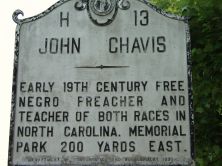
This marker, originally approved and erected in 1938, was the first one in the North Carolina Highway Historical Marker Program dedicated to African American history. The original sign (depicted in the photograph) was replaced in 2009 by one with a revised inscription.

John Chavis, born around 1763 in Virginia, was a prominent free black preacher and educator in and around Raleigh area from 1810 on. Chavis had an extensive education for the time, likely the best education of any African American of his day. He is best known for his classical teaching in Raleigh, educating children of all races. In 1832 free blacks lost many of their rights in North Carolina, and Chavis lost his freedom to preach and teach. He died in 1838, having lived and worked as a respected member of society.

Little is known about John Chavis’s early life, but it is thought, based on estate records from 1773, that he may have been an indentured servant for Halifax, Virginia, attorney James Milner. It is also speculated that Chavis received early education from Milner’s classical library under the tutelage of Reverend William Willie. In 1778, Chavis enlisted in the 5th Regiment of Virginia, serving for three years for the Patriots. Honorably discharged, Chavis studied at Washington Academy, present-day Washington & Lee University, and possibly studied privately at Princeton with Dr. John Witherspoon, the president of what was then College of New Jersey. In 1800 he returned to Virginia and was licensed as a Presbyterian minister.

Between 1801 and 1807, John Chavis did mission work among slaves for the Presbyterian Church throughout the southeastern United States. In 1809 he moved to Raleigh, where he began preaching as a part of the Orange County Presbytery. It was around this time that Chavis began his school.

Chavis’ school accepted both black and white students, widely expanding the options available for the education of free blacks in Raleigh at the time. Chavis taught white students during the day and black students during the evening. Many were from notable families in North Carolina, including future Governor Charles Manly and the sons of Chief Justice Leonard Henderson. Chavis may also have  instructed future United States Senator Willie P. Mangum.

Following Nat Turner’s Rebellion, free blacks across the south lost their standing as citizens. Chavis could no longer legally preach or educate, and was forced to close his school and retire. In 1833 he published his only written work, a sermon entitled An Essay on Atonement. The work was successful and widely read, and helped to supplement his income during the final years of his life. Chavis died on June 15, 1838. His burial location is unknown, although there is speculation that the grave is on Willie P. Mangum’s former plantation in present-day Durham County.

Adapted from ncmarkers.com.

Ever an anomaly.

INTRODUCTION

The most pathetic figure in North Carolina prior to the Civil War was the free negro. Hedged about with social and legal restrictions, he ever remained an anomaly in the social and political life of the State. The origin of this class of people may be attributed to many sources, the most common of which are (1) cohabitation of white women and negro men, (2) intermarriage of blacks and whites, (3) manumission, (4) military service in the Revolution, and (5) immigration from adjoining States. As early as 1723 many free negroes, mulattoes and persons of mixed blood had moved into the Province and had intermarried with the white inhabitants “in contempt of the acts and laws in those cases provided.” In the year 1715 in order to discourage intermarriage between white women and negro men, a penalty of £50 was imposed upon the contracting parties, while clergymen and justices of peace were forbidden to celebrate such marriage under a like penalty.

However regrettable it may be, it is certain that there were a few disreputable white women who had illegitimate children by negro men, and such children inherited the legal status of the mother. The laws of 1715 take cognizance of this fact by imposing a penalty on any white woman “whether bond or free,” who shall have a bastard child by any negro, mulatto or Indian.

Probably the most fruitful origin of the free negro class was manumission. While it is doubtful whether many slaves were set free prior to 1740, it is certain that the Quakers in their Yearly Meeting began to agitate the question of emancipating slaves in that year, and they never ceased to advocate emancipation both by precept and example.

The free negro class was slightly augmented by the addition of certain negroes who had served in the continental line of the State during the Revolutionary War, many of whom had been promised their freedom before they enlisted. It was easy in such cases to allege meritorious service as a ground for emancipation. To the before-mentioned causes for the existence of the free negro in North Carolina should be added one other; namely, immigration, particularly from Virginia. Despite the law to the contrary, many free negroes drifted across the State line from Virginia into North Carolina and quietly settled on the unproductive land adjacent thereto.

In every instance except one (service in the Revolution) the free negro came into being against the will of the State either expressed or implied; but once given a place in the social order of the commonwealth, his tribe increased in spite of adverse laws and customs prescribed by the dominant race.

From R.H. Taylor, The Free Negro in North Carolina (1920).