Fourth Generation Inclusive

Historical Documents of Genealogical Interest to Researchers of North Carolina's Free People of Color

Month: March, 2013

Not considered white.

61 N.C. Confederate Levi Cummings.  Cap’t Francis D. Koonce’s Co. (Koonce’s State Guerillas) N.C. Volunteers. Appears on Company Muster-In and Descriptive Roll of the organization named above. Dated Jones County, July 22, 1862. Born Duplin Co., N.C. Age 26. Laborer. Enlisted July 14, 1862 in Jones County by F.D. Koonce.  … Note: This company is mustered in the service of the State of North Carolina as “guerillas” for local service, to operate east of the Wilmington & Weldon Rail Road, between the Neuse and Cape Fear Rivers.

———-

61 N.C. Confederate Levi Cummings.  Pvt. Co. K, 61 Reg’t N.C. Inf. (State Troops). Cap’t Francis D. Koonce’s Co. (Koonce’s State Guerillas) N.C. Volunteers. Appears on Company Muster Roll of the organization named above. Dated May and June 1863. Enlisted August 30, 1862, Jones County, by Capt. Koonce. Last paid by Capt. Anderson, April 30, 1863. “Detailed as ambulance driver.”

———-

61 N.C. Confederate Levi B. Cummings. Pvt. Co. K, 61 Reg’t N.C. Inf. (State Troops). Cap’t Francis D. Koonce’s Co. (Koonce’s State Guerillas) N.C. Volunteers. Appears on Company Muster Roll of the organization named above. Dated July and August 1863. Enlisted August 30, 1862, Jones County, by Capt. Koonce for 3 years. “Not considered white and dropped by order.”

Compiled Service Records of Confederate Soldiers Who Organized For the State of North Carolina, National Archives and Records Administration.

In the 1850 census of North Division, Duplin County: James C. Cummings, 47, farmer, wife Rebecca, 42, and children Levi W., 13, John J., 11, Betsey A., 9, Sarah L., 7, and Mary J., 5, all mulatto.

In the 1860 census of Tuckahoe, Jones County: Levi Commins, 20, and sister Sallie, 15; described as black.

In the 1870 census of Tuckahoe, Jones County: Levi Cummings, 34, mulatto, cooper.

In the 1880 census of Richlands, Onslow County: Levi Cummings, 50, works on farm, wife Caroline, 25, and children William H., 9, Minnie J., 6, and Lydia A., 2.  Levi is described as mulatto; his wife and children, as white.
She mixed his blood with whiskey and drank it.

EX-SLAVE STORY AS TOLD BY MILLIE MARKHAM OF 615 ST. JOSEPH ST., DURHAM, N.C.

I was never a slave. Although I was born somewhere about 1855, I was not born in slavery, but my father was. I’m afraid this story will be more about my father and mother than it will be about myself.

My mother was a white woman. Her name was Tempie James. She lived on her father’s big plantation on the Roanoke River at Rich Square, North Carolina. Her father owned acres of land and many slaves. His stables were the best anywhere around; they were filled with horses, and the head coachman was named Squire James. Squire was a good looking, well behaved Negro who had a white father. He was tall and light colored. Tempie James fell in love with this Negro coachman. Nobody knows how long they had been in love before Tempie’s father found it out, but when he did he locked Tempie in her room. For days he and Miss Charlottie, his wife, raved, begged and pleaded, but Tempie just said she loved Squire. ‘Why will you act so?’ Miss Charlottie was crying. ‘Haven’t we done everything for you and given you everything you wanted?’

Tempie shook her head and said: ‘You haven’t given me Squire. He’s all I do want.’

Then it was that in the dark of the night Mr. James sent Squire away; he sent him to another state and sold him.

But Tempie found it out. She took what money she could find and ran away. She went to the owner of Squire and bought him, then she set him free and changed his name to Walden, Squire Walden. But then it was against the law for a white woman to marry a Negro unless they had a strain of Negro blood, so Tempie cut Squire’s finger and drained out some blood. She mixed this with some whiskey and drank it, then she got on the stand and swore she had Negro blood in her, so they were married. She never went back home and her people disowned her.

Tempie James Walden, my mother, was a beautiful woman. She was tall and fair with long light hair. She had fifteen children, seven boys and eight girls, and all of them lived to be old enough to see their great-grandchildren. I am the youngest and only one living now. Most of us came back to North Carolina. Two of my sisters married and came back to Rich Square to live. They lived not far from the James plantation on Roanoke River. Once when we were children my sister and I were visiting in Rich Square. One day we went out to pick huckleberries. A woman came riding down the road on a horse. She was a tall woman in a long grey riding habit. She had grey hair and grey eyes. She stopped and looked at us. ‘My,’ she said, ‘whose pretty little girls are you?’

‘We’re Squire Walden’s children,’ I said.

She looked at me so long and hard that I thought she was going to hit me with her whip, but she didn’t, she hit the horse. He jumped and ran so fast I thought she was going to fall off, but she went around the curve and I never saw her again. I never knew until later that she was Mis’ Charlottie James, my grandmother.

I don’t know anything about slavery times, for I was born free of free parents and raised on my father’s own plantation. I’ve been living in Durham over sixty-five years.

From Slave Narratives: A Folk History of Slavery in the United States from Interviews with Former Slaves (1841).

Squire Walden married Tempy James on 28 March 1832 in Halifax County. John Keemer was bondsman, and clerk of court J.H. Harwell witnessed. 

In the 1850 census of Northampton County: Squire Walden, 38, laborer, wife Temperance, 34, and children Samuel, 14, William, 13, Amanda, 12, Martha, 11, James, 9, Hester, 8, Peyton, 5, and Whitman, 1, plus William Walden, 78, farmer. All born in NC, except the elder William, who was born in Virginia. All were described as mulatto.


Porch detained.

Ordered that Francis McBride be cited to appear at this court tomorrow to show cause if any he can why he detains a mulatto boy named porch in his service when it is supposed he ought to have his freedom.

Minutes, August Term 1781, Court of Pleas and Quarter Sessions, Guilford County Records, North Carolina State Archives.

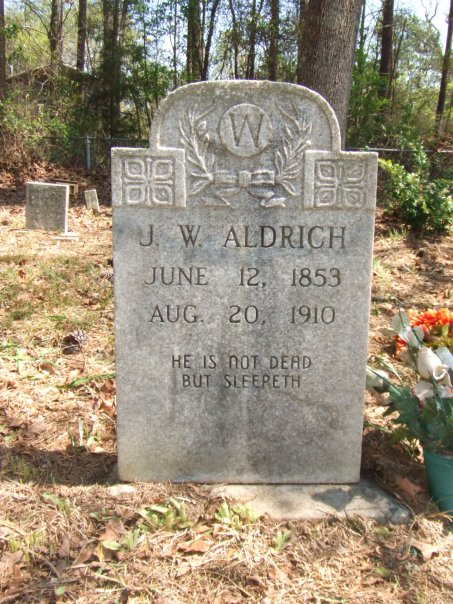
John W. Aldridge.

Image

JOHN WILLIAM ALDRIDGE (1853-1910) was born in Sampson County to Robert Aldridge and Mary Eliza Balkcum Aldridge. In the 1870s, he and his brothers Mathew Aldridge and George Aldridge were among former free men of color hired to teach in Wayne County colored schools. (Another was E.E. Smith.) John and George were posted near Fremont, in northern Wayne County, where John met and married one of his students, Louvicey Artis.  The couple settled among his family near Dudley, in southern Wayne County.  The original site of John’s grave is now forgotten, but he now lies in a family cemetery on land still owned by Aldridge descendants. (The W on the headstone is a bit of a mystery, but suggests that the marker was second-hand.  The spelling of his surname, “Aldrich,” is that preferred by his son, Thomas, who paid for it.)

An Act to Emancipate Hannah.

CHAPTER LVIII.

An Act to Emancipate Hannah, Alias Hannah Bowers, a Person of Mixed Blood, Belonging to the Estate of the Late Alexander Gaston Deceased.

Whereas it appears to this General Assembly, That the late Alexander Gaston, of the town of New Bern, did in his lifetime frequently express a desire that the said girl Hannah should be set free, and did certify the same in his own handwriting, which certificate has been since found among the papers of the deceased: And whereas the widow of the said Alexander Gaston has also signified her desire that the said girl should in compliance with her husband’s wishes in his lifetime be set free:

I. Be it therefore Enacted by the General Assembly of the State of North Carolina, and it is hereby Enacted by authority of the same, That the said molatto girl called Hannah, alias Hannah Bowers, shall be, and is hereby declared to be emancipated and made free to all intents and purposes, and shall be entitled to all the privileges and benefits of a free person in as full and absolute manner, as if she the said Hannah had been born of a free woman. (Passed Jan. 6, 1787.)

Acts of the North Carolina General Assembly, 1786-1787, Colonial and State Records of North Carolina. 

Surname swap, no. 5.

In 1860, Wayne County Court of Pleas & Quarters Sessions bound James Newsom, 7, and Norfleet Newsom, 5, to Barny D. Yelverton to serve as apprentices.

But, in the 1860 census of Davis, Wayne County: Barney Yelverton’s household includes Nervy Artis, 27, and sons James Artis, 6, and Norphlet Artis, 4.

Free-Issue Death Certificates: MISCELLANEOUS, no. 8.

Marsellas Evans. Died 21 September 1922, New Hope, Chatham County. Colored. Married to Emmer Evans. Farmer. Age 64. Born Hatham County to Granderson Evans of Chatham County and Arbella Smith of Raleigh. Buried Mount Zion Church. Informant, Weldon Evans.

In the 1860 census of Eastern Division, Chatham County: Granderson Evans, 36, farmer, wife Arobella, 20, and children Marcellas, 3, and Leweann, 2, plus William Stewart, 3, and Fab Lucus, 9.

Vancie Ann Glover. Died 29 April 1930, Hickory Mountain, Chatham County. Resided Siler City. Colored. Single. Age 75. Daughter of Kerney Glover and unknown mother. Buried Glovers cemetery. Informant, Berneice Alston.

In the 1860 census of the Western Division of Chatham County: Carney Glover, 38, Mahala, 35, Susan, 15, Sarah, 11, and Ann, 2.

Elda Cummings. Died 14 June 1923, Jones County. Negro. Single. Cook for Chas. Jones. Age about 65. Born Jones County to Jim Cummings of Lenoir County and Rebecca Bowen. Buried Gooding graveyard. Informant, Allen Gooding, Comfort NC.

In the 1860 census of Southern Division, Jones County: James Cummings, 56, cooper, born Onslow County; wife Rebecca, 52; and John J., 21, Farina, 10, and Elda Cummings, 6. 

Polly Edmundson. Died 20 May 1923, Nahunta, Wayne County. Colored. Widow of Lewis Edmundson. Born 1860 in Wayne County to Henry Hobbs of Johnston County and Elizabeth Hogans, Johnston County. Buried in Bert graveyard. Informant, Wesley Hobbs.

Lucinda Artis.  Died 23 June 1931, Wilson, Wilson County. Resided at 310 Reid Street. Colored. Widow of Jessie Artis. Age 84. Born Wayne County to Henry Hobbs of unknown and Elizabeth Hobbs of Wayne County. Buried in Wayne County. Informant, Cora Artis, Wilson NC.

In the 1860 census of Neuse River, Johnston County: Henry Hobbs, 37, distiller, wife Betsey, 36, and children Lucinda, 12, John, 11, Nicey, 9, Laurina, 7, Francis, 5, Polly, 4, and Green, 3.

George King.  Died 6 November 1923, Dudley, Wayne County. Colored. Single. Blacksmith. Age 76. Born Wayne County to Jim King of NC and Susie Booker of Duplin County. Informant, Jim King.

In the 1860 census of Buck Swamp, Wayne County:  James King, 43, carpenter, Susan, 27, and children George, 9, James H., 8, Jerome, 4, John, 4 months, and Polly A., 2.

Free Colored Inhabitants of the Town of Hillsborough, Orange County, 1850.

#286. Green Caudle, 33, cabinet maker, born in NC, and Catharine Strudwick, 24, born Orange County.

#287. Henry Evans, 33, cabinet maker, born Hillsboro, wife Henrietta, 22, born NC, and children Lizzy, 6, Julia, 4, Matthew, 2, and Sarah, 10 months, all born in Hillsboro, plus Fanny Evans, 65, born in Virginia, and James Allison, 66, cabinet maker, born Delaware.

#288. Martha Day, 25, Mary Day, 5, and Susan Day, 2, all born in Orange County, in the household of Anderson Vanderford, carpenter.

#289. Alexander Webb, 53, saddler, and Judy Webb, 55, both born NC.

#294. Richard Mayo, 29, cabinet maker, Martha Mayo, 40, William Mayo, 17, laborer, Mary Mayo, 12, Jane Mayo, 3, Henrietta Mayo, 3, Betsey Mayo, 60, George Mayo, 18, laborer, and Faddis Mayo, 25, laborer, all born in NC.

#295. Julia Revell, 3, born in Orange County, in the household of James Parks, shoemaker.

#298. James Volentine, 28, barber, born NC, Susan Volentine, 30, born Orange County, Manuel Strudwick, 80, shoemaker, born NC; Jack Strudwick, 24, and Umstead Mayo, both laborers, and Eliza Mayo, 15, the last three born in Orange County.

#303. Samuel Barton, 15, laborer, born NC, in the household of James M. Palmer.

#328. William Freeman, 66, laborer, born Virginia.

#329. Henry Freeman, 32, shoemaker, wife Patsey, 45, Nancy Burke, 20, Edy Mitchell, 11, and Mary Redding, 28, all born in NC.

#332. Peggy Revill, 49, Sally Day, 20, Fanny Chaveous, 10, Wilson Evans, 26, cabinet maker, Coon Chaveous, 26, laborer, James Huckabee, 23, laborer, all born NC.

#335. Waldon Jeffreis, laborer, born Orange County.

#338. Patience Chavous, 28, Polly Burnett, 20, John Burnett, 2 months, Rebecca Chavous, 14, Patsy Revills, 4 months, all born NC.

#343. George Mays, 19, laborer, born Hillsboro.

#344. Eliza Chavous, 40, Leroy Chavous, 10, and Martin Chavous, 6 months, all born NC, in the household of Andrew C. Murdock.

#349. Dicey Winstead, 51, Harriet Wilson, 28, James Wilson, 16, laborer, Egbert Wilson, 9, John Wilson, 10, Mary Wilson, 7, and Thomas Wilson, 3, all born NC.

#352. Ned Cain, 76, laborer, born NC.

#355. Mary Bush, 16, born NC, in the household of William Newman Sr., laborer.

#370. Harry Douglas, 70, laborer, born NC.

#373. “Jail” – James Mitchell, 25, laborer, born NC, “stealing money, and John McAndless, 22, laborer, born NC, “giving his free papers to a slave.”

#378. Robert Mitchell, 50, laborer, Sophia Mitchell, 46, Frances Mitchell, 7, all born NC.

Trifling.

State v. Griffin Stewart, 31 NC 342 (1849).

Griffin Stewart was indicted in Nash County for murder in the death of Penny Anderson.  Though unmarried, he and Anderson had lived together for several years as man and wife. On a Monday night in October 1848, Anderson was at home with Griffin. Witnesses reported hearing blows and lamentation, as if a woman were being beaten violently and begging for mercy. The outcry came from the direction of Stewart’s house. The next morning Penny Anderson was missing, and Stewart claimed, “She had gone to one Hale’s,” who lived about ten miles off.  Anderson had not been at Hale’s, however, and could not be found anywhere. Six weeks later, her body was found, “partially buried in an out-of-the-way place,” some five hundred yards from Stewart’s house. Her badly decomposed body showed signs of violence, and she appeared to have been choked to death.  She was identified by a ring, several articles of clothing, a broken finger, and other means.

Stewart was “of a black complexion.” He had lived in the area about ten years, and during all that time he passed for and was treated as a free man of color.  He was treated as a free negro during trial and spoken of as such by the counsel. Circumstantial evidence tended strongly to show that Stewart had murdered her, and the jury found him guilty.

Stewart appealed on two grounds.  First, evidence showed that the only people at Stewart’s house on the night of the murder were Stewart, Anderson, and Anderson’s grandson, who was between seven and eight years of age. The State did not call the boy as a witness and, in its opening address to the jury, Stewart’s counsel strongly urged that the jury presume that the child’s testimony would have hurt the State’s case. The State countered that the boy had no testimony to offer and, in case, Stewart’s counsel could have called him himself.  Stewart’s lawyer then moved the Court to instruct the jury that they should not convict Stewart upon circumstantial evidence, when the boy’s direct testimony was available. The Court refused to give the instruction, and Stewart’s counsel moved for a new trial.  However, the state Supreme Court found no error on this ground, noting that it is “in the discretion of the prosecuting officer, what witnesses he will examine.” “If other witnesses can shed more light on the controversy, it is competent for the prisoner to call them.”

Second, Counsel argued that Stewart, being black, was prima facie a slave, and the Court had committed error in not admonishing the mulatto witnesses, as required by law in the trial of a slave for a capital offense.  The Supreme Court rejected this argument as well, reasoning that If Stewart had wished to be tried as a slave, he had raised the issue too late. Further, there was evidence to rebut the presumption of slave status, and Stewart had been treated as a free negro during the whole trial. “It would be trifling with the administration of justice, to allow a prisoner to pass himself off as a free negro, and take his chances for a verdict; and then turn around and insist that he was a slave.”

[Sidenote: In White Women, Black Men: Illicit Sex in the 19th Century South, Martha Hodes notes that Penny Anderson was a white woman. I will supplement this post when I get a chance to study the case’s manuscript records. – LYH]

Opens at once both earth and heaven.

I went to my mistress and inquired what was her price for me. She said a thousand dollars. I then told her that I wanted to be free, and asked her if she would sell me to be made free. She said she would; and accordingly I arranged with her, and with the master of my wife, Mr. Smith, already spoken of, for the latter to take my money  and buy of her my freedom, as I could not legally purchase it, and as the laws forbid emancipation except, for “meritorious services.” This done, Mr. Smith endeavored to emancipate me formally, and to get my manumission recorded; I tried also; but the court judged that I had done nothing “meritorious,” and so I remained, nominally only, the slave of Mr. Smith for a year; when, feeling unsafe in that relation, I accompanied him to New York whither he was going to purchase goods, and was there regularly and formally made a freeman, and there my manumission was recorded. I returned to my family in Raleigh, and endeavored to do by them as a freeman should. I had known what it was to be a slave, and I knew what it was to be free.

But I am going too rapidly over my story. When the money was paid to my mistress and the conveyance fairly made to Mr. Smith, I felt that I was free. And a queer and a joyous feeling it is to one who has been a slave. I cannot describe it, only it seemed as though I was in heaven. I used to lie awake whole nights thinking of it. And oh, the strange thoughts that passed through my soul, like so many rivers of light; deep and rich were their waves as they rolled; — these were more to me than sleep, more than soft slumber after long months of watching over the decaying, fading frame of a friend, and the loved one laid to rest in the dust. But I cannot describe my feelings to those who have never been slaves; then why should I attempt it? He who has passed from spiritual death to life, and received the witness within his soul that his sins are forgiven, may possibly form some distant idea, like the ray of the setting sun from the far off mountain top, of the emotions of an emancipated slave. That opens heaven. To break the bonds of slavery, opens up at once both earth and heaven. Neither can be truly seen by us while we are slaves.

[Footnote omitted.] From THE NARRATIVE OF LUNSFORD LANE, FORMERLY OF RALEIGH, N. C., Embracing an account of his early life, the redemption by purchase of himself and family from slavery, And his banishment from the place of his birth for the crime of wearing a colored skin. PUBLISHED BY HIMSELF (1842).