Fourth Generation Inclusive

Historical Documents of Genealogical Interest to Researchers of North Carolina's Free People of Color

Being in a slow state of health.

In the Name God Amen

I Tamsey Gandy of the County Wayne and State of North Carolina being in slow State of Health but of Sound mind and memory blessed be god for the Same Calling to mind the certainty of death, I make & publish this my last will and Testament in manner and form following Viz I give and bequeath unto my Son Henderson Gandy my bed bedstead and necessary furniture, and Red chest and all my clothes and Spun Cotton. I leave the rest of my property to be Sold by my Executor and money arising there from I leave to my Son Anderson Gandy.

I leave my Worthy friend Robert Williams my Executor to this my last will and Testament revoaking all other Wills by me made. April 28th in the year of our Lord one thousand eight hundred and forty two whereof I have hereunto set my hand and affixed my seal    Tansey X Gandy

Signed sealed and published in the presence of William Lewis

The will was proved at May Term 1842. Recording Docket Book 8, p. 309. Office of Clerk of Superior Court, Wayne County Courthouse, Goldsboro.

Tamsey Gandy’s estate was sold on 15 August 1842 and brought in $41.33 ¼.  Purchasers included Theo. Seaberry and Offie Seaberry (probably the same man, Theophilus Seaberry), but were primarily white neighbors. Though she could not write (or, presumably, read), Tamsey’s estate included “1 Lot Books.” Recording Docket Book 8, p. 355-356. Office of Clerk of Superior Court, Wayne County Courthouse, Goldsboro.

Edward Gandy named his daughter Tamsey Gandy as a beneficiary in his 23 July 1823 will filed in Nash County. Will Book 1, page 291, Office of the Clerk of Superior Court, Nash County Courthouse, Nashville. In 1809, the surname of Tamsey Whiddon and her siblings Griffin, Brinkley and Elizabeth was changed to Gandy, and they were “legitimated.” North Carolina General Assembly, 1809 Session Laws, Chapter CXXVIII, page 40.
Acts passed.

The following are the Titles of the Acts passed at the Session of the General Assembly of the State of North-Carolina, held at the city of Raleigh, on the 1st of November, 1795.

To emancipate a mulatto boy by the name of Gustavus Adolphus Johnston, in the county of Chowan; and also a mulatto girl by the name of Amy Philips, in the county of Brunswick.

North-Carolina Journal, Halifax, 12 December 1795.


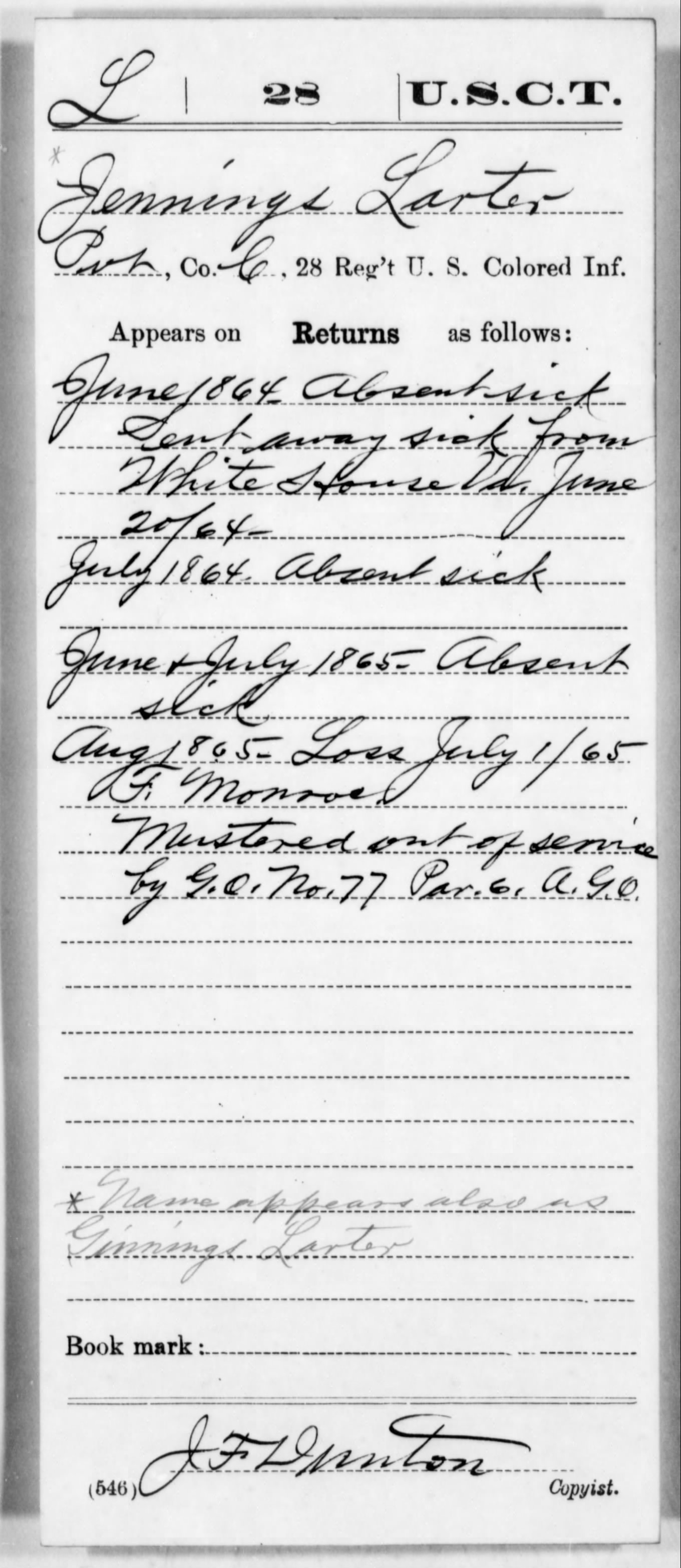
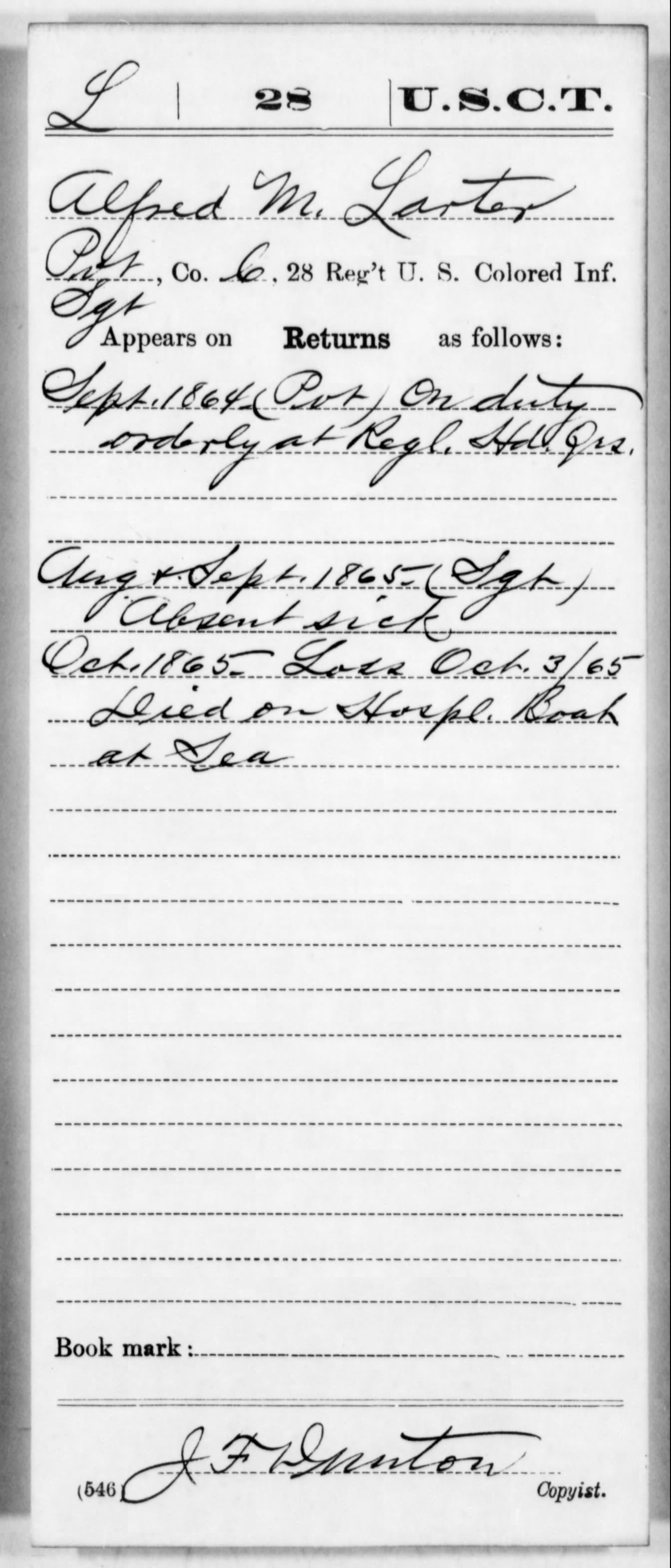
Larter brothers, U.S. Colored Troops.

ImageImageJennings Larter and Alfred Larter were sons of Arthur and Mary Larter, who migrated from Surry County NC to Owen and Lawrence Counties, Indiana, in the early 1850s. The Twenty-eighth U. S. Colored Troops were recruited in Indiana. Six companies were organized at Indianapolis in April, 1864, and turned over to the United States as a battalion of the 28th U. S. Colored infantry.

Compiled Military Service Records of Volunteer Union Soldiers in the 26th through 30th Infantry Units, and the 29th Connecticut Infantry (Colored). National Archives and Records Administration.

Notice of application.

NOTICE.

Application will be made to the ensuing General Assembly of North Carolina for the passage of a law to emancipate Peter Turner, of Fayetteville.

Oct. 10, 1854.

Fayetteville Observer, 23 October 1854.

I give as a legacy.

This Dec. the 28 1911

State of N.C. County of Wayne

I Adam T. Artis of aforesaid State and County being of sound mind considering the uncertainty of life I hereby constitute and declare this to be my last will and Testament.

Item 1. I hereby constitute and appoint my friend S.S. Strother to execute this my last will.

Item 2. My executor shall prepare a decent burial for my body suitable to the wishes of my relatives and friends and pay for the same out of the first money that comes into his hands together with all my just debts.

Item 3. For the love and affection I have for my wife Katie Artis I give and bequeath unto her about 18 acres [illegible] of the Thompson Tract of land as widow dower [illegible] life together with all appurtenances thereto, I also give and bequeath unto said wife Katie all of my Household and Kitchen furniture with all other personal property belonging unto me to have and to hold during her natural life.

Item 4. I give as a Legacy unto my son Pinkney Artis $100.00 One hundred Dollars.

Item 5. I give unto my son June Scott Artis Ten Dollars for his full share of my property.

Item 6. I give unto my son Henry Artis Ten Dollars for his full share of my property.

Item 7. I give unto my son Columbus Artis Ten Dollars for his full share of my property.

Item 8. I give unto my son William Artis Five Dollars for his full share of my property.

Item 9. I give unto my son Walter Artis Five Dollars for his full share of my property.

Item 10. I give unto my daughter Josephine Artis Sherard Fifteen Dollars for her full share of my property.

Item 11. I give unto my son Robert Artis Five Dollars for his full share of my property.

Item 12. My executor shall sell the balance of my land after my death and pay over to my children the Items I have give to them and what is left shall be paid over to, in equal shares, Vicey Aldridge, Liza Everet, Augustus K. Artis, Georgana Reid, Mary Jane Artis, Emma D. Locus, Ida Reid, Lillie Thompson, Napoleon Artis, Haywood Artis, Addie Artis, Annie Artis, Alberta Artis, Jesse Artis, and at the death of my wife Katie the property I gave to her shall be equally divided between the 12 above named heirs, that are not limited.   Testator – Adam X Artis.

Witness W.F. Lewis, J.J. Coley, J.E. Exum

Proved 1 May 1919. Will Book 4, page 398. Office of Clerk of Superior Court, Wayne County Courthouse, Goldsboro.

[Sidenote: Adam Artis bought and sold hundreds of acres near present-day Eureka in northern Wayne County.  He outlived four wives (Winnie Coley, Lucinda Jones, Frances Seaberry, and Amanda Aldridge) and at least five of his children (Cain, Caroline, Adam jr., Emma, and Louetta). Son Noah is the only child not mentioned in his father’s will. Josephine A. Sherrod, Adam’s longest-lived child, died in 1988. –LYH]

Dempsey Reid’s estate settlement.

Inventory of the Estate of Dempsey Read dec’d taken 21st May 1850

Cash on hand at the time of his death Twenty five 85/100 dollars $25.85. One Note on Council Best for four 80/100 due the 4th April 1849. Bad debts – one note on James Mathews for $2.00 due 6th October 1847, on d’o on Stephen Pettiford for $5.00 due 18th November 1848, One account on James Pettiford for $1.50    Aug Co 1850   /s/ Jesse Coleman adm’r.

Jesse Coleman filed an account of the sale of Dempsey Reed’s property. The buyers included Tabitha Read, John Read, Wash. Read, Rhody Read, Benj. Read, Absalom Artis, Zion Read, Nelson Row, Jane Read, Dave, Dempsy Hall, Waty Locus, and a smattering of white neighbors. The sale netted $98.50.  Recording Docket Book 10, pages 434-435, Office of Clerk of Superior Court, Wayne County Courthouse, Goldsboro.

In the settlement of Dempsey Read’s estate, Jesse Coleman paid Pearcy Read $2.50, plus 38 cents interest, on 16 July 1850; and $9.50, plus 57 cents interest, each to Patsey Read, Lila Read and Barna Read on 19 November 1850. Recording Docket Book 11, pp. 163-164, Office of Clerk of Superior Court, Wayne County Courthouse, Goldsboro.

In the 1850 mortality schedule of Wayne County: Dempsey Read, age 70, black, free, hatter, died in March of unknown causes. 

[Sidenote: The relationships among the Reids are not clear. As reported in the 1840 census of Wayne County, Dempsey Reid lived alone. He may not have had a wife or children.  Other Reid heads of household were Allen Reed, Barna Reed (the one above?), Bytha Reed, Bytha Reed and Rhoda Reed.  Pearcy Reid, above, born about 1825, was the daughter of Allen and Sarah “Sally” Reid. Tabitha “Bitha” Reid was married to an enslaved man named Raiford.  They had no known children Rhoda Reid’s husband, David — “Dave,” above — was also enslaved. Their children were Tabitha Reid (one of the Bythas, above, born ca. 1811), Melvina Reid Artis (ca. 1813), Zion Reid (ca. 1815), Washington Reid (ca. 1818), John Reid (ca. 1822), Martha “Patsey” Reid Hall (married to Dempsey Hall above, ca. 1824), Isaac Reid (ca. 1828) and Benjamin Reid (ca. 1831). — LYH]

Surnames: Burke County, 1850.

The following surnames are found among free people of color in the 1850 census of Burke County: BOYCE, BUNCH, CHAVES, COOPER, CRANLEY, CRISP, HARDY, HAYDEN/HEYDEN, MATHIS, McNEILL, MILLER, MITCHELL, PAYNE, POWELL, RAYNE, REED, RODES, SCOTT, SHADD, SHADE, SISK, THOMAS, TUCKER, UNDERWOOD and YORKE.

I am sorry that Mrs. Lynch is trying to be so large.

Camp near Kinston

Feby 22d 1864

Dear wife,

Your letter by Tom has been Read. I am glad to hear that you are all well. I am well & hearty. I am sorry that Mrs. Lynch is trying to be so large. I think the best way you can manage is for her to stay to herself. I want you to let her go Back to her house & stay there. If you & she can’t get along, there is no use trying to stay together. You may give her all that you think you can spare. I told Lynch when he came I could let him have what you could spare. You may tell Lynch that I had rather she would stay in her House as you & she can’t agree. I don’t see why she made such a bargain & then flew from it so quickly. The Best way you can do is to attend to your own Business. I think you will be better satisfied. I want you to tell Lynch that our Bargain shall all be right. I told Lynch his wife could have corn from my House & all the Bacon I could Spare. I left that to you to say what you could Spare & he & I were to settle that ourselves. You may tell Lynch that all will be right with me & him & tell his wife I rather she would not stay as one of the family. I think you had best attend to your own Business than to be run over by a negro. You know already she will not do to depend upon.

[The remainder of this letter has been lost.]

Footnotes: “Caroline Lynch was a free Negro woman born in 1837.” “Wyatt Lynch, an illiterate free Negro, was born in 1830. He was a plasterer and brickmason by occupation.”

In another letter written 23 May, 1864, Barnes told his wife, “Tell Lynch he must make my colt gentle.”

Hugh Buckner Johnston, Jr., ed., “The Confederate Letters of Ruffin Barnes of Wilson County,” North Carolina Historical Review, vol. XXI, no. 1 (January 1954).

In the 1860 census of Saratoga, Wilson County: Wyatt Lynch, 30, wife Caroline, 23, and child Frances, 3. [Sidenote: in the 1870 census, Lynch’s wife is named Nicey. Lynch married Nicey Hall on 5 June 1860 in Wilson County. It appears that Nicey and Caroline were the same woman. In the 1850 census of North Side Neuse, Wayne County: Lucy Hall, 45, and children Sarah, 16, George, 15, Nathan, 13, Nicy, 10, Samuel, 3, and Esther Hall, 6, plus Alford Artis, 15, and John Artis, 14, and Rhoda Artis, 13, and her children Julia, 12, and Rheuben Artis, 10, plus Rufus Lane, 22. – LYH] 

For the murder of Archibald Beebee.

MATTHEW N. LEARY, jr., a witness for the prosecution, having been first duly sworn, testified as follows:

Examined by the Counsel for the prosecution.

Q. What is your name? A. Matthew N. Leary, jr.  Q. Where do you reside? A. In Fayetteville. Q. What is your occupation in Fayetteville? A. Saddle and harness maker was previous to the war. Since the war I have added to that a small grocery in the same building. A. Have you been a free man all your life? A. All my life, sir.  Q. Where did you reside in the beginning of the year 1867? A. In Fayetteville. Q. Did you know one Archy Beebee there? A. I did, sir, by sight. I knew him when I saw him. Q. Where is he now? A. Dead. Q. When was he killed? A. On the 11th of February. … [p. 3]

ROBERT SIMMONS, a witness for the prosecution, having been first duly sworn, testified as follows:

What is your name? Robert Simmons. Where do you live? In Fayetteville, sir. What is your occupation there? I keep a grocery there. Was that your occupation at the beginning of the year? Yes, sir. Did you know Archy Beebee? Yes, sir. … [p. 47]

HENRY HAGANS, a witness for the prosecution, having been first duly sworn, testified as follows:

Examined by the Counsel for the prosecution.

Where did you live at the beginning of this year? In Fayetteville. What is your business there? Shoemaker. Whose shop did you work in, the first part of this year? I worked with Mr. Henry Sykes. Is that the one-armed man? Yes, sir. Did you know Archy Beebee? Yes, sir. … [p. 55]

Argument of ED. GRAHAM HAYWOOD:

… Here is Matthew N. Leary, jr., whose character is unassailed, and unassailable, who says – he was standing to the right of the man who fired the pistol, and his rear, about five feet. … Between Leary and the man who fired his pistol, stood Lewis Smith. Square behind [John] Armstrong – almost touching him – and within five feet or six feet of the man who fired the pistol, stood Henry Hagans; a little further to the front than James Douglass, and to his left stood Robert Simmons… [p.347]

Proceedings in the Case of the United States against Duncan G. McRae, William J. Tolar, David Watkins, Samuel Phillips and Thomas Powers, for the Murder of Archibald Beebee at Fayetteville, North Carolina on the 11th Day of February, 1867, together with the Argument of Ed. Graham Haywood, Special Judge Advocate (1867).

In the 1860 census of Fayetteville, Cumberland County: D. Simmons, 40, Robert, 23, Saml., 20, and Mary Simmons, 12.

In the 1860 census of Fayetteville, Cumberland County: Joseph Heggins, 51, laborer, wife Harriett, 31, and children Henry, 13, Duncan, 9, Lavina, 7, Sophia, 5, and Mary, 3.

Jeffreys, woodworkers.

Thomas Day—who was born in 1801 in Greensville County, Virginia, to mixed-race parents, John and Mourning Day—moved with his family to Warren County, North Carolina, in 1817. When he moved to Hillsborough in the early 1820s, it appears that he became friends with members of the Jeffreys family who, although listed as “mulattos” in official records, were actually of Indian origin. The Jeffreys were part of a larger group of Occaneechi people from Virginia who had settled in the northwest section of Orange County, which became Alamance County in 1849. As with the Day family, the Jeffreys family had originated in Greensville County, Virginia. In 1830 Uriah Jeffreys served as a bondsman for Thomas Day when he married Aquilla Wilson. A bondsman was usually a close family member (such as a father, brother, or uncle) who assured the court that the couple should be married, and that the groom would not change his mind and leave the bride at the altar. Uriah Jeffreys must have been a close friend of Thomas to agree to be his bondsman. Historic records make it clear that both men were cabinetmakers, and it is possible that Uriah and his brother Nathan worked with Day for a short time. In 1828 Uriah decided to move. He advertised in the Hillsborough Recorder that he had a variety of furniture from his cabinetmaking business for sale, including “Bureaus, Bedsteads, Tables.”

Uriah moved to Ohio with two of his brothers, Parker and Augustus. Unfortunately, they experienced the same type of prejudice in the North that they had tried to leave behind. The law required free blacks entering Ohio to pay a bond of $500 to county officials. Whites thought this would guarantee that only free blacks of “good character” would settle and be able to support themselves. Parker Jeffreys refused to pay, insisting that his blood was a mixture of Indian and white, and not black. The case went to the county court, where he lost. Jeffreys persevered, and the Ohio Supreme Court heard his case in 1842. In Parker Jeffreys v. Ankeny et al., the supreme court justices ruled that he was an Indian with no African ancestry and did not have to pay the bond. Members of the Jeffreys family continued to make furniture near Xenia, Ohio, well into the twentieth century.

Nathan Jeffreys lived the rest of his life in North Carolina. It seems that he continued to work as a journeyman cabinetmaker, because in 1834 he is listed as such in a court document. However, in the 1850 and 1860 censuses, he is listed as a farmer owning $500 in property. Many cabinetmakers supplemented their incomes by farming. Day clearly considered Nathan a close family friend, because in 1851 in a letter to his own daughter, Mary Ann, he mentions the death of Nathan’s daughter, Safroney.

Fine furniture made by Nathan Jeffreys between 1845 and 1855 is known to exist in a private collection. The construction techniques that he used are similar to those found on the bureaus made in Day’s Milton shop, indicating that the two men probably worked together at one time. Jeffreys and other members of the Indian community passed on their woodworking skills. His great-great-grandson, William Bill Jeffries, learned woodworking from his father. He built houses as well as chairs during most of the twentieth century.

Adapted from Dr. Patricia Phillips Marshall, “Indian Cabinetmakers in Piedmont North Carolina,” www.ncpedia.org