Fourth Generation Inclusive

Historical Documents of Genealogical Interest to Researchers of North Carolina's Free People of Color

Category: Wills & Estates

Criminal conversation with a negro man.

Elizabeth Walters v. Clement H. Jordan, 34 NC 170 (1851).

Elizabeth Walters petitioned for a year’s allowance out of the estate of her late husband, Hardy Walters, who died intestate. Hardy “seduced” Elizabeth and “lived in adultery” with her before marrying her.  Both were white.  After the marriage, Elizabeth “had criminal conversation with a negro man” and got pregnant. Hardy ordered her to leave his home.  She did, but, with his permission, moved into another house on his property. There she gave birth to a mulatto child.  Hardy died soon after.

“Whatever cause this woman may have given her husband for taking steps to have the marriage dissolved, and thereby protect his estate from her claims. it is sufficient for this case, that he did not such thing, but did leave her as his widow and under no bar to her claims, as such, on his property.”

Acount of Sale of the Property of Bethana Jones

Image“Acount of the Sale of the Property of Bethana Jones Dest: Sold the 28 of December 1852 on a Credit of Six months the Percher to give Note With Two Approved Suritis before the Rite Con is Changed Sold by Bengamin Simpson a Special Admin”

Bethana Jones was a prosperous farmer, matriarch of a sprawling family that knit all of southern Nash and western Wilson Counties’ major free colored families, including Joneses, Blackwells, Powells, Evanses, and Locuses.  Kinsmen purchasing goods from her estate included Willis Jones, Jacob Jones, William Jones, Asberry Blackwell, Dempsey Powell, Shadrach Jones, and Joseph Jones. This is the first page of three.

Estate Records, Records of Wilson County, North Carolina State Archives.

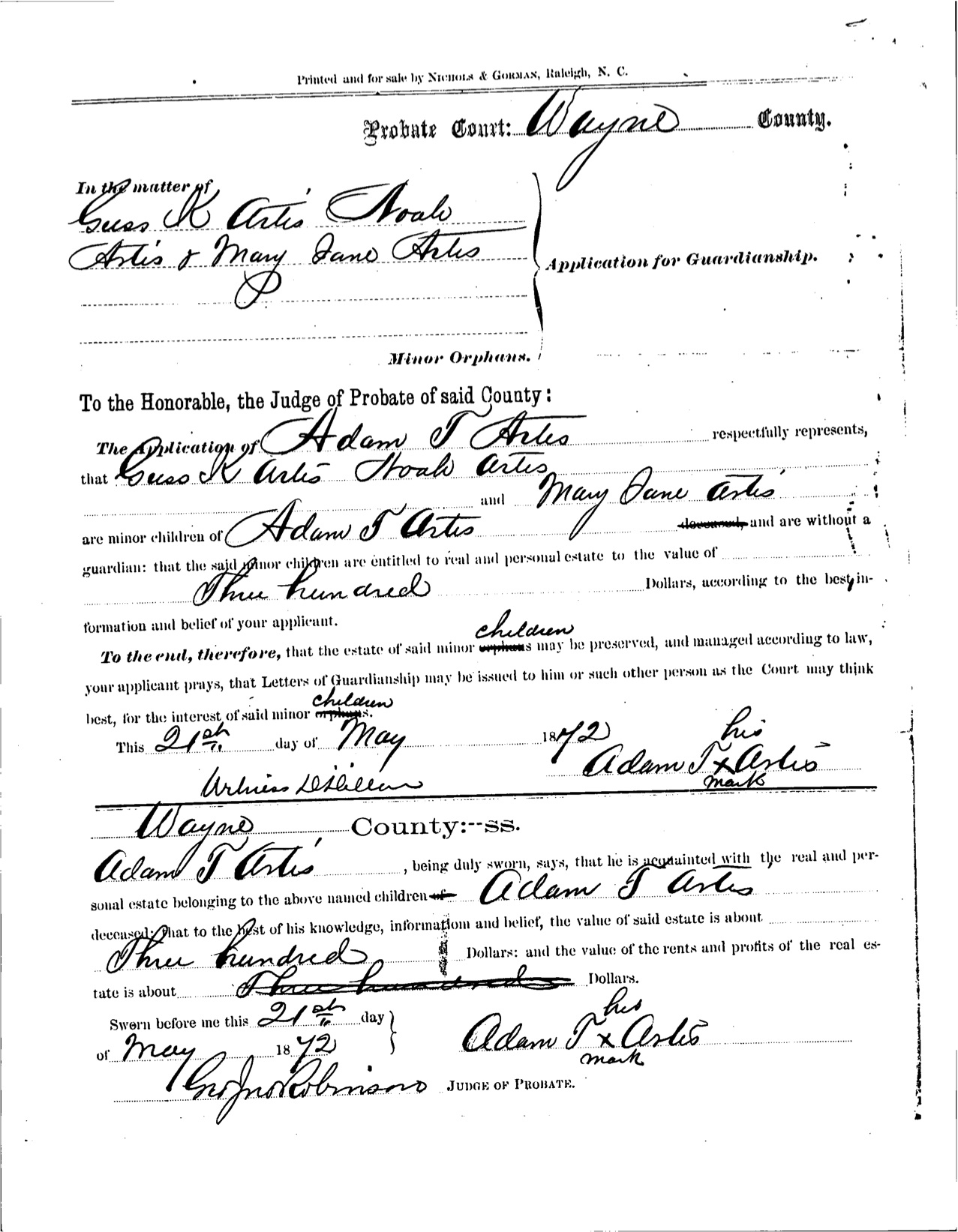
Application for Guardianship.

Image

Application filed by Adam T. Artis in 1872 for guardianship of his minor children Augustus Kerney, Noah and Mary Jane Artis.  Their mother, Lucinda Jones Artis, died circa 1860, and they inherited her share of the estate of her father Jacob Ing, who died in 1870.  See earlier post.  Gus Artis, born about 1857, migrated to Arkansas, where he died in 1921.  Noah Artis was born in 1856, married Patience Mozingo, and died in 1952 in Wilson NC.  Mary Jane, born 1859, married Henry Artis and died after 1900.

In the 1860 census of Davis district, Wayne County, Adam Artis, 30, appears with children Kerney, 4, Noah, 2, and Mary J, 1, plus Jane Artis, 26 (who was his sister), and a one month-old infant.

Estate Records, Records of Wayne County, North Carolina State Archives; 1860 federal population schedule.

Crop, stock and provisions.

State of North Carolina Robeson County  }

To the worshipful the Justices of the Court of pleas and quarter sessions of the said county November term 1862 we John G. McLean Justice of the peace of Said county and Hector J. McLean Angus Wilkeson and John McNair freeholders in obedience to the anexed order proceeded on the 17th day of October to view the estate of Hugh Chavous, deceased, and out of the crop stock and provisions on hand we have laid off and allotted Clarisa Chavous widow of Hugh Chavous, deceased, as follows that is to say one hundred bushels of corn eighteen head of hogs one Beef all the peas.  One table four bushels of salt one Bible and Hymn Book one Loom one pot one tray and sifter.  And there being not sufficient of the crop stock and provisions on hand to make a comfortable provision for the said Widow and family for a year we assess the deficiency to the sun of Thirty five Dollars in money to be paid to the said Widow by the administrator of the said Hugh Chavis (Decd) and we have further laid off and alloted to the said Widow one Bed and necessary furniture and Well and Cards as her absolute property and put her in possession of the same.  Given under our hands and seals this 17th day of October AD 1862.  /s/ John G. McLean J.P., H.J. McLean. A.D. Wilkison, Jno McNair

Freedom/unfreedom.

21 Dec 1784.  Petition of James Sampson and Richard Clinton, executors for John Sampson deceased, praying negro wench Moll and mulatto wench Hannah to be manumitted and set free agreeable to all; read in, convened with and ordered to be filed.

15 Aug 1786.  Ordered that Miles Hammonds a mulatto orphan boy about 14 to be bound to Jonathan Fryer until 21, to learn the art and mystery of a saddler and shoemaker and to read and write and cypher as far as the rule of 3

16 Aug 1786.  Ordered that mulatto boy George, son of Clarinda, property of James Spiller, be set free and emancipated for sufficient reasons shown to the Court, to be bound til 21 to Spiller

Minutes, Sampson County Court of Pleas and Quarter Sessions

Milly’s Mary Ann?

Fanshaw v. Jones, 33 NC 154 (1850).

Henry Britt found an infant mulatto child at his doorstep in Currituck County. He took the baby in, named her Mary Ann, reared her as a free child and, at his death, left her $200.  Britt’s wife dissented from the will, asserting that Mary Ann was in fact a slave.  The purported evidence: about 1829, one Wilson, a Caswell County “negro-trader,” sold to one Willis a pregnant slave named Milly. Milly ran away from Willis to the house of a widow who lived near Britt, “bringing with her a female infant, perfectly naked and apparently not more than a day old.”  The widow told Milly that she and the baby would die if they remained exposed in the woods and advised her to return to her owner.  Milly left, and a few days later an infant, Mary Ann, was found at Britt’s.  The widow could not swear that Milly’s baby was Mary Ann, but Mary Ann was a “bright mulatto” and resembled Milly.  Britt and his wife were childless and brought the child up “tenderly,” becoming much attached.  After about four years, Willis showed up to claim Mary Ann, but Britt refused to give her up without valid title and asserted his belief that she was the child of a white man and a colored woman.  After Britt’s death in 1836, Mary Ann lived with his administrator, William Jones, who did not claim as part of Britt’s estate.  The lower court found that whether or not Mary Ann was the child of a slave, the verdict was in favor of Jones, the administrator.  The Supreme Court, however, deemed the jury instructions invalid and ordered a new trial.

Jacob Ing’s children.

In the name of God I Jacob Ing of the County of Nash and State of North Carolina being of sound mind and memory do this 8th day of April A.D. Eighteen Hundred and Sixty Seven, make this my last Will and Testament as follows (viz)

I will and direct that my Executor hereinafter named Sell my real and perishable Estate either private or publick at his discretion, and the proceed therefrom together with all species of Property of every discription be disposed of as follows (to wit)

I give and bequeath to Mary Reynolds, wife of Benjamin Reynolds, Elizabeth Boon wife of Jesse Boon, Selah White, wife of James White, Sally Reynolds, wife of William H. Reynolds, William C. Jones, Matthew Jones, also old Chaney Freed woman (formally my house servant) also Lucinda Artist (dead) to her Children if any surviving (all colored) to be Equally divided in Nine parts, and distributed as above directed.  In case any of the above named persons dies before the execution of this will, leaving Children, in that event their child or children will take the parents intended shear to them and their heirs for ever. (carried forward)

I do hereby nominate and appoint my friend Jesse H. Drake the sale executor of this my last will and Testament ratifying this and no other to be my last.  In Testimony whereof I have hereunto set my hand and seal the day and year above written.

Jacob Ing

April 30th 1869.  I Jacob Ing of the County of Edgecombe and State of North Carolina do make this my Codicial to my last will and Testament, bearing date the 8th day of April 1867.  I will and direct that said will be so amended that altered that the said old woman Chaney therein provided for I loan her the lot and improvements whereon I now live (in Battleboro) during her natural life and at her death the same be sold and proceeds Equally divided amongst the surviving Legatees there mentioned.  In Testimony whereof I have hereunto Set my hand and Seal the day and date above written.

Jacob Ing

Easter Jones, also known as Hester, was the mother of Jacob Ing’s children.  The family appear together in the 1850 census of Nash County: Jacob Ing (64, white, farmer) and Easter Jones (55), John Jones (20) (and his wife Dolly, 21), Matthew Jones (18) and Lucy Jones (16), all mulatto.  

Lucinda “Lucy” Jones married Adam T. Artist on 10 October 1855 in Nash County.  Their children Noah, Mary Jane and Augustus Kerney Artis inherited her share of her father’s estate.

Wills, Nash County Records, North Carolina State Archives; Estates Records, Wayne County Records, North Carolina State Archives; Marriage Records, Register of Deeds, Wayne County Courthouse, Goldsboro NC; 1850 federal census schedule.

An earlier post shows Ing’s application for a marriage license for his daughter Elizabeth and Jesse Boon.

To be Eaqually divided be tween them.

State of North Carolina, Wayne County

I Roday Reed of said county as this 16th day of Sept 1863 make and declare this to be my last Will & testament in manor & form following (Viz)

I lend to my daughter Patsey Hall all my lands & all my other property of all kind my money & debts all that I may have at death after my just debts & burying Expense are paid provided the the said Patsey Hall takes her Two sisters in with her Say Bytha & Vina to be supported on the land & this property sepperate & apart from their husbands at the death of the last one of my before named daughters say Bytha & Vina & Patsey I give my mare Dobie(?) to Edmond Hall my grandson & I give all the rest of above named property to my grand children Edmund Hall & Eveline Hall to them & their heirs forever to be Eaqually divided be tween them.  I also give it so my will for my husband David to be supported out of the above named property during his life.  Lastly I nominate my beloved son Washington Reed to Execute this my last will & testament to all interests declaring this & no other to be my will, I or witness whereof I have unto set my hand & seal

Signed & acknowledged                                    Roda X Reed

W Thompson

John Read

[Sidenote: Rhoda Reid was a prosperous free woman of color born about 1795, most likely in northeastern Wayne County.  She and her sister Tabitha Reid married enslaved men whom they informally manumitted.  Rhoda, who recorded her first deed in 1821, amassed considerable property in the Nahunta area of Wayne County.  Her daughter Martha “Patsey” Reid, born about 1824, married Dempsey Hall.  Edmond and Eveline Hall were Patsey’s children.  Her daughters Tabitha “Bitha” and Melvina “Vina” were born 1810-1815.  Rhoda’s sons Washington, Zion, John, Isaac and Benjamin Reid were well-to-do farmers as well. — LYH]

Wills, Wayne County Records, North Carolina State Archives.

1 grubing hoe, 1 irone Square, 1 saw & drawing knife

The “Account of the Sale of the property of Ablassom [sic] Artis decest Sold by Jesse Hollowell Admr for Confederate money this March 9th 1864” chronicled the disposal of Absalom Artis‘ possessions.  His estate included household goods, farm implements, carpenter’s tools, a cow and calf, and 5 “chickings.”  Most of the buyers were Absalom’s free colored neighbors and kin: Green Simmons, Jacob Artis, Patrick Artis, Joseph Artis, John Artis, Edwin Artis, Oliver Guy, Edmond Artis, Charity Hagans and Levi Winn.

Records of Wills and Estates, Wayne County Records, North Carolina State Archives.

[Sidenote: The Civil War is raging. Absalom Artis has died of old age. Folk gather at the sale of his estate, hoping for a good deal on a harness or maybe a hammer. The crowd, standing shoulder to shoulder to peer at each item, is unusually mixed. Of the 21 buyers listed in the account, only ten were white. The others, 10 men and a woman, were members of Wayne County’s resilient little free colored community. Most were desperately poor, clinging to their precarious toehold on liberty. Others, like Absalom Artis and many of his kin, had managed to achieve a measure of comfort (material, anyway) that equalled or bested that of their white neighbors. They stepped up and laid down their Confederate dollars like the next man. 

I am an Artis, but not descended from Absalom. The connection between him and my Artis forebear is lost to time, but the Artises collectively comprised one of the largest free colored families in antebellum North Carolina. They had been freed generations before in southside Virginia. — LYH]