Fourth Generation Inclusive

Historical Documents of Genealogical Interest to Researchers of North Carolina's Free People of Color

Category: Skilled Trades

Competition? Drive it out.

The Mechanics of Washington, N.C., have formed an association, and published resolutions declaring that hereafter they will not give employment to any negro mechanic, or learn any negro boy a trade. They condemn the practice of masters letting slaves hire their own time. They refer to the influx of free negroes from Virginia, driven out by the laws of that State; and they express a determination to petition the Legislature of North Carolina to pass a similar act, or tax free negroes to raise a fund to send them to Africa. – North Carolinian.

Carolina Watchman, 15 August 1850.


An act to emancipate Jerry.

An Act to emancipate Jerry, a slave.

Sec. 1. Be it enacted by the General Assembly of the State of North Carolina, and it is hereby enacted by the authority of the same, That Jerry, a slave, the property of H.B Williams and S.A. Davis, of Mecklenburg county, be, and he is hereby, with the consent and at the request of his said owner, emancipated and set free; and, by the name of Jerry Bethel, shall hereafter possess and exercise all the rights and privileges which are enjoyed by other free persons of color in this State: Provided nevertheless, that before said slave shall be emancipated, the said Williams and Davis, or either of them, shall give bond and good security, to the Governor and his successors in office, in the county court of Mecklenburg county, in the sum of one thousand dollars, that the said Jerry shall honestly and correctly demean himself as long as he shall remain in the State, and shall not become a county charge; which bond may be sued upon in the name of the governor for the time being, to the use of the said county, and of any person injured by the misconduct of said slave hereby emancipated. [Ratified the 8th day of January, 1855.]

Chapter 108, Public and Private Laws of North Carolina Passed by the General Assembly 1854-55, State Library of North Carolina.

In the 1860 census of Western Division, Mecklenburg County: Jerry Bethel, 45, barber, “manumitted,” wife Mary Bethel, 40, and Robison Reid, 8.  Bethel reported $2300 of real property and $1250 of personal property.

Near the blacksmith shop on the old road.

I, Thomas Hollowell, of the County of Wayne and the State of North Carolina being in feeble health but of sound mind and memory do make this my last will and testament in manner and form as follows: First – I give to my wife all my household and kitchen furniture, my buggie and harness also I have one note I hold against John Hollowell in the hands of my executors for them to pay to her the amount of interest so long as she may live. My will further is that my two sons Jesse and Thomas shall furnish my wife a bountiful support and in case they shall refuse at any time, I wish for her to have a dower laid off on the lands I leave them. Second – I give to my Levi Hollowell two notes that I hold against him. Item 3rd – I give to my granddaughter Elizabeth A. Stanton one note that I hold against her brother Thomas H. Stanton. Item 4th – I give to my grandson Levi H. Massey one acre of land joining Dudley on the south side of the old road near Levi Winn‘s blacksmith shop. Item 5th – I give to my son John Hollowell two shares in the Wilmington and Weldon Railroad Company. Item 6th – I give to my son Jesse Hollowell all the land I own lying on the east side of my Gin Branch also the upper part in the Big Fork down to where the bend of the Branch comes nearest together, and then down the run of Big Fork to the head of the Gin Branch and then to extend down the Canal to the run of Brook’s Swamp except the privilege of enough land near the Gin House at the end of the Gin Dam to put up a cotton screw also two shares in the Wilmington and Weldon Railroad Company, also two lots in Dudley known as No. 5 and No. 15. Item 7th – I give to my son Thomas L. Hollowell all the land I own on the west side of said Gin Branch from the line marked out for Jesse Hollowell to the aforesaid Brook’s Swamp also one share in the Wilmington and Weldon Railroad Company, two lots in Dudley known as No. 13 and 14, and one note that I hold against the said Thomas L. Hollowell. Item 8th – I wish my executors hereafter named to pay all of my just debts out of my estate not heretofore named and given away. Item 9th – My will and desire is that the balance of the amount due my estate in John Hollowell’s hands after paying the interest to my wife during her life and the balance of my estate after paying my debts to be equally divided between my living children and to those deceased to the heirs of their body. Lastly – I constitute and appoint my son John Hollowell and my grandson Levi H. Massey Executors to this my last will and testament hereby revoking all other wills by me made this 25th of 10th month A.D. 1861. Thomas Hollowell. Sealed in the presence of – Mary E. Hollowell, Jesse T. Hollowell.

Proved November Term 1865.

Book R14, Page 239, Wayne County Superior Court Clerk’s Office, Wayne County Courthouse.

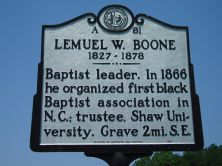
Lemuel W. Boone.

Image

LEMUEL WASHINGTON BOONE (1827-1878) was a leader of African American Baptists in North Carolina during the Reconstruction era. In 1866, he organized on Roanoke Island the East Roanoke Association, the first black Baptist association in the state. The following year, he moderated the organizational meeting of the General Association of the Colored Baptists of North Carolina, the first statewide black Baptist association and the direct forerunner of the present-day General Baptist Convention of North Carolina. Praised by Carter Woodson as a “preacher of power,” Boone is said to have “possessed a gift of oratory and mental ability seldom excelled by men of the best opportunities.”

Boone, born free in Northampton County, worked as a brickmason and teacher preceding the Civil War. After moving to Hertford County, he organized twenty churches with over 3,000 members in the area. The inaugural meeting of the statewide Baptist organization took place in 1867 in Goldsboro and was timed to coincide with the white annual Baptist State Convention from whose members they received counsel and support.

Boone sought a reconciliation between white and black Baptists and opposed a rule requiring that white churches dismiss former slaves who ran away to join the Union army and served as one of seven original trustees of Shaw University. At his death in 1878, the minutes of his association recorded that “it is safe to say that from his ordination till his death, no person in eastern North Carolina exerted a wider and more lasting influence among his people than Elder Boone.” In 1913, a monument was erected at his grave.

Adapted from http://www.ncmarkers.com.

James, an industrious, sober and honest barber and hairdresser.

State of North Carolina, Chowan County  }   June Term 1795

To the worshipful the County Clerk of Please and Quarter Sessions for the County of Chowan the petition of John Cunningham Humbly Sheweth that your petitioners Father died when he was very Young leaving a Valuable but unproductive Estate for the Support of your Petitioner and his Mother, consisting principally of Young Slaves, among whom is a Mulatto Male Slave by the Name of James, the profits of whose labour, has greatly if not principally contributed to the Maintenance & Support of your Petitioner thru a long Minority and an expensive course of Education. Your petitioner further Sheweth that the great profit which he has derived from the labour of the said Slave James has been owing as well to the great assiduity and attention of the said James in acquiring & presenting himself in the Trade of Mystery of a Barber & Hair Dresser as to his Industry sobriety and honesty Your petitioner further Sheweth that during a very dangerous and lingering Sickness last Spring (1794) the attention of the said James was such as cannot fail to inspire the highest gratitude in him in consideration whereof and as a reward for the past faithful Services of the said James, your Petitioner is willing and desirous to Manumit or set him free conceiving that no less a reward will be commiserate to the Services rendered, but as to guard against the great injuries & inconvenienced which might result from the indiscriminate Manumission of Slaves the legislature have Wisely provided that no Slave shall be manumitted except for Meritorious services to be approved of by the County Court, your petitioner is prevented from effecting his intentions without the aid and assistance of your Worships. May it thereof please your Worships taking the past character and faithful and meritorious Services of the said James into consideration to order & Decree that he may be Manumitted & Set free agreeable to the Directions of the act of the General Assembly in Such Cases Made and provided And your petitioner as in Duty bound shall ever pray &c.     John Cunningham

Miscellaneous Slave Records, Chowan County Records, North Carolina State Archives.

She put her pretty gold head on his shoulder, and …

An Interview with Adora Rienshaw of 431 South Bloodworth Street, Raleigh.

I wuz borned at Beulah, down hyar whar Garner am now, an’ my parents wuz Cameron an’ Sally Perry. When I wuz a month old we moved ter Raleigh.

We wuz called ‘Ole Issues’, case we wuz mixed wid de whites. My pappy wuz borned free, case his mammy wuz a white ‘oman an’ his pappy wuz a coal-black nigger man. Hit happened in Mississippi, do’ I doan know her name ‘cept dat she wuz a Perry.

She wuz de wife of grandfather’s marster an’ dey said dat he wuz mean ter her. Grandfather wuz her coachman an’ he often seed her cry, an’ he’d talk ter her an’ try ter comfort her in her troubles, an’ dat’s de way dat she come ter fall in love wid him.

One day, he said, she axed him ter stop de carriage an’ come back dar an’ talk ter her. When he wuz back dar wid her she starts ter cry an’ she puts her purtty gold haid on his shoulder, an’ she tells him dat he am her only friend, an’ dat her husban’ won’t eben let her have a chile.

Hit goes on lak dis till her husban’ fin’s out dat she am gwine ter have de baby. Dey says dat he beats her awful an’ when pappy wuz borned he jist about went crazy. Anyhow pappy wuz bound out till he wuz twenty-one an’ den he wuz free, case no person wid ary a drap of white blood can be a slave.

When he wuz free he comed ter Raleigh an’ from de fust I can remember he wuz a blacksmith an’ his shop wuz on Wolcot’s Corner. Dar wuz jist three of us chilluns, Charlie, Narcissus, an’ me an’ dat wuz a onusual small family.

Before de war Judge Bantin’s wife teached us niggers on de sly, an’ atter de war wuz over de Yankees started Hayes’s school. I ain’t had so much schoolin’ but I teached de little ones fer seberal years.

De Southern soldiers burned de depot, which wuz between Cabarrus an’ Davie Streets den, an’ dat wuz ter keep de Yankees from gittin’ de supplies. Wheeler’s Cavalry wuz de meanest troops what wuz.

De Yankees ain’t got much in Raleigh, case de Confederates has done got it all an’ gone. Why fer a long time dar de way we got our salt wuz by boilin’ de dirt from de smoke house floor where de meat has hung an’ dripped.

I’m glad slavery is ober, eben do’ I ain’t neber been no slave. But I tell yo’ it’s bad ter be a ‘Ole Issue.’

In the 1860 census of Raleigh, Wake County: Cameron Perry, 48, blacksmith, wife Sarah, and children Adora, 7, Narcissa, 5, Charley, 3, plus Susan Cuffy, 70, and Henderson Duntson, 21; all mulatto except Susan, whose color designation was left blank.
She is probably with her mother. Or a free negro.

$20 REWARD. Ranaway from the subscriber, on the evening of the 18th inst., a mulatto woman by the name of LUCY. Said woman is about 23 years old, slender frame, but now quite corpulent, of ordinary bright, and will probably weight 120 to 140 lbs., short hair, with rather a bony face, and is quite intelligent.

Said woman is probably harbored by her mother, owned by J.A. Worth, and Bill Bruinton, a free negro, with whom she has been very intimate. I will pay the above reward of $20 if she is delivered to me or lodged in the Jail of this County, or I will pay $50 if she is taken in any other county and confined in the Jail of the same.  JNO. D. WILLIAMS. Fayetteville, July 12, 1862.

Fayetteville Observer, 4 August 1862.

———-

Ranaway, a mulatto woman by the name of LUCY, about 23 years old, of medium size, but now quite corpulent.

Said woman is probably in or near Town, but may have been led off in the direction of Newbern by Bill Bruinton, a free mulatto man who has been at work as a Carpenter probably on the Wilmington & Weldon Railroad at a Depot North of Warsaw. I will pay $25 for the delivery of the girl to me or lodged in Jail in town, if found in this County, or $50 if said girl is found in any other County and confined in the Jail of the same, the party arresting giving me early information of the same.  JNO. D. WILLIAMS. Fayetteville, Aug, 25, 1862.

Fayetteville Observer, 14 November 1862.

We ain’t knowed so much ’bout slavery.

An Interview with Anthony Ransome of 321 S. Tarboro St., Raleigh, N.C.

I reckon dat I is eighty years old, an’ I wus borned in Murfreesboro in Hertford County. My mammy wus named Annice an’ my father wus named Calvin Jones. My brothers wus named Thomas, Wesley, Charlie, Henry an’ William.

We wus borned free, my mammy bein’ de daughter of a white ‘oman, an’ my paw’s paw onct saved do life o’ his master’s chile, an’ wus freed.

My paw wus a shoemaker an’ he made a putty good livin’ fer us. Course we ain’t knowed so much ’bout slavery, but Doctor Manning who lived near us owned some slaves an’ he treated ’em bad. We could hyar ’em screamin’ at de top of dere voices onct in a while, an’ when dey got through beatin’ ’em dey wus tied down in de cellar. Dey ain’t had much ter eat nother.

Dar wus a preacher what tol’ us ’bout a member of his congregation durin’ de war. De wife wus sold from de husban’ an’ he married ag’in. Atter de war his fust wife comed back an’ atter his secon’ wife died he married de fust one ober ag’in.

From Slave Narratives: A Folk History of Slavery in the United States from Interviews with Former Slaves (1841).

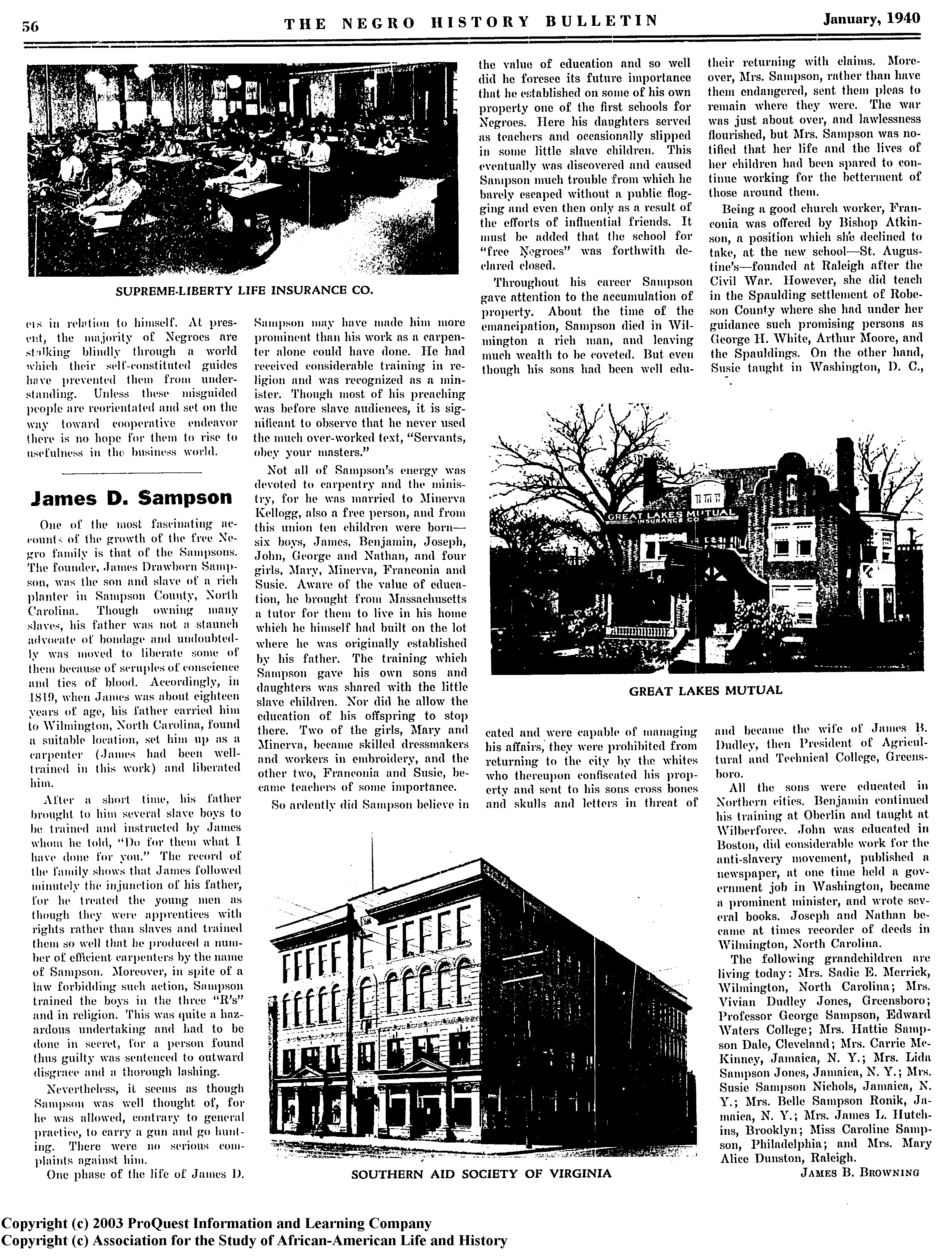
James Drawhorn Sampson.

ImageNegro History Bulletin, January 1940.

Shuffer Tonies was free issues and part Indian.

MEMORIES OF UNCLE JACKSON, John H. Jackson, 309 S. Sixth St., Wilmington, N.C.

My mother was the laund’ess for the white folks. In those days ladies wore clo’es, an’ plenty of ’em. My daddy was one of the part Indian folks. My mammy was brought here from Washin’ton City, an’ when her owner went back home he sold her to my folks. You know, round Washin’ton an’ up that way they was Ginny (Guinea) niggers, an’ that’s what my mammy was. We had a lot of these malatto negroes round here, they was called ‘Shuffer Tonies’, they was free issues and part Indian. The leader of ’em was James Sampson. We child’en was told to play in our own yard and not have nothin’ to do with free issue chil’en or the common chil’en ‘cross the street, white or colored, because they was’nt fitten to ‘sociate with us. You see our owners was rich folks. Our big house is the one where the ladies of Sokosis (Sorosis) has their Club House, an’ our yard spread all round there, an’ our house servants, an’ some of the bes’ artisans in Wilmin’ton lived in our yard.

I mus’ tell you’ bout Gov’ner Dudley’s election, an’ the free issue niggers. They say Mr. Dudley told ’em if they’d vote for him he’d do more for ’em than any man ever had. So they voted for him an’ he was elected. Then he ups an’ calls a const’utional convention in Raleigh an’ had all the voting taken away from ’em. An’ that the big thing he done for em.

From Slave Narratives: A Folk History of Slavery in the United States from Interviews with Former Slaves (1841).

In the 1860 census of Wilmington, New Hanover County: carpenter Jas. Sampson heads a household that includes his wife Francinia, 49; James, 30, shoemaker; Joseph, 28, carpenter; Eliza, 19; Jannie, 15; and Susan Sampson, 8; carpenters Ben Freeman, 19, and Wm. Campbell, 18; and “sv’t in house” Melinda Green, 72, Dave Miller, 30, Lucy Miller, 27, Virgil McRae, 60, and Maria McRae, 55, all mulatto. Sampson reported owning $26,000 real estate and $10,000 personal estate.