Fourth Generation Inclusive

Historical Documents of Genealogical Interest to Researchers of North Carolina's Free People of Color

Category: Newspapers

Lucky negro.

A colored teamster at Newark, N.J., named James Thorp, has become heir by will to an estate in North Carolina valued at $75,000. The testator is undoubtedly the father of Thorp, who owes his life and his good fortune to one of those frequent accidents at the South, by which the difference of races is rapidly fading out.

Troy (NY) Daily Times, 1 October 1858.

——

LUCKY NEGRO. – A gentleman well known to the merchants of the city, says the South Side Democrat, went north a few days since in search of a free negro from Rocky Mount, N.C., who had lately become heir to a large fortune.

We copy the following from the Newark Daily Advertiser, and have no doubt it refers to the same person:

A FORTUNATE TEAMSTER – It is stated that a colored teamster in this city, named James Thorp, has been left property by a gentleman in North Carolina, valued at $75,000, which will be placed in his hands as soon as his identity is legally established, of which there is no difficulty. Thorp was born on the estate in Carolina, and was afterward sent North to school at Norristown, Pa. He left school and has since been married and endeavored to sustain himself. He is represented as worthy of the good luck which has so suddenly enriched him.

Newbern Daily Progress, 4 October 1858.

In the 1860 census of Newark, Essex County, New Jersey: James Thorp, 34, teamster, born in NC, and children Emma, 3, and Wilson, 6, plus Ellen DeCamp, 10, Emaline Obey, 23, and Hannah Henderson, 50. All described as black. The children and Emaline were born in NJ, and Hannah in NY. Thorp reported owning only $1000 real property and $100, personal.
Services at Andrew Chapel.

CHURCH DIRECTORY.

RELIGIOUS SERVICES TO-MORROW.

Andrew Chapel, (colored.) –Services at 10 A.M. and 8 P.M., by the pastor, Rev. W.M. Walsh.

Newbern Daily Progress, 25 June 1859.

He was found dead in a ditch.

DISTRESSING. – A free colored man named Hugh Cherry, a carter, left this place with a horse and buggy on Wednesday last, for Williamston, for the purpose of brining a person home; but finding that the person had not arrived there, determined to return home that evening. The evening was stormy and an immense quantity of rain fell. Next morning he was found about twelve miles from this place dead in a ditch, and the horse upon him. The horse was blind and it is supposed, the man being unable to guide him in the excessive darkness, that the horse plunged into the deep ditch, which gave the buggy a sudden jerk, throwing the man forward and breaking his neck in the fall, plunging him into the ditch. The horse in his scuffle to get out got upon the man, and their [sic] remained until he was found next morning. Strange to say the horse and buggy were not injured. – Washington Dispatch.

North Carolina Argus (Wadesboro), 8 September 1859.

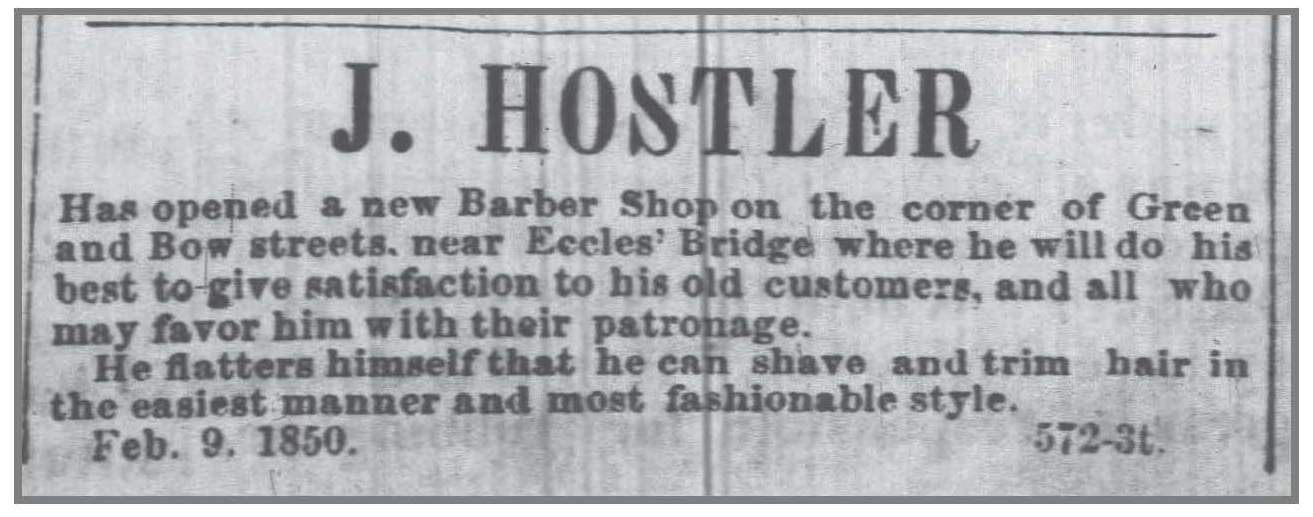
He flatters himself that he can shave and trim hair easily and fashionably.

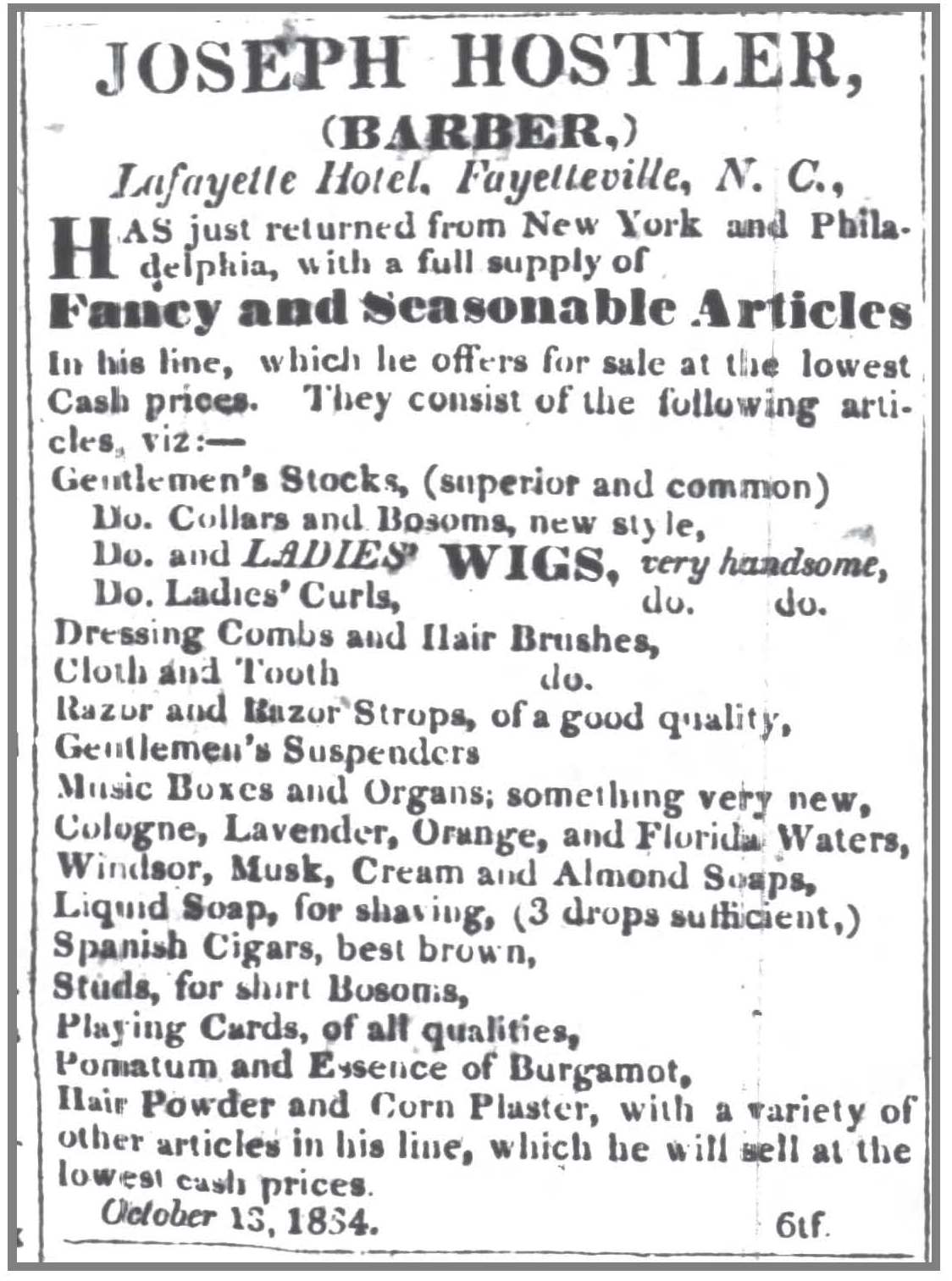
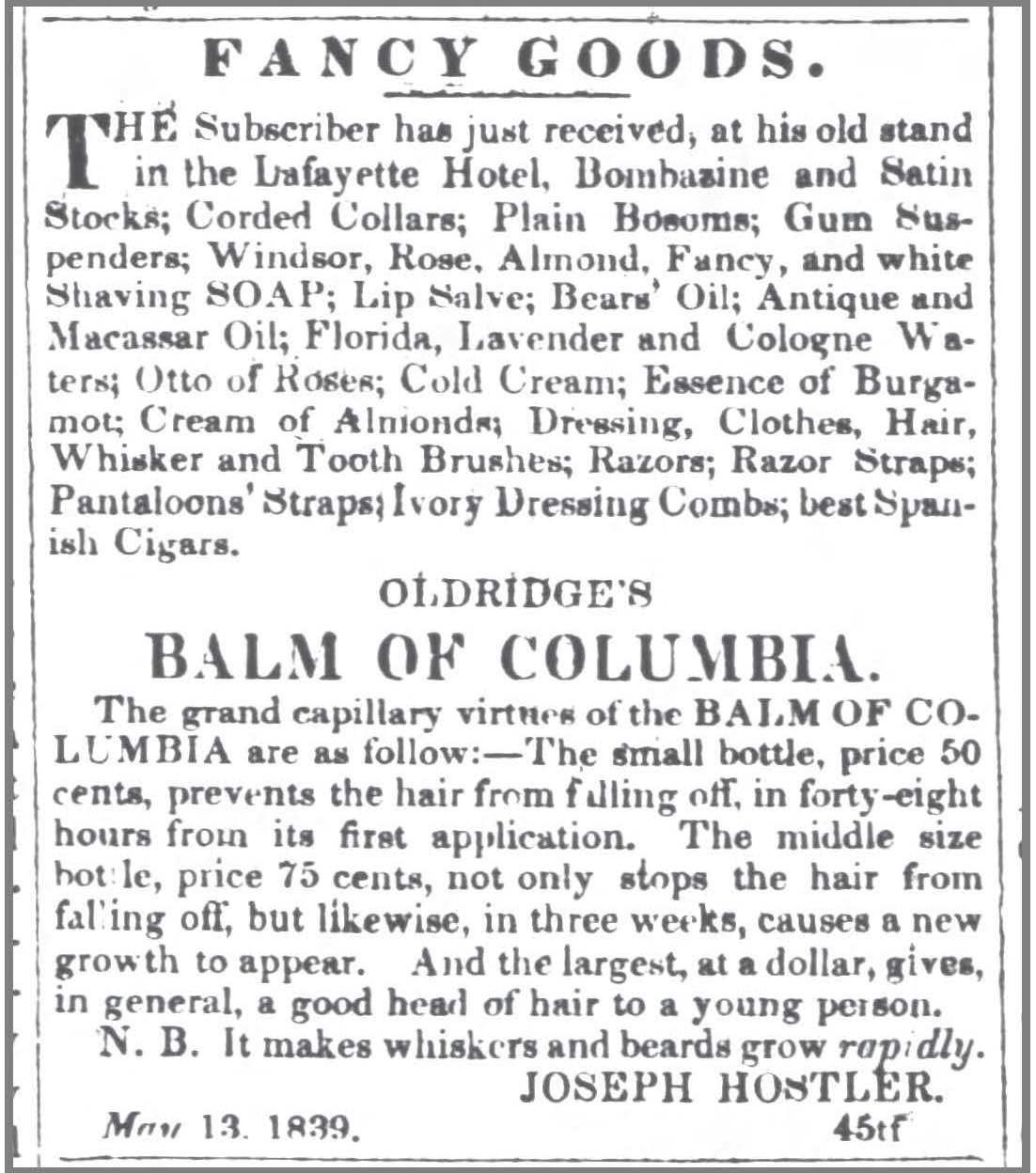
The North Carolina Legislature freed Joseph Hostler during its 1833-1834 session. He did not waste time:ImageFayetteville Weekly Observer, 27 January 1835.

Image Fayetteville Weekly Observer, 15 May 1839.

ImageThe North-Carolinian (Fayetteville), 16 February 1850.

An account of an execution.

FOR THE PRESS.

WENTWORTH, N.C., Jan. 11th, 1859.

DEAR SIR:

On Friday last, according to the sentence of His Honor, Judge DICK, Lucy Hine, a free woman of color, and a resident of your county, was publicly executed about 1 ½ miles East of town, in the presence of an unusually small crowd, compared with the number generally attending executions. I was glad to see so small a crowd in attendance, as I think such spectacles have anything but a good tendency. – Instead of morality, immorality is taught on all such occasions.

The day of execution was a little damp, and the roads muddy, but not sufficiently so to be disagreeable. About 11 o’clock the Sheriff proceeded to the jail with the attending officer, robed the criminal for execution, placed her in a wagon, and conducted her to the gallows. – She was attended by three ministers, Rev’s Day, Fields and Norman. Arriving at the gallows, she ascended the scaffold with a firm and resolute step. On being asked, if she had any confessions to make, she relied, none more than she had already made to the jailor, which in substance is, that she was innocent of the murder, and that there was no plot whatever between Frank and herself to kill her husband, and that she lent no aid either for or against him, and that she helped to conceal the body after the murder was committed.

She then exhorted all persons present, mostly negroes, to beware of their acts and conduct and not so as she had done. Said that she had been a great sinner, but felt that she was forgiven, and was willing to die. After which Rev. B. Field of the Methodist Church, delivered a short and appropriate address; and at 1 o’clock, the rope being adjusted, the drop fell, and her spirit took its flight to that last resting place “whence no traveler returns.”

Much credit is due Rev. Wm. Gay of the Episcopal church at Leaksville, who visited the criminal the day before her execution, and prayed with attended her to the gallows. AVO.

The People’s Press (Winston-Salem), 14 January 1859.

In the 1840 census of Bethabara, Stokes County: Lucy Hine, a free woman of color aged 24-36, living alone.

Their eyes have been injured.

Ten Dollars Reward.

RAN AWAY from the subscriber on the 8th inst, my negro man MINGO, aged about 45 years, of ordinary size, rather dark complexion, a white streak near the sight of one of his eyes, (which eye is not recollected) has rather a bad look out of his eyes. It is supposed that he is lurking about the lower edge of Edgecombe, or the upper part of Pitt, or he may have got as low down as Washington, Beaufort county, as his wife is a free woman of color, named Julia Read, lately of Pitt and has relations in Beaufort. The eyes of both him and her have been injured, his by a splinter and hers by a burn. The above reward will be given for the apprehension of Mingo, if delivered to me near Tradesville, in Edgecombe county, or if secured in any jail so that I get him again. All persons are forbid harboring, employing, or carrying off said negro under penalty of the law. MATTHEW WHITEHEAD. Nov 15, 1843

Tarboro’ Press, 10 February 1844.

To come back to North Carolina and be a slave again.

Wants to Return.

We find in the Kinston Advocate, the annexed letter from a colored man formerly a slave in Wayne County, but who was emancipated some years since by the Legislature, and went to the Northern land of promise where negroes are as good as white people, and every body loved them so much – out of their sight.

The letter is addressed to Wm. T. Dortch, Esq., a member elect from Wayne County to the next Legislature. It will itself explain the objects and wishes of the writer, however defective it may be in spelling and composition: —

State of New York, Brooklyn L.I.   }

september 1st 1860                       }

Mr W.T. Doch sir I writ to you to let you no that I am well hoping these few lines may find you the same. I have written to you because I no you are a man I can depend on. I want to no if I pertition to come back to N.C. and be a slave again if you are a member elected this year if you will advocate it the general assembly & if you will be after gitting the consent of wayn county of her leading men you will please to writ to me & let me no what the prospect would be. Your obedient servant, D.B. Williams.

this was my old name   david Bulls Williams

If this letter is agreeable I will writ again & let you no my reason for writing at all

Direct your letter to Brooklyn L.I. Nancy St No. 152

Wilmington Journal, 27 September 1860.

Frame house burns.

FIRE. – The alarm of fire last night about 11 o’clock, proceeded from the burning of a frame house in the Eastern portion of the town, North of the Wilmington & Weldon Rail Road. The house was occupied by a free colored man named Wm. Merrick, with his family. We believe Merrick also owned the property. We do not know the exact amount of loss, but suppose it might be between six hundred and eight hundred dollars.

Wilmington Journal, 31 January 1861.

A free man of color gives information, is handsomely rewarded.

The Edenton Gazette states, upon information received from an undoubted source, that there have been killed in Southampton county upwards of one hundred negroes, consequent upon the late insurrection in that county. Fourteen of the thoughtless, savage wretches have been tried, of whom, thirteen were convicted, and are to be hung during the present week — there are thirty more now in the jail at Jerusalem yet to be tried, besides others in jail at Bellfield.

We understand that about twenty-one negroes have been committed to jail in Edenton, on a charge of having been concerned in concerting a project of rebellion. A slave has also been arrested and imprisoned in Duplin county, upon a similar allegation. He had communicated his knowledge of the scheme in agitation to a free man of color, who gave immediate information to the whites. Serious reports in relation to a revolt of the slaves in Wilmington and Sampson county, reached this city, by the way of Smithfield, on Monday night and Tuesday morning last. On Tuesday evening, certain intelligence from various sources reached us of an insurrection having occurred on Sunday night last in a part of Sampson and Duplin counties. Its extent or the damage done is unknown to us. But, as the militia have been called out in the adjacent counties, we flatter ourselves that it will be speedily suppressed, and that the deluded wretches who are concerned in the diabolical attempt will be made to suffer severely for their temerity.…

The miserable deluded and fiendish band in Southampton have paid dearly for their stupidity and atrocious wickedness; and such will inevitably be the late of all who may ever be so silly and depraved as to intimate their example. But there are some, it seems, reckless enough to attempt it. Vigilance, therefore, becomes necessary for perfect security.

North Carolina Star (Raleigh), 15 September 1831.

——

General Assembly.

The resolution in favor of Leavin Armwood, was read the second and third time and ordered to be engrossed. [This Resolution votes $250 to the individual named, a free man of color, as a reward for his having disclosed the meditated conspiracy amongst the slaves of Duplin and Sampson.]

North Carolina Free Press (Halifax), 10 January 1832.

The barn.

BARN BURNT.

The Barn of the free negro, named Benjamin Perry, living at the head of Little River in this County, was struck by lightning last Friday, and entirely consumed.

The Old North State (Elizabeth City), 10 August 1850.