Fourth Generation Inclusive

Historical Documents of Genealogical Interest to Researchers of North Carolina's Free People of Color

Category: Newspapers

Can the preacher preach?

Friday, 30th.

Mr. Morris presented the petition of sundry citizens of Anson, praying the passage of an act to permit Ralph Freeman, a free man of color, to exercise the functions of a Preacher. Referred.

North-Carolina Free Press (Halifax), 11 December 1832.

The question is now put.

CITY BAKE-HOUSE.

THE new Bakery in this City, which was announced a few weeks since in such flaming style and recommended to the public patronage by the Register, having gone down, or rather passed into the hands of a free man of color, the subscriber takes occasion to state that he is still in business at his old stand, where he is prepared to furnish all kinds of BREAD in his line of business. The people here know the subscriber — he is not in the habit of disappointing them; and he now assures them that he will spare no pains to please them and merit their patronage. The question is now put to the Mechanics and citizens of Raleigh, whether they will patronize his establishment or a free man of color.   GEORGE H. TONNOFFSKE.

Raleigh, October 1st, 1845.

Weekly Standard (Raleigh), 15 October 1845.

He strove to entice.

A Free Negro Entices a Slave to Runaway

Kit Huffman, a free negro who was tried for murder last spring in our Court, has enticed a boy, the property of Wm. Cade, Esq., of this place, to run away with him and go North. It seems that for some time past he had been striving to entice two of Mr. Cade’s boys (brothers) away, and prevailed upon one to do so. Kitt was up here on Wednesday, but left in the boat for Wilmington, just one hour before the officer arrived at the wharf. It is expected that he will leave the boat at White Hall or some place between this and Wilmington, and meet the boy at some place before arranged upon. Kitt is a bright mulatto, about 5 feet 11 inches or 6 feet high. The citizens of this and adjoining counties ought to keep good look out for them. – Fay. Carolinian.

Wilmington Daily Herald, 20 February 1860.

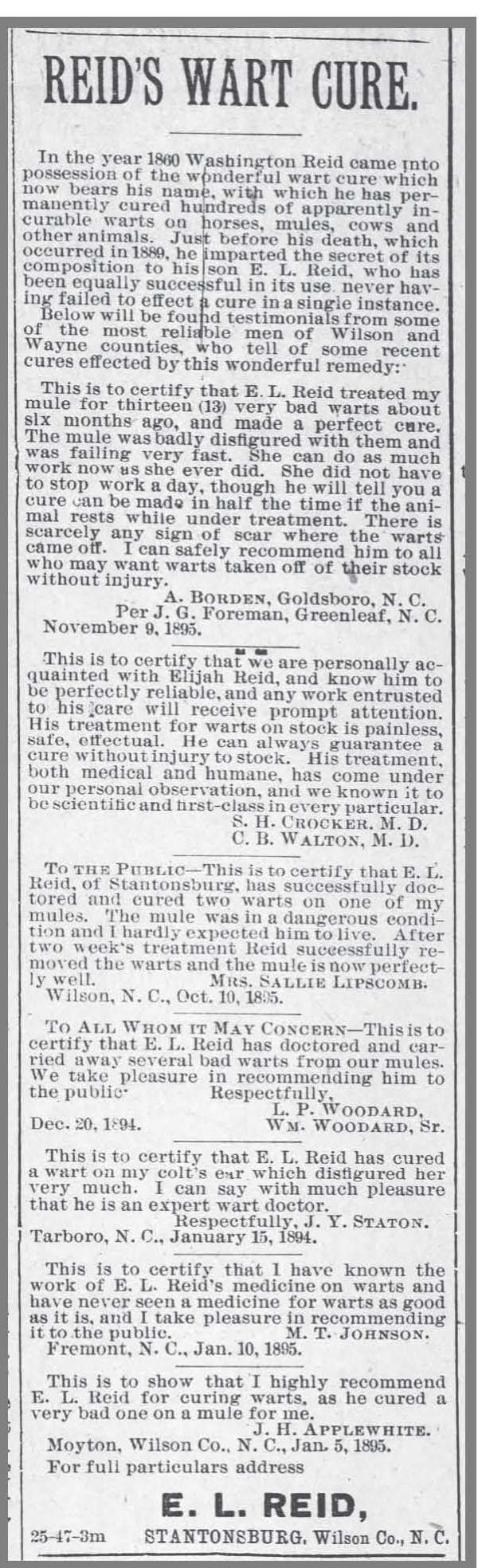
An heirloom wart cure.

Wilson_Advance_12_26_1895_Reid_Wart_Cure

Wilson Advance, 26 December 1895.

In the 1850 census, North Side of the Neuse, Wayne County: farmhand Washington Read, 28, wife Pennina, 25, and daughter Lewiser, 2 months.

A landmark.

The death of Green Simmons, an old and well known colored landmark, of Dudley, occurred last night.

Goldsboro Daily Argus, 7 January 1901.

In the 1850 census of South Side of the Neuse, Wayne County: cooper Green Simmons, 33, wife Betsy J., 26, and children Needham, 5, Cicero, 3, and Mary, 1.

The horrid deed.

MURDER. – An inquest was held by coroner Scott over the body of a free negro named Chaves, who was found murdered on the Fayetteville road, several miles from this city, on Friday morning last. His death was caused by a frightful wound extending from the groin upwards towards the bowls, which was doubtless made by a knife. The testimony before the coroner’s jury, we learn, implicates a free negro named Jordan, and a free woman in the horrid deed. The woman has been lodged in jail, but the man has not been taken.

The North-Carolina Star (Raleigh), 8 November 1854.

She might have gone off with him.

$10 Reward.

RANAWAY from the Subscriber, about the 15th ult. a negro woman named HANNAH; formerly the property of Col. Edward Williams, of Onslow County, but more recently owned by Richard Saunders, Esq. Hannah is above the ordinary size, black complexion – about Forty years of age. – She has relations in Onslow county and at Rocky Point.

She has, for some years past, been living with a free colored man named Isaac Scott, who has left this place, and she might have gone off with him.

I will give the above reward for her apprehension, upon delivery to me at Wilmington, or confinement in any jail, so that I may recover her. ANN GUTHRIE. Wilmington, Sept. 11th, 1835.

Wilmington People’s Press and Advertiser, 25 September 1835.

He has gone by a false name.

WAS TAKEN UP and committed to the Jail of Craven Co., a mulatto man by the name of Clinton Oxendine, and is of the medium size and height. Said man says, since he was put in Jail, that he was gone by a false name, but says he is a free negro and that his name is Jacob Goings, and was sold several years ago for cost in Cumberland county, and John Wright became the purchaser for five years, and afterwards the said Wright sold him to Littleton Gunn of Roberson county. The owner is requested to come forward, prove property, pay charges and take him away or he will be dealt with as the law directs. A.C. LATHAM, Sheriff. By W.S. BALLENGER, D. Sheriff. Jan. 1, 1862

Newbern Daily Progress, 21 January 1862.

Intemperance and exposure.

Coroner’s Inquest.

On Sunday, 16th inst., a jury of inquest was held upon the dead body of Caroline Alfonzo, a free colored woman: the evidence proved her to be a drudge laborer about town. At her will, she was the wife of Ned, a superannuated slave, formerly the property of John W. Guion, dec’d. On Saturday, the 15th inst., at 3 o’clock, P.M., she parted company with Ned in good health and went to the house of Mrs. Emily Jane Fulford to fulfill an engagement with her. She left Mrs. Fulford’s about 1 ½ hours before night-fall, and took with her a tray of plates containing sausages and pigs feet to sell for Mrs. Fulford – she was under the influence of liquor at the time, — she did not return to her husband nor her employer as was her custom to do. Sunday morning Caroline was found dead in the road leading to Pembrook near the South-West part of the town: on examination there was traces of blood from where she lay to a ditch about thirty yards distant; a smooth deep cut on her right cheek was the only mark of violence found on the body. By request of the Jury, Dr. R.S. Primrose examined the wound and pronounced it insufficient to produce death and stated that it might have been the result of accident. The clothes of the deceased were wet and frozen; the ditch had water in it about 3 ½ feet deep, and showed that it had been recently disturbed; a tray, some crockery and plates, etc. lay near the body. In her pockets was ninety cents, in silver and copper coin, a snuff-box, &c.

Verdict of the Jury was: “The deceased came to her death by intemperance and exposure.”

Newbern Weekly Progress, 18 December 1860.
To leave Fayetteville as soon as I possibly can.

The_North_Carolinian_8_23_1851

The North Carolinian, 23 August 1851.

Despite his firm-toned notice, Lewis Levy does not seem to have left Fayetteville after all. Well after the publication of this ad, he bought land in town, and his 1876 Southern Claims Commission statement asserts that he lived three miles from Fayetteville and owned nearly 200 acres in Cumberland County.