Fourth Generation Inclusive

Historical Documents of Genealogical Interest to Researchers of North Carolina's Free People of Color

Month: March, 2013

He gave the last and final vote.

Hillsboro.

I am indebted to my uncle Alex Smith for the following short history of Hillsboro, written by Lawyer Joe Turner over twenty years ago, thinking it may interest some of the readers of the leader, I send same for print if you see fit. – F.W. Nelson.

Hillsboro was one of the five towns entitled to a representative (see Wheelers history if it be five or seven). Governor Graham and Chief justice Nash were Borough representatives. Traditions says it was a tie between Gov. Graham and his competitor when Hazekiah Revels an old issue free negro was sent for and gave the last and final vote for Graham, dropping this speech with his vote, “Ki Revels always votes for a gentlemen.” Before the next election the constitution was amended and the free negroes with old Ki Revels were disenfranched. …

Mebane Leader, 13 July 1911.

The Cousins brothers, dark of skin.

First Residents of Boone and Vicinity. — … There was another house which stood in the orchard near the present Blackburn hotel. It was a small clapboard house, with only one room. Ben Munday and family occupied it first and afterwards Ellington Cousins and family, dark of skin, lived there till Cousins built a house up the Blackburn branch in rear of the Judge Greer house. It is still known as the Cousins place …

John and Ellington Cousin. – The brothers came from near East Bend, Forsythe County, soon after Boone was formed, bringing white women with them. Ellington’s wife was Margaret Myers and John’s was named Lottie. Ransom Hayes sold Ellington an acre of land up the Blackburn branch, where he built a house and lived in 1857, having moved from the house in the orchard below the road near the present Blackburn hotel. He had two daughters. Sarah married Joseph Gibson and moved to Mountain City, Tenn., where he carried on a tannery for Murphy Brothers, but he afterwards returned to the state and lived at or near Lenoir, finally going West, where he remains. Ellington died at Boone and his widow and daughter, nicknamed “Tommy,” went with Gibson and wife to Mountain City, where she also married. John lived near Hodges Gap and at other places, dying at the Ed. Shipley place near Valle Crucis. He had several children.

From John Preston Arthur, A History of Watauga County, North Carolina, with Sketches of Prominent Families (1915).

In the 1850 census of Watauga, Watauga County: Johnson Cusins, 44, farmer, wife Charlotta, 41, and children Hezekiah, 18, Mary, 14, Clarkson, 11, William H., 9, Rebecca, 8, Annanias, 5, Martha, 4, W.W. and Evaline, both 3 months.  All described as mulatto, except Charlotta, white.  In the 1860 census of Boone, Watauga County: John Cuzzens, 52, farmer, wife Charlotte, 50, and children Henry, 19, Rebecca, 17, Ann, 15, Martha, 13, Wiley, 10, and Eveline, 10, all mulatto.

In the 1850 census of Northern Division, Davidson County: in jail, Francis Briant, 20, laborer, Alva Sapp, 22, laborer, and Ellington Cozzens, 41, shoemaker. Cozzens was mulatto; the others, white.  In the 1860 census of Boone, Watauga County: Ellington Cuzzens, 53, boot & shoemaker, wife Margarett, 44, and daughters Sarah, 8, and Martha J., 5; all mulatto except Margarett, was described as white.
She put her pretty gold head on his shoulder, and …

An Interview with Adora Rienshaw of 431 South Bloodworth Street, Raleigh.

I wuz borned at Beulah, down hyar whar Garner am now, an’ my parents wuz Cameron an’ Sally Perry. When I wuz a month old we moved ter Raleigh.

We wuz called ‘Ole Issues’, case we wuz mixed wid de whites. My pappy wuz borned free, case his mammy wuz a white ‘oman an’ his pappy wuz a coal-black nigger man. Hit happened in Mississippi, do’ I doan know her name ‘cept dat she wuz a Perry.

She wuz de wife of grandfather’s marster an’ dey said dat he wuz mean ter her. Grandfather wuz her coachman an’ he often seed her cry, an’ he’d talk ter her an’ try ter comfort her in her troubles, an’ dat’s de way dat she come ter fall in love wid him.

One day, he said, she axed him ter stop de carriage an’ come back dar an’ talk ter her. When he wuz back dar wid her she starts ter cry an’ she puts her purtty gold haid on his shoulder, an’ she tells him dat he am her only friend, an’ dat her husban’ won’t eben let her have a chile.

Hit goes on lak dis till her husban’ fin’s out dat she am gwine ter have de baby. Dey says dat he beats her awful an’ when pappy wuz borned he jist about went crazy. Anyhow pappy wuz bound out till he wuz twenty-one an’ den he wuz free, case no person wid ary a drap of white blood can be a slave.

When he wuz free he comed ter Raleigh an’ from de fust I can remember he wuz a blacksmith an’ his shop wuz on Wolcot’s Corner. Dar wuz jist three of us chilluns, Charlie, Narcissus, an’ me an’ dat wuz a onusual small family.

Before de war Judge Bantin’s wife teached us niggers on de sly, an’ atter de war wuz over de Yankees started Hayes’s school. I ain’t had so much schoolin’ but I teached de little ones fer seberal years.

De Southern soldiers burned de depot, which wuz between Cabarrus an’ Davie Streets den, an’ dat wuz ter keep de Yankees from gittin’ de supplies. Wheeler’s Cavalry wuz de meanest troops what wuz.

De Yankees ain’t got much in Raleigh, case de Confederates has done got it all an’ gone. Why fer a long time dar de way we got our salt wuz by boilin’ de dirt from de smoke house floor where de meat has hung an’ dripped.

I’m glad slavery is ober, eben do’ I ain’t neber been no slave. But I tell yo’ it’s bad ter be a ‘Ole Issue.’

In the 1860 census of Raleigh, Wake County: Cameron Perry, 48, blacksmith, wife Sarah, and children Adora, 7, Narcissa, 5, Charley, 3, plus Susan Cuffy, 70, and Henderson Duntson, 21; all mulatto except Susan, whose color designation was left blank.

Confederate veteran has always been a good negro.

Old Negro in Destitute Circumstances.

William Winters, a mulatto about 70 years old and helpless, lies at his home on Poplar street, between Trade and Fourth streets, in destitute circumstances. Winter has had a rather interesting career. He was born a free negro and during the war was a soldier in the Confederate forces. He left home as the valet and cook for Col. Charles Fisher, of the Sixth North Carolina Regiment, who was killed in the first battle of Manassas. Winters was with Col. Fisher when he was shot and assisted in getting him off the field. He remained with the Confederate army during the war and afterwards cooked in Charlotte hotels and cafes until about 10 years ago when he became too feeble to work. He has always been a good negro and has had many friends among the white people, especially among the old veterans.

Charlotte Observer, 4 January 1906.

Two years longer for the mulatto.

Charlotte DeOrmond, a white woman servant of Major John Dunn has had a white & a mulatto bastard; she must serve a year for the white bastard and two years longer for the mulatto, who, being a female, is bound to said Dunn until 21 years old.

January Term, 1769, Minutes, Court of Pleas and Quarter Sessions, Rowan County Records, North Carolina State Archives.  

She is probably with her mother. Or a free negro.

$20 REWARD. Ranaway from the subscriber, on the evening of the 18th inst., a mulatto woman by the name of LUCY. Said woman is about 23 years old, slender frame, but now quite corpulent, of ordinary bright, and will probably weight 120 to 140 lbs., short hair, with rather a bony face, and is quite intelligent.

Said woman is probably harbored by her mother, owned by J.A. Worth, and Bill Bruinton, a free negro, with whom she has been very intimate. I will pay the above reward of $20 if she is delivered to me or lodged in the Jail of this County, or I will pay $50 if she is taken in any other county and confined in the Jail of the same.  JNO. D. WILLIAMS. Fayetteville, July 12, 1862.

Fayetteville Observer, 4 August 1862.

———-

Ranaway, a mulatto woman by the name of LUCY, about 23 years old, of medium size, but now quite corpulent.

Said woman is probably in or near Town, but may have been led off in the direction of Newbern by Bill Bruinton, a free mulatto man who has been at work as a Carpenter probably on the Wilmington & Weldon Railroad at a Depot North of Warsaw. I will pay $25 for the delivery of the girl to me or lodged in Jail in town, if found in this County, or $50 if said girl is found in any other County and confined in the Jail of the same, the party arresting giving me early information of the same.  JNO. D. WILLIAMS. Fayetteville, Aug, 25, 1862.

Fayetteville Observer, 14 November 1862.

A good deal of human interest.

There is a good deal of human interest to be found in many of the experiences of these colored slaveholders and in their relations with those whom they held in bondage. Rose Petepher, of the neighborhood of New Bern, N.C., was a free colored woman who was married to a slave named Richard Gasken, who had taken the name of his master. He ran away and was in the woods for years, when his wife finally bought him to take possession. When she could find him this change of owners brought him in at once. They lived together for many years afterward, raising many children whom they hired out just as slaves were hired out. Thus they all prospered. Near the town mentioned above, on their own land, some of the grandchildren are now living and doing well.

Judge William Gasken, who owned the man of whom we have just told, was thrice married, one of his wives being a daughter of Colonel McClure of New Bern. After his death, one of the slaves, Jacob, became the property of Mrs. Gasken. This Jacob’s wife was a free woman, and they had a son Jacob, then a young man and free of course, as the child of a free woman. Aided by his mother’s efforts, he managed to purchase his father at a very reasonable price as negroes were then held. All went smoothly for awhile, when young Jacob did not act as his father thought he should and his parent reproved him with fatherly love. Young Jacob was so disgruntled that he went off to a negro speculator named John Gildersleeve, who was from Long Island and was then in New Bern. This trader bought the father at a high price and at once sent him off south. Young Jacob afterward boasted that “the old man had gone off to the corn fields about New Orleans where they might learn him some manners.”

From Calvin D. Wilson, “Negroes Who Owned Slaves,” Popular Science Monthly, vol. LXXXI (1912).

In the 1850 census of Craven County: Richard Pettiford, 80, wife Rose, 69, children Dinah, 27, and Bryan, 25, and Elizabeth Pettiford, 100. (!!!) (Note that Richard adopted his wife’s surname. Wright Pettiford, 38, living alone nearby may have been another son.)

Perhaps: in the 1850 census of Craven County: Jacob Gaskins, 64, farmer, Penelope Gaskins, 88, Sarah Wiggans, 25, and her children Martha, 5, Elizabeth, 3, and Sabeah, 1 month.

Seemingly white predominating their features.

Image

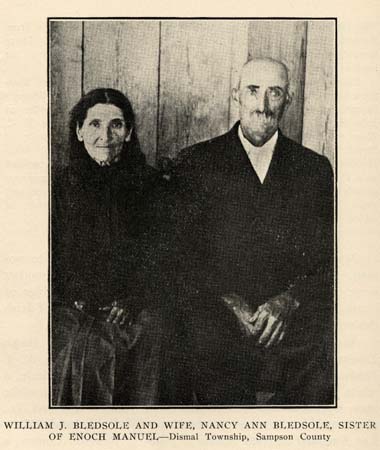
William J. Bledsole, one of the most prominent Indians of Sampson County, was evidently a white man with only a small degree of Indian blood. His wife was Nancy Emanuel, the This couple reside in Dismal Township, Sampson County. The father of William was a Croatan and his mother was Mary Bledsole, a white woman. Nancy, his wife, was Nancy Manuel, a sister of Enoch Manuel, and youngest daughter of Michael Manuel. The Manuels were large land owners in Sampson County prior and since the Revolutionary War. There is no record in their family history or family tradition for over 150 years showing any mixture of negro blood. This couple have seven children: Docia, wife of Enoch Manuel. Jr.; Rutha, wife of Ollin Brewington; Molsy, wife of Matthew Burnette; Isabella, wife of Erias Brewington; Lou Berta, wife of Jonah Manuel; W. L. Bledsole, who married Amandy Warrick; James Henry Bledsole, who married Hannah Warrick. Amandy and Hannah were daughters of William J. Warrick and wife Betsie Manuel Warrick, prominent Croatans of Robeson County. The Bledsole family are good specimens of white and Indian blood.  His oldest son, Luther Bledsole, married Amandy Warrick, a woman of white and Indian blood. Her father was William J. Warrick and her mother, Betsie Emanuel. James Henry Bledsole, his youngest son, married Hannah Warrick, the daughter of the above named William J. Warrick.

The Bledsole families are fine specimens of pure white and Indian, seemingly white predominating their features.

From George E. Butler, “The Croatan Indians of Sampson County, North Carolina. Their Origin and Racial Status. A Plea for Separate Schools,” (1916).

In the 1860 census of Westbrooks, Sampson County: Robin Bedsole, 80, Polly Bedsole, 35, Eliza Bedsole, 16, and William Bedsole, 12. William is described as mulatto; the others, white.

In the 1850 census of Northern District, Sampson County: Michael Manuel, 63, cooper; wife Fereby, 49; and children Gideon, 19, Cintilla, 16, Drusilla, 15,Michael, 13, Eden, 11, John, 9, William, 7, Enoch, 4, and Nancy, 1; all described as mulatto.

In the aftermath of Nat Turner …

The Edenton Gazette states, upon information received from an undoubted source, that there have been killed in Southampton county upwards of one hundred negroes, consequent upon the late insurrection in that county. Fourteen of the thoughtless, savage wretches have been tried, of whom, thirteen were convicted, and are to be hung during the present week — there are thirty more now in the jail at Jerusalem yet to be tried, besides others in jail at Bellfield.

We understand that about twenty-one negroes have been committed to jail in Edenton, on a charge of having been concerned in concerting a project of rebellion. A slave has also been arrested and imprisoned in Duplin county, upon a similar allegation. He had communicated his knowledge of the scheme in agitation to a free man of color, who gave immediate information to the whites. Serious reports in relation to a revolt of the slaves in Wilmington and Sampson county, reached this city, by the way of Smithfield, on Monday night and Tuesday morning last. On Tuesday evening, certain intelligence from various sources reached us of an insurrection having occurred on Sunday night last in a part of Sampson and Duplin counties. Its extent or the damage done is unknown to us. But, as the militia have been called out in the adjacent counties, we flatter ourselves that it will be speedily suppressed, and that the deluded wretches who are concerned in the diabolical attempt will be made to suffer severely for their temerity.…

The miserable deluded and fiendish band in Southampton have paid dearly for their stupidity and atrocious wickedness; and such will inevitably be the late of all who may ever be so silly and depraved as to intimate their example. But there are some, it seems, reckless enough to attempt it. Vigilance, therefore, becomes necessary for perfect security.

North Carolina Star, Raleigh,15 September 1831.

We ain’t knowed so much ’bout slavery.

An Interview with Anthony Ransome of 321 S. Tarboro St., Raleigh, N.C.

I reckon dat I is eighty years old, an’ I wus borned in Murfreesboro in Hertford County. My mammy wus named Annice an’ my father wus named Calvin Jones. My brothers wus named Thomas, Wesley, Charlie, Henry an’ William.

We wus borned free, my mammy bein’ de daughter of a white ‘oman, an’ my paw’s paw onct saved do life o’ his master’s chile, an’ wus freed.

My paw wus a shoemaker an’ he made a putty good livin’ fer us. Course we ain’t knowed so much ’bout slavery, but Doctor Manning who lived near us owned some slaves an’ he treated ’em bad. We could hyar ’em screamin’ at de top of dere voices onct in a while, an’ when dey got through beatin’ ’em dey wus tied down in de cellar. Dey ain’t had much ter eat nother.

Dar wus a preacher what tol’ us ’bout a member of his congregation durin’ de war. De wife wus sold from de husban’ an’ he married ag’in. Atter de war his fust wife comed back an’ atter his secon’ wife died he married de fust one ober ag’in.

From Slave Narratives: A Folk History of Slavery in the United States from Interviews with Former Slaves (1841).